Published November 8, 2026 by SonicJobs
Compare SonicJobs GPT Suite, Profound and Peec for hiring-focused AI search visibility, candidate questions, citation evidence and company-wide reporting.
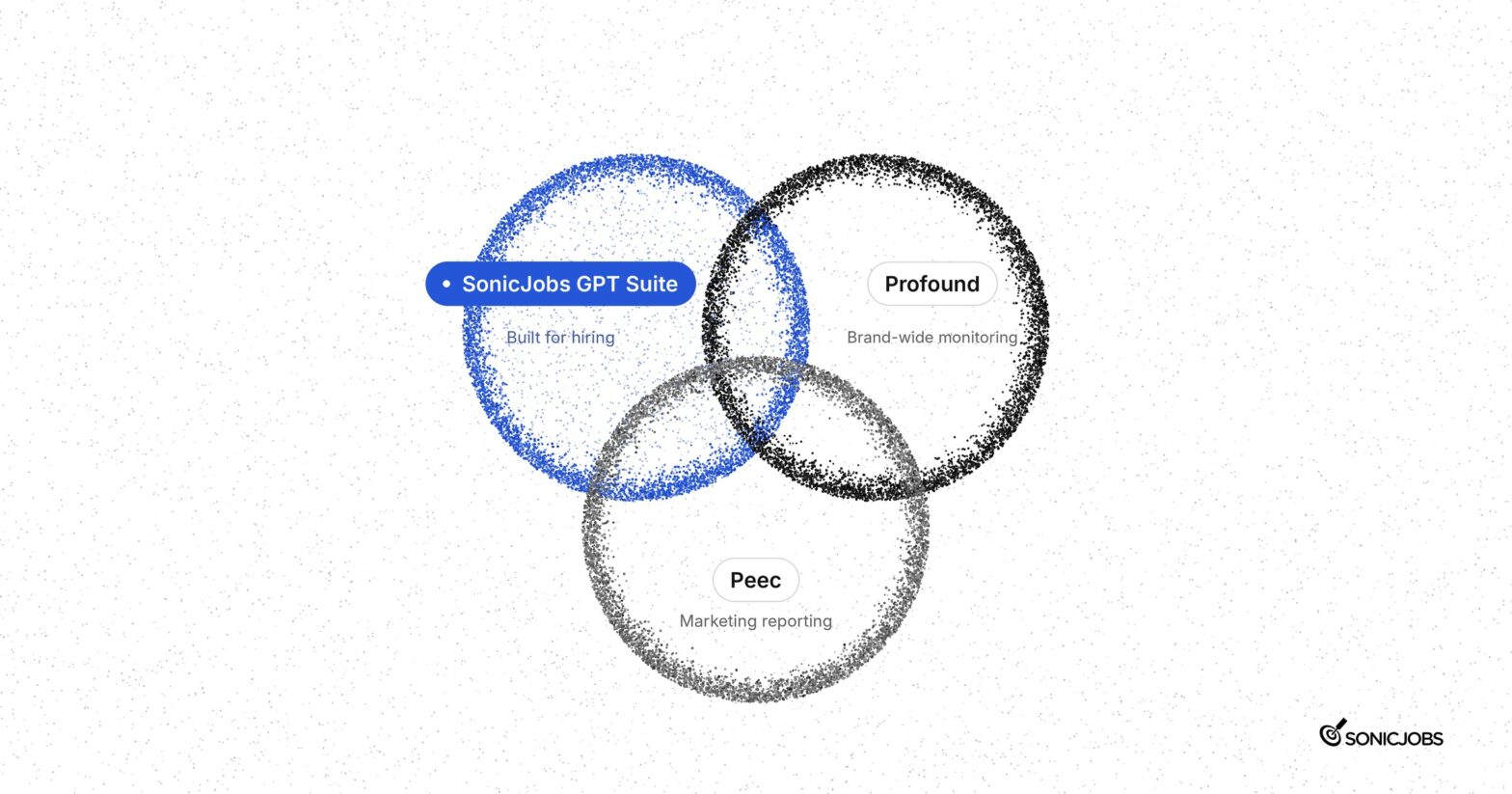
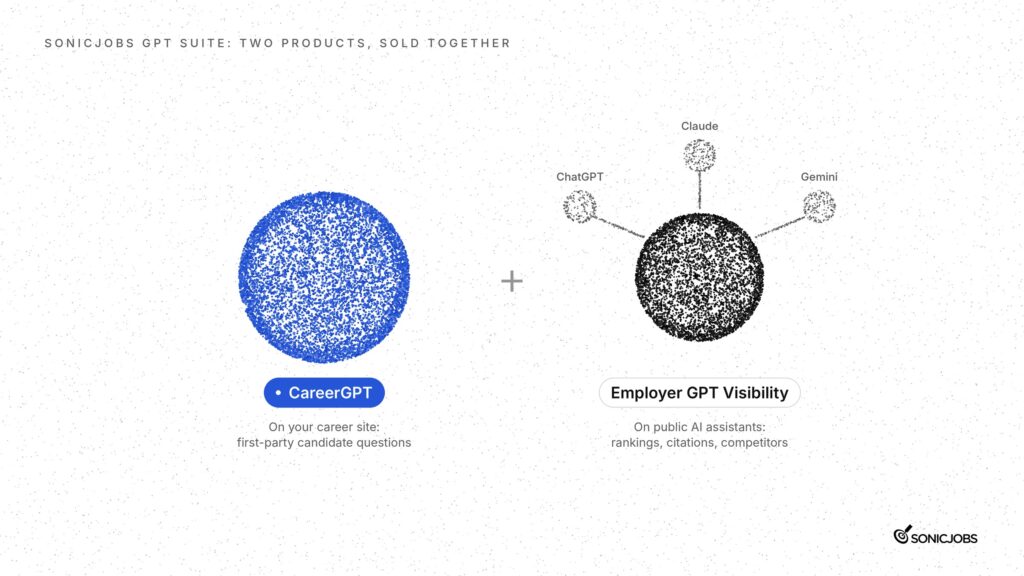
Check how your employer appears when candidates ask AI search engines about work. We compare SonicJobs GPT Suite, Profound and Peec by hiring workflow fit and broader brand monitoring, rather than a universal ranking. It separates hiring-specific positioning from configurable general-purpose tracking. SonicJobs GPT Suite is our umbrella name for two separate products sold together: CareerGPT, for conversational search and candidate insights on your career site, and Employer GPT Visibility, for measuring employer visibility on ChatGPT, Claude and Gemini.
What does AI search visibility mean for talent acquisition?
AI search visibility for talent acquisition means checking whether an employer appears in answers to candidate questions, which sources those answers cite and how competing employers appear alongside it. Our SonicJobs Employer GPT Visibility measures those external appearances on ChatGPT, Claude and Gemini against the competitors an employer chooses. CareerGPT has a separate role: it is our conversational AI career agent on the employer’s career site. Candidates ask questions in their own words and receive cited answers from approved content and live jobs. Those on-site conversations are distinct from measuring answers on public AI assistants.
Employer mentions, cited job-page URLs and native requisition tracking should be evaluated separately. A mention establishes that an answer names the employer; a citation identifies a source URL. Neither establishes tracking of a requisition through its lifecycle. Profound Pages, for example, analyzes citation performance by individual URL, so it should not be described as brand-only tracking. Our review of Profound and Peec product pages, checked November 8, 2026, did not establish native requisition lifecycle tracking. That capability remains not publicly verified, rather than proven absent. Visibility metrics also do not establish applications or hires, or guarantee future employer mentions.
What should talent acquisition teams look for in an AI visibility platform?
Talent acquisition teams should look for candidate-question inputs, documented engine coverage, inspectable evidence, employer comparisons and guidance they can turn into content changes. Apply those criteria equally to SonicJobs, Profound and Peec. Our package contains two separate products: CareerGPT supplies the on-site candidate experience and candidate-question insights; Employer GPT Visibility measures external AI visibility.
Which five capabilities matter when evaluating hiring-focused AI visibility?
-
Candidate-question inputs. Distinguish questions candidates actually ask from prompts configured for tracking. CareerGPT captures first-party questions on the employer’s career site. Employer GPT Visibility tests candidate questions externally. Teams can use those insights to choose tracking questions. For Profound and Peec, ask how configured prompts will reflect your hiring needs, and verify any claimed recruitment-specific prompt library.
-
Documented engine coverage. Employer GPT Visibility measures ChatGPT, Claude and Gemini. Profound documents broader coverage, including Perplexity, Microsoft Copilot and Google’s AI search experiences, subject to configuration. That breadth can matter more for company-wide monitoring. Check Peec’s current documented coverage against the same required-engine list rather than assuming all three vendors cover identical services.
-
Inspectable answer and citation evidence. Employer GPT Visibility provides timestamped screen recordings and full answers alongside employer appearances and citations. Ask each vendor to demonstrate how a recruiter can inspect an answer, identify its cited sources and revisit the evidence. Profound documents URL-level citation analysis through Pages. Do not assume either competitor lacks inspectable evidence, or confuse URL-level reporting with native job-requisition tracking.
-
Employer competitor comparisons. Employer GPT Visibility documents comparisons between employers. Profound documents share-of-voice and average-position measures; Peec documents source gaps where competitors appear but a brand does not. Ask each vendor to demonstrate its supported comparisons using your relevant employer set and hiring questions. A company-wide competitor list may need different choices from a recruitment competitor list.
-
Content-improvement guidance. Our package connects understanding candidate questions with identifying content improvements: CareerGPT supplies the first-party questions, while Employer GPT Visibility supplies external appearance and citation evidence. Profound Pages documents content scoring and recommendations, and Peec documents ranked recommendations and source-gap analysis. Evaluate whether the findings give your career-site team a specific page or unanswered question to work on.
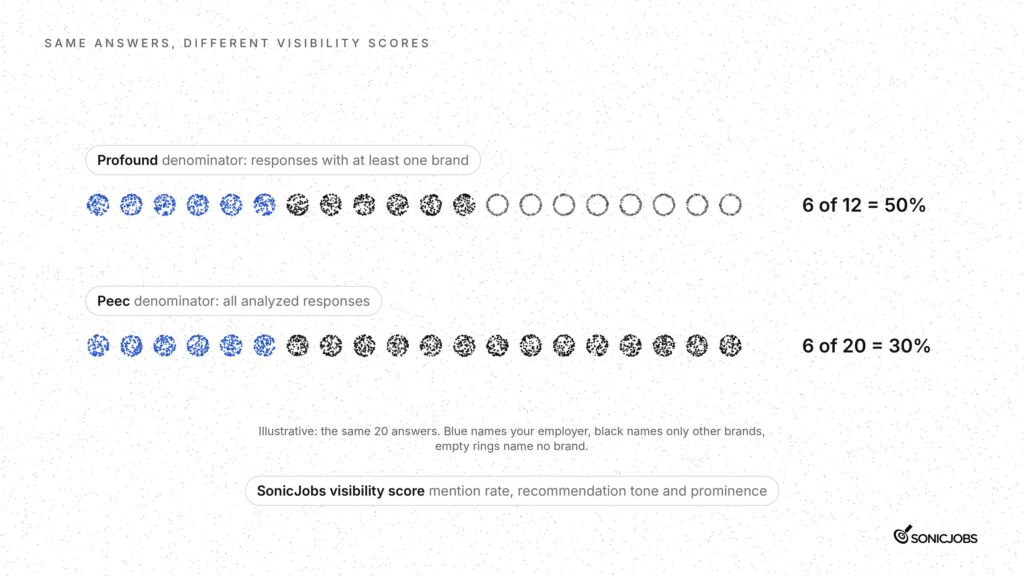
Record the date checked and sources used; the supplied methodology references include Profound documentation dated September 16, 2026, and Peec research dated September 29, 2026. Recruitment prompt libraries, requisition identifiers, closed-job handling and recruitment benchmark cohorts still need verification. Tracking prompts sample possible questions, so disclose their selection and separate branded from non-branded questions. Visibility denominators also differ: Profound uses responses containing at least one brand, while Peec uses all analyzed responses. Neither visibility percentage should be treated as interchangeable with another vendor’s score or with share of voice.
When is Profound a fit for hiring-related AI visibility?
Profound is a strong fit when hiring-related visibility sits within a company-wide brand-monitoring program. Its documented capabilities cover multiple AI engines, competitor analysis, brand accuracy and individual page performance. Teams can configure candidate questions as tracked prompts, though that does not establish a packaged recruitment workflow. This assessment uses Profound’s product pages and help documentation, checked November 8, 2026, rather than hands-on testing.
Profound Key Features
- Visibility and competitor analytics: Profound documents visibility scores, share of voice, sentiment, citations and competitor rankings, with analysis by time, region, topic and audience persona. Its documented visibility denominator uses responses containing at least one brand, so the percentage should not be treated as interchangeable with another vendor’s score.
- Configurable prompts and engine coverage: Teams can upload prompts, generate them or select them from Prompt Volumes, then edit or add tracked prompts later. Documented engines include ChatGPT, Claude, Gemini, Perplexity, Microsoft Copilot, Google AI Overviews, Google AI Mode, Grok and DeepSeek, subject to configuration.
- FactCheck: Profound compares claims about a brand with the brand’s source of truth and identifies citation URLs associated with inaccurate information. This supports brand-accuracy analysis, without establishing a recruitment-specific workflow.
- Pages and configurable reporting: Pages provides URL-level citation performance, content scoring and optimization recommendations. Reporting includes visibility, share of voice, average position and citation rank, with filters for topics, tags, platforms, regions and personas, plus PDF exports and shareable links. Page-level analysis should not be confused with native job-requisition tracking.
Which teams and use cases are best suited to Profound?
- Company-wide multi-engine monitoring: Brand and marketing teams evaluating visibility beyond hiring have a strong reason to consider Profound. Its documented engine coverage and cross-topic analytics suit a broader monitoring program that can also include employer-brand questions.
- Configured employer-brand analysis: Talent acquisition and recruitment marketing teams can configure hiring-related prompts and examine employer mentions, sentiment, citations and competitor rankings. Buyers should verify how that setup would meet their hiring needs rather than assume a ready-made candidate-intent library or recruiting workflow.
What should buyers conclude about Profound?
Profound’s documented strengths make it a stronger fit for company-wide brand tracking outside hiring: broad engine coverage, brand-accuracy checks and page-level analysis. It can also track candidate questions through configurable prompts.
The reviewed documentation did not publicly verify packaged candidate-intent libraries, native applicant tracking system (ATS) or job-feed connectivity, requisition lifecycle tracking or recruitment-specific benchmarks. Those capabilities remain not publicly verified, not proven absent.
When is Peec a fit for hiring-related AI visibility?
Peec is a fit when a marketing team wants company-wide AI search reporting and can configure hiring-related prompts within that broader program. Its documented strengths include daily competitor analytics, detailed prompt dashboards and recommendations for improving visibility. For this comparison, we reviewed Peec’s product pages and help documentation, with the evidence boundary checked on November 8, 2026.
Peec Key Features
- Daily visibility and competitor analytics: Tracks visibility, position, sentiment and share of voice, with side-by-side competitor comparisons and analysis of cited sources. Peec defines visibility as responses mentioning a brand divided by all analyzed responses. That is distinct from share of voice; its visibility percentage should not be treated as interchangeable with Profound’s without checking denominators.
- Per-prompt dashboards and tagging: Shows visibility, top brands, source distribution, query fanouts and common terms. Teams can filter by topic, tag and model, then share dashboards through PDF exports or links. System tags distinguish branded from non-branded prompts and classify informational, commercial and transactional intent.
- Ranked recommendations and source-gap analysis: Provides ranked improvement recommendations and identifies sources where competitors appear but the tracked brand does not. These capabilities support decisions about where to focus visibility improvements.
- Cross-engine recurring reporting: Peec’s documented MCP reporting use case compares visibility, sentiment and competitor share of voice across ChatGPT, Perplexity, Gemini, Claude and Google AI Overviews, with weekly reporting into Notion and Slack.
Which teams and use cases are best suited to Peec?
- Marketing-led company-wide reporting: Peec suits teams tracking the company’s presence beyond hiring, using competitor comparisons and recurring cross-engine reports. This is its documented marketing use case and the stronger reason to shortlist it.
- Configured hiring-topic monitoring: Teams can organize hiring-related prompts through topics and user-created tags, then inspect individual results. However, general informational, commercial and transactional tags do not establish a packaged candidate-intent library or make Peec a ready-made recruitment product.
What should buyers conclude about Peec?
Peec offers documented reporting and improvement capabilities, including prompt-level analysis, ranked recommendations and source-gap analysis. It deserves consideration when hiring visibility sits within a wider company reporting program.
For recruitment-specific requirements, the reviewed documentation did not publicly verify packaged candidate-intent libraries, native applicant tracking system (ATS) or job-feed connectivity, requisition lifecycle tracking or recruitment-specific benchmarks. Treat those capabilities as not publicly verified, rather than absent, and ask Peec to demonstrate any that your team requires.
How does SonicJobs GPT Suite address candidate questions and employer visibility?
Our SonicJobs GPT Suite connects two hiring tasks: understanding what candidates ask on the career site and measuring how the employer appears in public AI answers. We sell two separate products together: CareerGPT, our conversational AI career agent for the employer’s career site, and Employer GPT Visibility, which measures employer appearances on ChatGPT, Claude and Gemini. Each has a distinct role.
SonicJobs GPT Suite Key Features
- CareerGPT: conversational career-site search. Candidates describe the work they want and ask questions in their own words.
- CareerGPT: answers from connected knowledge. Cited answers draw from approved content and live jobs the employer connects. External sources are used only when the employer chooses to connect them.
- CareerGPT: first-party candidate questions. It captures the prompts candidates enter on the career site, giving teams direct evidence of what visitors want to know.
- Employer GPT Visibility: anonymous browser-agent checks. Browser agents ask candidate questions on ChatGPT, Claude and Gemini anonymously, the way a candidate would.
- Employer GPT Visibility: employer and competitor appearances. Teams can review where the employer ranks, which competitors appear and which sources the answers cite.
- Employer GPT Visibility: recorded answer evidence. Timestamped screen recordings preserve full answers so teams can inspect the evidence behind a visibility result.
SonicJobs GPT Suite Differentiators
- Employer and candidate focus. CareerGPT addresses questions on the employer’s career site. Employer GPT Visibility examines how the employer appears when candidate questions are asked on public AI assistants.
- Candidate-style external measurement. Employer GPT Visibility uses anonymous browser agents to ask candidate questions and record employer rankings and cited sources.
- First-party question capture. The separate CareerGPT product captures questions from career-site visitors. Those questions give hiring teams a concrete starting point for deciding what they want to investigate externally.
- Inspectable full answers. Employer GPT Visibility provides timestamped recordings, allowing teams to review the answer itself alongside employer appearances and citations.
Benefits of using SonicJobs GPT Suite
- Examine appearances relative to competitors. Employer GPT Visibility helps teams see which employers appear in answers to hiring-related questions and where their own employer ranks.
- Inspect the supporting sources. Employer GPT Visibility lets teams review citations and full-answer recordings when investigating an employer mention or absence.
- Understand career-site questions. CareerGPT gives teams first-party candidate prompts to review when deciding which information their career content needs to address.
How can talent acquisition teams use SonicJobs GPT Suite?
- Talent acquisition review: A team can use Employer GPT Visibility to examine employer appearances, competitor appearances and citations for candidate questions relevant to its hiring priorities.
- Career-site answers: A career-site team can connect approved content and live jobs to CareerGPT so candidates can ask questions and receive cited answers from that information.
- Employer-brand content review: An employer-brand team can review questions captured by CareerGPT, then inspect relevant answers and cited sources in Employer GPT Visibility to identify content improvements worth investigating.
What makes SonicJobs GPT Suite relevant to hiring teams?
The strongest fit is the connection between questions candidates ask and evidence of how public AI assistants answer them. CareerGPT provides the on-site conversation and first-party questions. Employer GPT Visibility provides external measurement, competitor appearances and recorded answers. Together, they give hiring teams evidence to guide content decisions while keeping career-site assistance distinct from external visibility tracking.
How do SonicJobs GPT Suite, Profound and Peec compare for hiring visibility?
Our hiring fit rests on connecting candidate questions with external employer visibility. CareerGPT and Employer GPT Visibility are separate products sold together in the SonicJobs GPT Suite package.
| Capability | SonicJobs GPT Suite | Profound | Peec | Evidence or buyer verification |
|---|---|---|---|---|
| Primary workflow | CareerGPT: conversational search and answers on the career site. Employer GPT Visibility: external employer visibility measurement. | General brand monitoring across engines, topics, regions and personas. | AI search analytics for marketing teams, with daily visibility and competitor tracking. | SonicJobs product details; Profound and Peec public documentation. |
| Candidate-question inputs | CareerGPT: captures first-party candidate questions. Employer GPT Visibility: tests candidate questions externally. | Uploaded or generated prompts, plus prompts selected from Prompt Volumes. A packaged candidate-intent library is not publicly verified. | Configurable tracked prompts and hiring-topic monitoring. A packaged candidate-intent library is not publicly verified. | Ask each vendor to demonstrate how candidate questions become tracked prompts. |
| Engine coverage | Employer GPT Visibility: ChatGPT, Claude and Gemini. | Lists ChatGPT, Claude, Gemini, Perplexity, Microsoft Copilot, Google AI Overviews, Google AI Mode, Grok and DeepSeek. | Its documented weekly-briefing use case covers ChatGPT, Perplexity, Gemini, Claude and Google AI Overviews. | These are documented scopes, not confirmation that every engine is included in every configuration. |
| Competitor and citation analysis | Employer GPT Visibility: employer appearances, citations and competitor comparisons. | Citation analysis, competitor rankings, sentiment and share of voice. | Side-by-side competitor comparisons, cited-source analysis, sentiment and share of voice. | All three document comparison capabilities; request a demonstration using hiring questions. |
| Answer evidence | Employer GPT Visibility: timestamped screen recordings with full answers. Runs use anonymous browser agents. | Run-level screenshots or recordings are not publicly verified in the reviewed sources. | Run-level screenshots or recordings are not publicly verified in the reviewed sources. | Ask what answer evidence is retained and accessible for each run. |
| URL-level analysis | Employer GPT Visibility: identifies cited sources. | Pages organizes citation performance by individual URL and adds content scoring. | Source distribution and source-gap analysis are documented; dedicated URL-level performance reporting is not publicly verified in the reviewed sources. | A cited job-page URL does not establish native requisition tracking. |
| Content-improvement guidance | Identifies content improvements alongside candidate questions and visibility measurement. | Pages provides content scoring and optimization recommendations. | Ranked improvement recommendations and source-gap analysis identify where competitors appear but a brand does not. | Compare the specificity of recommendations for hiring content. |
| Reporting | Employer GPT Visibility: shows appearances, citations, comparisons and answer evidence. | Configurable dashboards, filters, PDF exports and publicly shareable links. | Per-prompt dashboards, topic/tag/model filters, PDF exports and links. A documented MCP use case adds weekly Notion and Slack reporting. | Profound and Peec provide documented reporting options beyond hiring. |
| ATS or job-feed connectivity for external measurement | CareerGPT: uses live jobs on the career site. | Native ATS or job-feed connectivity for external measurement is not publicly verified. | Native ATS or job-feed connectivity for external measurement is not publicly verified. | Career-site job access does not establish external-measurement connectivity. Request a demonstration. |
| Visibility-score definitions | Employer GPT Visibility: a visibility score built from mention rate, recommendation tone and prominence. | Visibility uses responses containing at least one brand as its denominator. | Visibility equals analyzed responses mentioning the brand divided by all responses analyzed. | Visibility and share of voice are separate metrics. Do not compare vendor percentages without aligning definitions and prompt sets. |
Evidence note: Source review date: November 8, 2026. Sources comprise the SonicJobs homepage and Employer GPT Visibility page, and the official Profound and Peec product and help documentation listed in the citations. “Not publicly verified” means the reviewed material does not establish the capability, not that the capability is unavailable. No common test set or normalized metric definition supports a cross-vendor performance score.
The hiring-fit argument for SonicJobs is the connection between CareerGPT’s first-party candidate questions and Employer GPT Visibility’s external measurement. Profound and Peec are stronger fits for company-wide brand tracking outside hiring: Profound’s documentation establishes wider engine coverage and monitoring dimensions, while Peec’s dashboard documentation supports marketing-led reporting. For job-level or requisition-level requirements, ask vendors to demonstrate the workflow before treating it as verified.
Which AI visibility platform is the best fit for talent acquisition in 2026?
Evaluate SonicJobs when your hiring team needs external employer visibility measurement alongside a separate conversational product for its career site. Our Employer GPT Visibility measures how your employer appears on ChatGPT, Claude and Gemini for candidate questions, including rankings and cited sources. CareerGPT is our separate conversational AI career agent on your career site, where candidates ask questions in their own words and get cited answers from approved content and live jobs. The two products are sold together. That makes SonicJobs the strongest fit for a hiring-specific workflow.
Profound and Peec are credible alternatives for configured employer-brand questions and stronger documented fits for broader company-wide monitoring. Profound merits evaluation when broader engine coverage, brand-accuracy checks through FactCheck and URL-level citation analysis through Pages are priorities. Peec merits evaluation when marketing-led reporting on visibility, sentiment and competitor share of voice, including weekly briefings into Notion and Slack, is the main requirement. Before choosing, verify packaged candidate-intent prompt libraries, native applicant tracking system (ATS) or job-feed connectivity, job-level and requisition-lifecycle tracking, and recruitment-specific benchmarks. The reviewed Profound and Peec materials do not publicly establish those recruiting capabilities; that does not mean they are absent.
Related reading: GEO for Recruitment in 2026: How to Get Your Jobs Cited in ChatGPT, Gemini and Claude · SonicJobs Launches Next-Gen AI Agents Powered by OpenAI’s Latest Models to Help Millions Find Fulfilling Work · Best AI Visibility Tools for Recruitment Marketing 2026
FAQs: SonicJobs GPT Suite vs. Profound vs. Peec
Why is SonicJobs GPT Suite a fit for talent acquisition teams?
SonicJobs pairs two separate products around candidate questions. CareerGPT works on the employer’s career site, helping candidates ask questions in their own words and receive cited answers from approved content and live jobs. It also captures first-party candidate prompts. Employer GPT Visibility measures external employer appearances on ChatGPT, Claude and Gemini, including competitor comparisons and cited sources. The package fits teams that want both career-site candidate insights and external visibility measurement.
When should I choose SonicJobs instead of Profound or Peec?
Choose SonicJobs when your priority is connecting career-site candidate questions with employer visibility on ChatGPT, Claude and Gemini. Profound is a stronger fit for broader company-wide monitoring when engine coverage matters: its documented coverage also includes Perplexity, Microsoft Copilot, Google AI Overviews, Google AI Mode, Grok and DeepSeek, subject to configuration. Peec fits marketing-led reporting needs through topic-filtered dashboards, exports and documented cross-engine briefings. Both deserve consideration when the reporting remit extends beyond hiring.
Does SonicJobs Employer GPT Visibility support competitor and citation analysis?
Yes. SonicJobs Employer GPT Visibility shows employer appearances, citations and competitor comparisons, with timestamped screen recordings showing full answers as evidence. Teams can examine whether an employer appears, which competitors appear and which sources receive citations. This is external visibility measurement, separate from CareerGPT’s candidate conversations on the career site.
Which are the best AI search visibility platforms for talent acquisition?
SonicJobs, Profound and Peec form a useful shortlist, with different roles. SonicJobs offers a hiring-focused package: CareerGPT handles career-site conversations, while Employer GPT Visibility measures external employer visibility. Profound and Peec are general analytics platforms that can be configured around employer-brand questions. Profound merits consideration for broader engine coverage; Peec for marketing-led dashboards and reporting. The best fit depends on whether the team needs candidate insights alongside measurement or company-wide brand tracking beyond recruitment.
Can Profound and Peec track employer-brand questions?
Yes. Their configurable prompts support employer-brand questions. Profound documents manually uploaded, generated and dataset-selected prompts, with later additions and edits. Peec documents per-prompt reporting with topic, tag and model filters. Neither should be excluded simply because its positioning is broader than recruitment. Our evidence review, checked November 8, 2026, used the supplied Profound and Peec product pages and documentation. It did not establish packaged candidate-intent libraries or recruitment-specific benchmarks; those capabilities remain unverified, rather than confirmed absent.
Are visibility scores comparable across SonicJobs, Profound and Peec?
No, not without checking their definitions and measurement scope. Profound’s September 16, 2026 documentation uses responses containing at least one brand as its visibility denominator. Peec calculates visibility as responses mentioning a brand divided by all analyzed responses. SonicJobs’ Employer GPT Visibility score combines mention rate, recommendation tone and prominence. A percentage from one platform therefore should not be treated as equivalent to the same percentage from another. Visibility and share of voice should also remain separate measures.
What is the difference between job-page citation tracking and requisition-level visibility?
Job-page citation tracking identifies citation performance for a particular URL. Requisition-level visibility would require evidence that reporting recognizes the underlying job requisition, including its identifier, lifecycle status and handling when the job closes. Profound Pages documents individual-URL citation analysis, so it should not be described as brand-only tracking. However, a cited job URL alone does not establish native requisition tracking.