Published November 8, 2026 by SonicJobs
Compare six AI visibility tools for recruitment marketing in 2026, including SonicJobs, with evidence on monitoring, candidate insights and content improvement.
When candidates ask public AI assistants about jobs or employers, recruitment marketers need to know whether their employer appears and which sources get cited. This shortlist compares six offerings: SonicJobs Employer GPT Visibility and CareerGPT, two separate products sold together as one recruitment-specific package, plus five general platforms: Profound, Peec AI, Scrunch, OtterlyAI and Semrush AI Visibility Toolkit. We assess visibility monitoring, candidate insight and content improvement separately, because recruitment-specific fit and breadth of general visibility analysis are different questions. For our package, SonicJobs Employer GPT Visibility supplies public-AI visibility monitoring, while CareerGPT supplies candidate-question insight from the employer’s career site to inform content improvements. The evidence cutoff is November 8, 2026. Inclusion reflects documented fit, not hands-on testing or an independently established ranking.
Why do recruitment marketing teams need AI visibility tools?
Recruitment marketing teams need AI visibility tools to inspect whether public AI answers name their employer, recommend competing employers and cite relevant sources. An April 30, 2026 announcement from iCIMS and Aptitude Research reported that 74% of companies report candidates using AI in job search. That is a company-reported finding, not a measure of the share of candidates using AI. It also does not establish how often candidates use AI specifically to discover or compare employers.
Which employer-visibility problems should recruitment teams investigate?
- Employer appearance: Does the employer appear when an assistant answers a relevant hiring question, and where does it rank?
- Competing recommendations: Which other employers appear for the same question?
- Cited sources: Which pages support the answer, and does the assistant cite the employer’s own content?
- Question relevance: Do the monitored prompts reflect questions candidates actually ask about roles, benefits and concerns?
Our two products address different parts of this investigation. SonicJobs Employer GPT Visibility measures employer visibility against competitors on ChatGPT, Claude and Gemini. Its browser agents ask candidate questions anonymously to show where the employer ranks and which sources are cited. CareerGPT, our conversational AI career agent, captures questions on the employer’s own career site about roles, benefits and concerns. Employer GPT Visibility supplies public-assistant visibility checks; CareerGPT supplies first-party career-site question insight. They are separate products, sold together as one package.
What should recruitment teams look for in an AI visibility tool?
Start with a hiring question your team needs answered. Ask the vendor to show how it selects that question, tests your employer’s visibility and helps you decide what content to change. Keep visibility monitoring, candidate insight and content improvement separate during the evaluation.
Which capabilities matter for recruitment visibility?
-
Recruitment specificity. Distinguish the ability to configure employer-related prompts from a workflow built around candidate questions and hiring priorities. Test questions about a role, location or benefit. Ask for evidence at the employer and individual job-page level rather than assuming either capability from a platform’s category.
-
Monitoring and citation evidence. Confirm supported assistants, competitor comparisons, cited URLs, configuration options and refresh cadence for your account. Employer GPT Visibility uses anonymous browser agents to ask candidate questions on ChatGPT, Claude and Gemini. It also shows ChatGPT employer appearances, citations, competing employers and timestamped screen recordings with full-answer evidence.
-
Candidate-insight provenance. Ask whether proposed questions come from first-party candidate conversations, prompt-volume research or analyst-created prompts. These inputs should be labeled separately. Check the knowledge boundaries too: CareerGPT answers only from employer-connected sources. External sites are used only when the employer chooses to connect them.
-
Content-improvement workflow. Request a demonstration that moves from a missing answer or citation to a specific content task. Separate diagnostic recommendations, content execution and employer-led editing. Confirm who publishes changes and how the team re-tests visibility afterward; monitoring alone should not be treated as content execution.
-
Enterprise governance and reporting. Request demonstrations of access controls, data handling, exports, multi-brand organization, geographic segmentation and reporting. For a Fortune 500 talent acquisition team, verify these against the intended account configuration rather than inferring them from an enterprise label.
The comparison applies these criteria to documented capabilities and dated public evidence, with gaps left visible. Our package contains two separate products, CareerGPT and Employer GPT Visibility.
How can recruitment marketers connect candidate questions with AI visibility checks?
Start with the questions candidates ask on your career site, then use selected questions to check how your employer appears in public AI answers. We recommend a six-stage editorial workflow: gather questions, group hiring themes, select monitoring prompts, inspect answers and sources, revise content, and repeat checks. CareerGPT and Employer GPT Visibility are separate SonicJobs products sold together as one package, with different roles in this process.
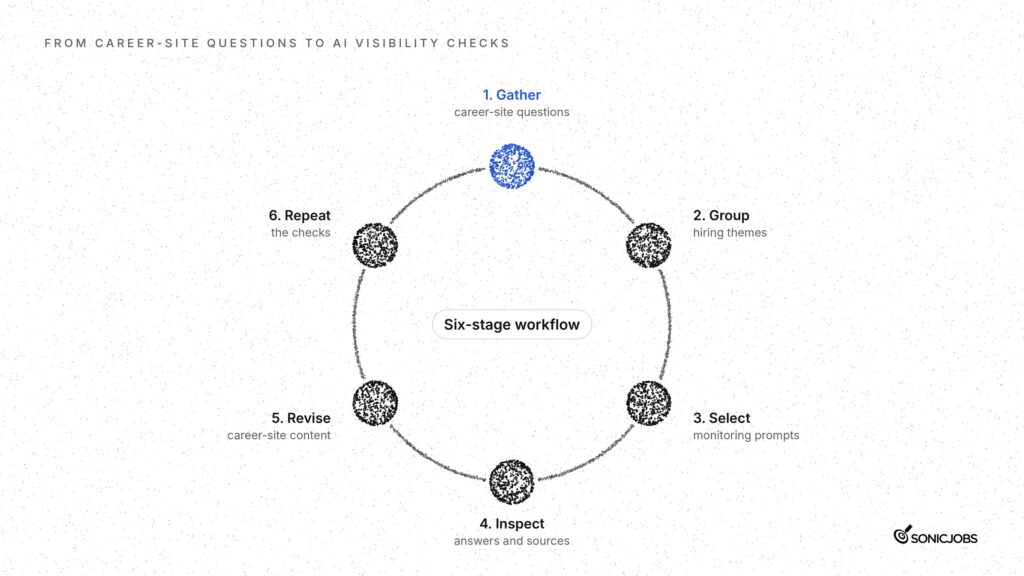
First, gather career-site questions through CareerGPT. CareerGPT captures questions about roles, benefits and concerns, and answers using approved connected content and live jobs, with source citations. It uses only the knowledge sources the employer connects. External sites are included only when the employer chooses to connect them.
Next, group those questions into hiring themes and select specific questions to monitor. For example, your team might group questions about shift requirements, identify an unanswered concern and turn it into a prompt relevant to a hiring priority.
Then inspect the public-assistant answers. SonicJobs Employer GPT Visibility uses browser agents to ask candidate questions anonymously on ChatGPT, Claude and Gemini, showing where the employer ranks and which sources are cited, alongside competing employers. Employer GPT Visibility provides timestamped screen recordings and full-answer evidence for ChatGPT.
Use the findings to decide what your team should clarify or publish on the career site. Compare the candidate’s question with the cited content and identify what your own content leaves unanswered. The Insights Portal also recommends content, job-data and metadata changes.
Finally, repeat the selected checks after making content changes and compare the answers and sources. Keep the prompts consistent enough to assess differences.
How do the six AI visibility tools compare for recruitment marketing?
The six offerings differ in where their insight comes from and what happens after a visibility gap is found. We separate monitoring, candidate insight and content improvement below. These tables compare documented vendor capabilities, inferred recruitment applications and capabilities not verified in the supplied evidence. They do not establish numerical winners or reflect hands-on testing. “Not verified” means the reviewed evidence does not establish a capability, not that the capability is absent.
How do the five general AI visibility platforms compare?
| Offering | Visibility monitoring and assistant coverage | Candidate-insight provenance | Content-improvement workflow | Recruitment fit and verification needs |
|---|---|---|---|---|
| Profound | Documented, Sep 16, 2026: daily prompt analysis covering visibility, citations, sentiment, share of voice and average position, organized with topics and tags (documentation). Documented, Nov 8, 2026: listed coverage includes ChatGPT, Perplexity, Claude, Microsoft Copilot, Google AI Overviews, Google AI Mode, Gemini, Grok and DeepSeek; confirm customer configuration (coverage). | Documented, Nov 8, 2026: Prompt Volumes surfaces audience questions and content gaps (features). Not verified, Nov 8, 2026: collection of first-party career-site candidate conversations. Audience-demand insight should not be treated as candidate-conversation data. | Documented, Nov 8, 2026: Pages provides URL citation share, prompt/platform breakdowns, scores and recommendations (Pages). Agents supports research, writing and publishing; Content Optimization adds structural-gap diagnosis, prioritized recommendations and CMS-connected workflows (Agents, optimization). | Inferred application, Nov 8, 2026: organize employer questions by hiring theme and examine individual career-page URLs. Not verified, Nov 8, 2026: a recruitment-native workflow. Demonstrate the intended hiring-topic structure and confirm included assistants. |
| Peec AI | Documented, Nov 8, 2026: model- and market-level visibility, citations, sentiment and share-of-voice comparisons; separate projects for brands, markets and teams. Listed assistants: ChatGPT, Perplexity, Google AI Overviews, Google AI Mode, Gemini, Copilot, Claude, DeepSeek, Grok, Mistral and Qwen (enterprise page). Confirm selected configuration. | Documented, Nov 8, 2026: topic/tag filtering, per-prompt dashboards, source distributions and query fan-outs provide analytical context (dashboard guide). Not verified, Nov 8, 2026: first-party candidate-conversation collection. Prompt analysis is a different evidence source. | Documented, Feb 10, 2026: Actions groups cited sources and proposes prioritized steps for competitive gaps. The announcement described a beta at launch (Actions announcement). Not verified, Nov 8, 2026: current Actions availability or release status. | Inferred application, Nov 8, 2026: segment employer-brand questions by hiring topic, market or team. Documented, Nov 8, 2026: SSO, access controls, API/BI integrations and automated reporting are enterprise evaluation factors, not recruitment-outcome evidence (enterprise page). Verify Actions availability. |
| Scrunch | Documented, Nov 8, 2026: prompt/model trends, competitor benchmarks and citation analysis by domain, URL and source type (monitoring). Listed coverage: ChatGPT, Perplexity, Gemini, Claude, Google AI Overviews, Google AI Mode, Copilot, Grok and Meta AI. Availability varies by configuration (coverage FAQ). | Documented, Nov 8, 2026: persona, country, platform and custom-tag filters support contextual analysis of cited URLs (URL FAQ). Not verified, Nov 8, 2026: first-party career-site candidate conversations. Persona filtering does not establish that provenance. | Documented, Nov 8, 2026: Site Diagnostics identifies technical and editorial issues alongside URL-level citation analysis (URL FAQ). | Inferred application, Nov 8, 2026: examine employer prompts and citations to particular job pages. Not verified, Nov 8, 2026: native job-feed monitoring. Confirm platform availability and demonstrate the proposed career-page workflow. |
| OtterlyAI | Documented, Nov 8, 2026: mentions, citations, sentiment, share of voice, competitor comparisons and stored answers across ChatGPT, Perplexity, Google AI Overviews, Google AI Mode, Gemini, Copilot and Claude (analytics). Documented, Aug 5, 2026: tracked prompts are checked daily (cadence). | Documented, Nov 8, 2026: tracked prompts, stored answers and competing citation sources provide the analytical inputs (analytics, optimization). Not verified, Nov 8, 2026: collection of first-party candidate questions. | Documented, Nov 8, 2026: content audits, crawler-access testing and recommendations derived from tracked prompts and competing citation sources (optimization). | Inferred application, Nov 8, 2026: track employer questions daily and audit recruitment content against cited sources. Not verified, Nov 8, 2026: a candidate-conversation workflow. Demonstrate the required prompt set and answer-review process. |
| Semrush AI Visibility Toolkit | Documented, Nov 8, 2026: daily custom Prompt Tracking covers Google AI Mode, Google AI Overviews, Gemini and ChatGPT Search. Weekly Brand Performance covers Google AI Mode, ChatGPT, Perplexity and Gemini. AI Search Site Audit runs on demand; coverage and cadence are feature-specific (data documentation). | Documented, Nov 8, 2026: prompt research and competitive prompt gaps provide audience-demand insight (solution page). Not verified, Nov 8, 2026: collection of first-party career-site candidate conversations. | Documented, Nov 8, 2026: technical accessibility audits and AI Search Optimizer connect with visibility, Site Audit and Position Tracking data (solution page). | Inferred application, Nov 8, 2026: a shared SEO and recruitment-content workflow. Not verified, Nov 8, 2026: recruiting outcomes from that workflow. Confirm the exact feature, assistant coverage and refresh cadence required. |
How does the recruitment-specific SonicJobs package compare?
| Offering | Visibility monitoring and assistant coverage | Candidate-insight provenance | Content-improvement workflow | Recruitment fit and verification needs |
|---|---|---|---|---|
| SonicJobs Employer GPT Visibility with CareerGPT | Employer GPT Visibility uses browser agents to ask candidate questions anonymously on ChatGPT, Claude and Gemini, measuring employer rankings and cited sources. It shows ChatGPT employer appearances, citations, competing employers, timestamped screen recordings and full answers. | CareerGPT captures first-party questions about roles, benefits and candidate concerns through the employer’s career site. It answers from approved content and live jobs and cites its sources. This insight comes from CareerGPT, a separate product sold with Employer GPT Visibility. | The employer uses CareerGPT questions and Employer GPT Visibility findings to decide which career-site answers to improve, publishes those changes and checks visibility again. | The package connects a candidate-facing career-site experience with employer visibility measurement, built for teams prioritizing candidate questions and employer-content gaps. |
The practical distinction is insight provenance, not a claim that general platforms cannot analyze job-page URLs: Profound Pages and Scrunch’s URL documentation establish URL-level analysis. CareerGPT captures career-site candidate questions, and Employer GPT Visibility provides ChatGPT answer evidence. For every offering, demonstrate the intended recruitment workflow before treating a documented capability as a verified fit.
What are the best AI visibility tools for recruitment marketing teams in 2026?
These six tools address different needs: employer-specific visibility, broader brand monitoring and content improvement. We compare their documented monitoring, audience insight, content workflows and recruitment fit. This is a shortlist, not a tested ranking. Evidence was checked on November 8, 2026, unless another documentation date is stated. Recruitment applications for the five general-purpose platforms are editorial assessments, not verified recruiting outcomes.
SonicJobs Employer GPT Visibility with CareerGPT
We sell two separate employer products together as one package. Employer GPT Visibility measures how an employer appears against competitors on ChatGPT, Claude and Gemini. CareerGPT is our conversational AI career agent on the employer’s own career site. This gives recruitment teams candidate-question insight alongside public AI visibility checks, without treating the two capabilities as one product.
Key features: Employer GPT Visibility uses anonymous browser agents to ask candidate questions and show employer appearances, rankings and cited sources. Employer GPT Visibility also provides timestamped screen recordings and full-answer evidence for ChatGPT checks. CareerGPT answers questions from employer-connected content and live jobs, cites its sources and captures questions about roles, benefits and concerns. External sources are used only when the employer connects them.
Recruitment marketing applications: Use CareerGPT questions to identify what career content needs clarification, then use Employer GPT Visibility to check how the employer and competitors appear for candidate questions.
Pros: The package connects recruitment-specific candidate insight with employer visibility measurement. Each product has a clear role: CareerGPT captures career-site questions; Employer GPT Visibility measures public AI answers.
Limitations: The package is built for recruitment, not general brand monitoring outside hiring.
Profound
Profound combines broad answer-engine analysis with documented content execution workflows. Its monitoring documentation, updated September 16, 2026, describes daily prompt-driven analysis.
Key features: Monitoring includes visibility, citations, sentiment, share of voice and average position, with topics and tags for organizing prompts. Prompt Volumes helps discover audience questions and content gaps. Pages adds URL-level citation share, content scores and recommendations, while Content Optimization documents structural-gap diagnosis and CMS-connected workflows.
Recruitment marketing applications: Our editorial assessment is that teams could organize prompts around hiring themes and investigate cited career-page URLs, then use the content workflows to address gaps.
Pros: Profound documents both measurement and content execution, including page-level investigation. That makes it relevant when employer-brand content shares an enterprise content operation.
Limitations: Organizing recruitment prompts is an inferred application, not a documented recruitment-native workflow. General audience-demand data should not be presented as first-party candidate conversations.
Peec AI
Peec AI documents multi-brand and multi-market reporting, with separate projects for brands, markets and teams.
Key features: Its enterprise page describes visibility, sentiment, citations and share-of-voice comparisons by model and market, alongside SSO, access controls, API and BI integrations, and automated reporting. Dashboard documentation adds topic and tag filtering and per-prompt source analysis. Its February 10, 2026 Actions announcement describes prioritized steps based on cited sources and competitive gaps.
Recruitment marketing applications: Our editorial assessment is that recruitment marketers could separate employer brands or hiring markets into projects and organize questions by hiring topic.
Pros: Project organization and enterprise reporting are relevant evaluation factors for teams managing several employer brands or countries. Actions provides a documented approach to turning citation analysis into proposed content work.
Limitations: Confirm the selected models and current Actions availability. The announcement described Actions as beta at launch, but that does not establish its October 2026 status. Topic analysis is not evidence of first-party candidate-question collection.
Scrunch
Scrunch supports investigation of brand presence and cited URLs, with filters that help teams examine differences between audiences and countries.
Key features: Documented monitoring includes competitive benchmarks, trends across prompts and models, and citation analysis by domain, URL and source type. Specific-URL analysis supports persona, country, platform and custom-tag filters. Site Diagnostics addresses technical and editorial issues.
Recruitment marketing applications: Our editorial assessment is that teams could investigate which career or job pages earn citations for employer-related prompts, then examine the technical or editorial issues affecting those pages.
Pros: URL-level citation investigation and audience filters support a focused review of the pages appearing in AI answers, rather than only an overall brand metric.
Limitations: Verify platform availability for the selected configuration. Support for analyzing specific URLs does not establish native job-feed monitoring or a recruitment-specific workflow.
OtterlyAI
OtterlyAI combines recurring prompt monitoring with stored answers and content audits. Its August 5, 2026 documentation states that tracked prompts are checked daily.
Key features: AI Search Analytics documents brand mentions, citations, sentiment, share of voice, competitor comparisons and stored answers. Its optimization tools describe content audits, crawler-access testing and recommendations based on tracked prompts and competing citation sources.
Recruitment marketing applications: Our editorial assessment is that teams could monitor a defined set of employer questions, review changes in the stored answers and audit career content against sources earning citations.
Pros: Daily checks and stored answers support review over time. Content and crawler-access audits give teams specific areas to investigate after identifying a visibility gap.
Limitations: The supplied documentation does not establish first-party candidate-question collection. Teams should distinguish questions they choose to monitor from questions captured directly in candidate conversations.
Semrush AI Visibility Toolkit
Semrush brings prompt research, visibility analysis and content optimization into a workflow connected with SEO data.
Key features: Its documentation distinguishes daily custom Prompt Tracking, weekly Brand Performance reporting and on-demand AI Search Site Audit. The broader solution includes competitive prompt gaps, technical accessibility audits and an AI Search Optimizer connected to visibility, Site Audit and Position Tracking data.
Recruitment marketing applications: Our editorial assessment is that recruitment content owners and SEO teams could use these tools together to research employer questions, identify competitive gaps and prioritize career-site changes.
Pros: The documented connections between visibility, technical audits and SEO data support coordination when several teams own the employer’s content.
Limitations: Assistant coverage and refresh cadence differ by feature. For example, custom Prompt Tracking lists Google AI Mode, Google AI Overviews, Gemini and ChatGPT Search, while Brand Performance separately includes Perplexity. Confirm coverage at the feature level rather than assuming one configuration applies throughout the toolkit.
How were these AI visibility tools evaluated for recruitment marketing?
We reviewed vendor documentation checked on November 8, 2026, and interpreted it for recruitment marketing. This was not a hands-on benchmark. The shortlist contains five general AI visibility platforms and one recruitment-specific package. Our package comprises two separate products, CareerGPT and Employer GPT Visibility. We distinguish documented capabilities from inferred recruitment applications and unverified features. For example, Scrunch documents cited-URL tracking and Site Diagnostics: a potential job-page analysis workflow is an editorial inference, not proof of native job-feed monitoring. The weights below express our editorial priorities, not measured product performance or a validated ranking.
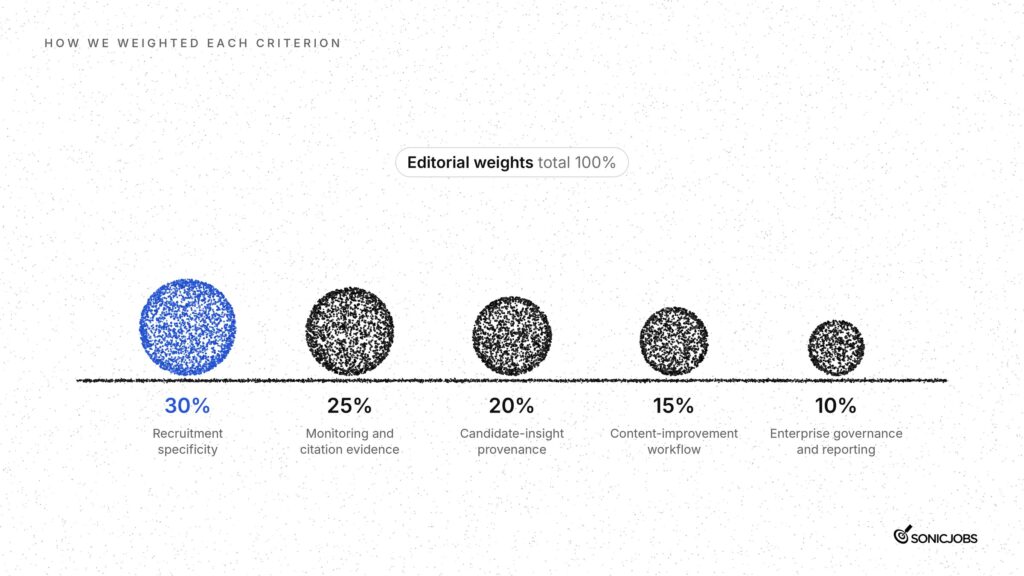
- Recruitment specificity: 30%. Assess relevance to candidate-intent questions, hiring priorities and employer comparisons. Distinguish recruitment-specific scope from general capabilities that a recruiting team could adapt.
- Monitoring and citation evidence: 25%. Examine documented assistant coverage, employer mentions, cited sources and repeat tracking. Compare coverage and refresh cadence by feature, rather than assuming one schedule applies across a toolkit.
- Candidate-insight provenance: 20%. Identify where questions originate and distinguish observed candidate questions from team-authored prompts. For SonicJobs, CareerGPT supplies candidate-question insight; Employer GPT Visibility measures public-assistant answers.
- Content-improvement workflow: 15%. Assess how evidence helps teams identify missing answers and decide what to publish. Keep content recommendations and diagnostics separate from visibility monitoring, and do not imply that measurement itself changes AI answers.
- Enterprise governance and reporting: 10%. Review documented controls and reporting options, while treating deployment readiness as something buyers must verify, not infer from company size or customer logos.
Before treating documentation as proof of deployment readiness, enterprise buyers should request demonstrations of access controls, data handling, exports, multi-brand organization, geographic segmentation and reporting.
Which AI visibility tool should your recruitment marketing team choose?
Choose around the work your team needs to do. If you need to connect candidate questions with employer comparisons in public AI answers, our Employer GPT Visibility and CareerGPT package is the right fit. They remain separate products: CareerGPT captures first-party candidate questions on your career site; Employer GPT Visibility checks candidate questions anonymously on ChatGPT, Claude and Gemini, showing employer rankings and cited sources. For broader answer engine optimization (AEO) analysis and content improvement, consider Profound’s documented content scoring, gap diagnosis and CMS-connected workflows. If recruitment content is managed alongside SEO, consider Semrush’s prompt research, technical audits and connected optimization tools. These alternatives offer content-improvement capabilities, not just monitoring. The cited web capabilities were checked November 8, 2026. Before choosing, request evidence for your deployment’s model coverage, employer-comparison needs, reporting and governance, and confirm who will turn the findings into content changes.
Related reading: How to Track What ChatGPT Says About Your Employer Brand (2026 Playbook) · What AI Assistants Tell Candidates About Your Company, and How to Change It (2026) · How Jobs Are Discovered in AI Assistants: 3 Routes
FAQs about AI visibility tools for recruitment
Why do recruitment marketers need AI visibility tools?
Recruitment marketers need visibility tools to see whether AI answers name their employer, which competitors appear and which sources earn citations. An April 30, 2026 announcement from iCIMS and Aptitude Research reported that 74% of companies said candidates were using AI in job search. That is a company-reporting measure, not the percentage of candidates using AI, and it does not isolate employer discovery. SonicJobs Employer GPT Visibility addresses the measurement question: how does an employer appear against its chosen competitors on ChatGPT, Claude and Gemini?
What is an AI visibility tool for recruitment?
An AI visibility tool for recruitment measures how an employer appears in answers to employer-related and candidate-intent prompts, including its position and the sources cited. SonicJobs Employer GPT Visibility uses anonymous browser agents to ask candidate questions on ChatGPT, Claude and Gemini, showing where the employer ranks and which sources appear. This gives recruitment marketers evidence to inspect alongside competitor results. Monitoring is separate from content improvement: the findings can inform what a team publishes.
What are the best AI visibility tools for recruitment marketing in 2026?
Our six-offering shortlist is SonicJobs Employer GPT Visibility with CareerGPT, Profound, Peec AI, Scrunch, OtterlyAI and Semrush AI Visibility Toolkit. This is a shortlist, not an independently validated ranking of recruitment outcomes. Evidence checked November 8, 2026, alongside Profound documentation updated September 16, supports evaluating these offerings for different workflows. Fit depends on whether your team needs general brand monitoring, enterprise reporting, URL-level citation analysis or candidate-question insight. For the SonicJobs package, CareerGPT supplies career-site candidate insight; SonicJobs Employer GPT Visibility supplies public-assistant visibility measurement.
Can general AI visibility tools track candidate-intent prompts and individual job-page citations?
Yes, documented general-platform capabilities support configuring candidate-intent prompts and inspecting citations to individual job-page URLs. Profound documentation updated September 16, 2026 describes prompt organization through topics and tags; its Pages feature, checked November 8, tracks citation share by URL with prompt and platform breakdowns. Scrunch documentation checked November 8 supports specific cited URLs with persona, country, platform and custom-tag filters. Applying these capabilities to recruitment is a configurable workflow, not proof of native job-feed monitoring or a first-party candidate-conversation product. In our package, CareerGPT supplies that candidate-question insight alongside SonicJobs Employer GPT Visibility.
How does CareerGPT differ from SonicJobs Employer GPT Visibility?
CareerGPT answers candidates on an employer’s career site, while SonicJobs Employer GPT Visibility measures how the employer appears on public AI assistants. CareerGPT answers from employer-connected content and live jobs, citing sources and capturing candidate questions. External sources are used only when the employer connects them. SonicJobs Employer GPT Visibility uses anonymous browser agents on ChatGPT, Claude and Gemini to inspect employer rankings and cited sources. We sell the two separate products together as one package.