Published November 8, 2026 by SonicJobs
Use SonicJobs’ 2026 AI search readiness checklist to evaluate visibility tracking, career-site content, crawler access and governance for enterprise TA.
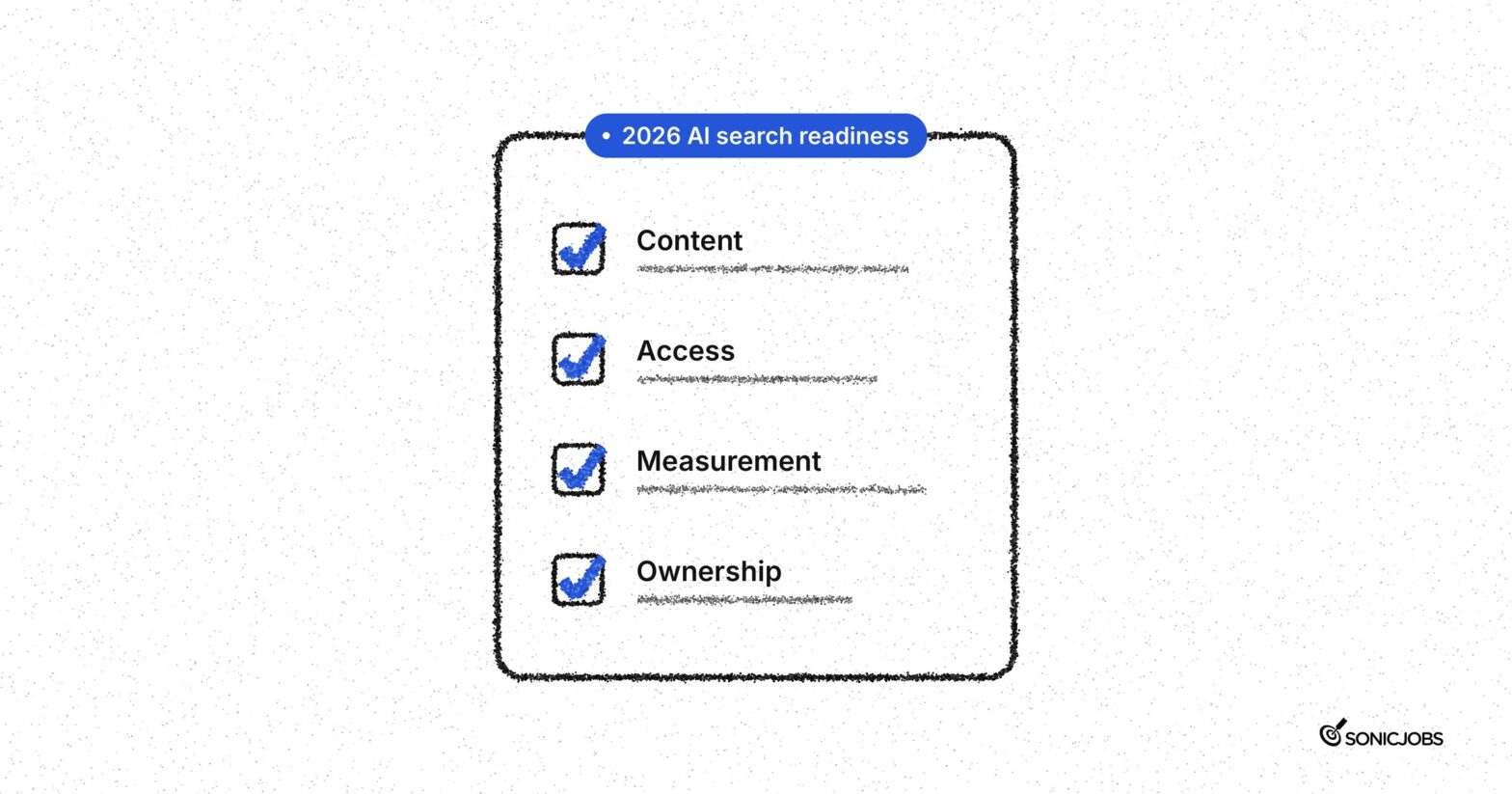
Enterprise talent acquisition teams need evidence of what candidates see in AI answers before choosing a visibility tracking platform. For Fortune 500 buyers, the evaluation should start with procurement requirements rather than a vendor ranking. This 2026 checklist covers content, access, measurement and ownership: what needs checking, what evidence to request and who is responsible. Our SonicJobs Employer GPT Visibility tool measures how employers appear compared with competitors on ChatGPT, Claude and Gemini, providing the visibility measurement side of that evaluation.
What AI search readiness means for enterprise talent acquisition
In this guide, AI search readiness is a working checklist across four areas: accurate candidate-facing content, appropriate crawler access, observable visibility and accountable ownership. It is an organizing framework for enterprise talent acquisition (TA) teams, not a certification. Each check should identify what needs to be verified, what evidence supports it and who owns the next action.
Our measurement product, SonicJobs Employer GPT Visibility, uses browser agents to ask candidate questions anonymously on ChatGPT, Claude and Gemini, the way a candidate would. It shows where the employer ranks and which sources the answers cite. That gives TA teams evidence of how the employer appears in public AI answers, separate from checks on the career site’s technical setup.
CareerGPT is our conversational AI career agent on employer career sites. CareerGPT and Employer GPT Visibility are separate products sold together as one package. CareerGPT answers only from knowledge sources the employer connects. External sources such as Glassdoor, LinkedIn or Reddit are available as sources only when the employer chooses to connect them.
Technical eligibility, assistant citations and candidate activity answer different questions. JobPosting structured data establishes eligibility for Google’s job-search experience; it does not guarantee display or citation by public AI assistants. Keep schema validation separate from visibility measurement. Neither a valid schema nor an assistant citation, by itself, establishes whether a candidate viewed a role or started an application.
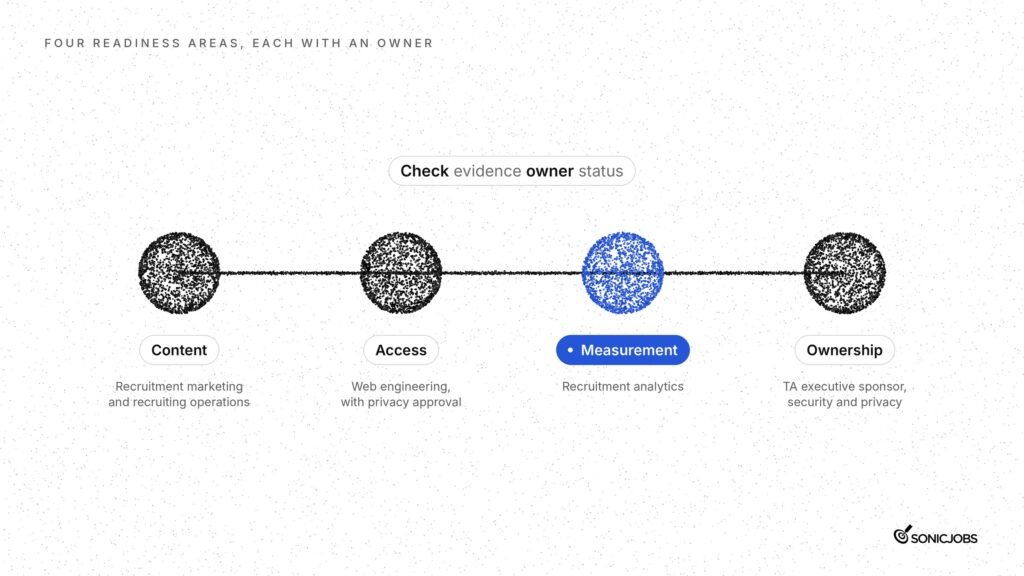
Ownership makes the checklist actionable. We recommend a TA executive sponsor, a recruitment-marketing content owner, an engineering access owner, an analytics measurement owner and security/privacy reviewers. Record who approves changes and handles incident escalation before deployment.
Why the 2026 TA checklist separates search access, training controls and reporting
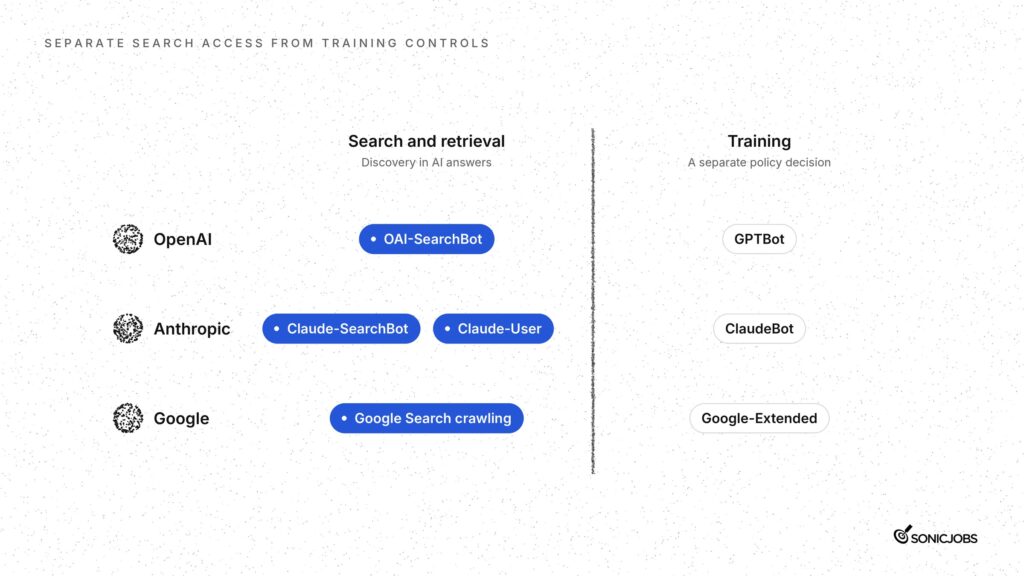
For this 2026 checklist, review current crawler documentation and reporting capabilities. The year does not establish a universal AI-search requirement. Web engineering and privacy should jointly approve crawler policy, documenting the purpose of each control rather than applying one blanket rule to every AI bot.
OpenAI separates OAI-SearchBot, used for search discovery, from GPTBot, used for potential model training. Their controls are independent: allowing search discovery does not require allowing GPTBot. Anthropic distinguishes ClaudeBot for potential training, Claude-SearchBot for search and Claude-User for user-directed retrieval. Anthropic also says blocking Claude-SearchBot can reduce search visibility and accuracy. These distinctions let teams review discovery access separately from training permissions.
Google-Extended requires a separate policy decision. It controls specified Gemini training and grounding uses, but does not affect inclusion or ranking in Google Search. Record which purpose each approved control serves so that a Gemini-related decision is not mistaken for a Google Search access decision.
Reporting needs its own documentation check. Google’s supplied guide identifies a Generative AI performance report in Search Console. Before publication or procurement sign-off, verify its current availability, name and scope. Do not repeat older assumptions that AI-feature performance is available only within aggregate Web reporting, or promise coverage that has not been confirmed.
Crawler permissions and reporting documentation do not establish how an employer appears in an assistant’s answer. Use our Employer GPT Visibility to measure the employer’s visibility against selected competitors on ChatGPT, Claude and Gemini. Keep that direct answer evidence separate from the access and training-policy record: each answers a different readiness question.
Common enterprise TA readiness gaps and how to investigate them
Use these four checks to investigate possible readiness gaps. Assign an owner to each finding and record the evidence needed to close it.
Readiness problems encountered in enterprise TA
Incomplete candidate answers. Check whether career content answers questions about roles, benefits and candidate concerns. CareerGPT captures those questions, giving career content owners specific prompts to investigate. Compare the questions with published information, identify missing detail and assign the relevant employer content owner to approve and publish corrections.
Stale or inconsistent job information. Recruiting operations should compare the job feed with published listings, checking closed roles, expired dates and geographic restrictions. Review validThrough and the remote-job properties jobLocationType and applicantLocationRequirements against Google’s job-posting guidance. Where information differs, recruiting operations and engineering should trace which feed or publishing step needs correction.
Blocked search retrieval. Ask engineering to test priority career pages beyond their robots.txt settings. OpenAI recommends allowing both OAI-SearchBot and requests from its published IP ranges. Check CDN, firewall and bot-management behavior as well, and retain evidence of successful fetches. A permissive crawler rule alone does not establish that a request can reach the page.
Visibility claims without retained evidence. Ask the recruitment marketing or measurement owner to retain full answers and timestamped screen recordings. Our Employer GPT Visibility provides evidence of where an employer appears, where it is cited and which competitors appear instead. Use that comparative evidence to investigate claims rather than relying on a summary score alone.
Keep correction and verification separate. Employer content and engineering owners remain responsible for published changes. Valid JobPosting structured data establishes eligibility for Google’s job-search experience, not guaranteed display or citation by public AI assistants. Validate schema separately from visibility measurement.
The 2026 checklist for evaluating AI visibility tracking platforms in Fortune 500 TA
Ask for evidence against each check before approving deployment. In this checklist, verified means the product capability is confirmed. Pending means an owner still needs to supply or approve evidence. Use not applicable only when the owner records why a check does not apply.
Must-have evidence across content, access, measurement and ownership
| Area | Check | Accountable owner | Acceptance evidence | Documentation | SonicJobs product connection | Status |
|---|---|---|---|---|---|---|
| Content | Review substantive answers about roles, locations and benefits. Avoid near-duplicate pages for every question variation. | Recruitment marketing | Approved pages and connected-source records that support candidate answers. | Google AI optimization guide | Use CareerGPT candidate-question insights to identify unanswered questions and prioritize content reviews. | pending |
| Content | Check expired roles, validThrough and remote-location restrictions, including jobLocationType and applicantLocationRequirements. |
Recruiting operations | Current feed samples, closed-role tests and confirmed geographic restrictions. | Google JobPosting documentation | Keep CareerGPT’s connected job feed accurate; visibility measurement does not replace feed checks. | pending |
| Access | Validate JobPosting on individual job-detail pages, not multi-job listing pages. Confirm markup matches visible information. |
Career-site engineering | Representative template-validation results and comparisons with candidate-visible content. | Google JobPosting documentation | An employer-site check, separate from either product’s measurement or question-answering capabilities. | pending |
| Access | Audit canonical relationships across employer, applicant tracking system (ATS) and syndicated copies. Check crawlable canonical job URLs in sitemaps. | Technical SEO | URL relationship audit showing canonical choices and sitemap entries. Do not assume equal visibility for every copy. | Google JobPosting documentation | Use citation findings from SonicJobs Employer GPT Visibility to investigate which sources appear. | pending |
| Access | Approve separate search, retrieval and training policies. Distinguish OAI-SearchBot from GPTBot; Claude-SearchBot and Claude-User from ClaudeBot; and Google Search access from Google-Extended’s specified Gemini training and grounding controls. | Web engineering, with privacy approval | Approved crawler policies and successful fetch evidence for priority pages. Test robots.txt, published IP allowances where relevant, CDN, firewall and bot-management rules. | OpenAI controls; Anthropic controls; Google controls | SonicJobs Employer GPT Visibility measures answers. It does not replace employer access-policy approval or fetch testing. | pending |
| Measurement | Request evidence of assistant coverage and anonymous browser-agent testing of candidate questions. | Recruitment analytics | Documented testing on ChatGPT, Claude and Gemini using anonymous browser agents. | SonicJobs product documentation. | SonicJobs Employer GPT Visibility uses this testing method across all three assistants. | verified |
| Measurement | Require full answers, timestamps, screen recordings, employer appearances, citations and competitor comparisons as review evidence. | Recruitment analytics | Documented answer evidence and comparison capabilities; confirm how your team will retain the records. | SonicJobs public product description. | SonicJobs Employer GPT Visibility provides full answers, timestamped screen recordings, appearances, citations and which competitors appear instead. | verified |
| Measurement | Document a repeat-measurement plan. Separately validate referral attribution and downstream application events. | Recruitment analytics | Agreed recheck procedure, referral tests and application-event validation. ChatGPT search referrals can include utm_source=chatgpt.com. |
OpenAI publisher FAQ | Rerun the baseline questions in SonicJobs Employer GPT Visibility after each content update. | pending |
| Ownership | Assign content, engineering, analytics and security/privacy responsibilities before deployment. | TA executive sponsor | Named owners, approvals, change-control records and incident-escalation responsibilities. | NIST AI risk guidance, used here to inform recommended roles. | Establish responsibilities for CareerGPT and SonicJobs Employer GPT Visibility separately. | pending |
| Ownership | Request product-specific security and data-governance evidence. | Security/privacy reviewers | Evidence covering data flows, retention, deletion, subprocessors, processing locations, training use, administrator access, encryption, auditability and incident response. Record a decision for each control. | NIST AI risk guidance, used here to inform procurement questions. | Review each product separately. | pending |
SonicJobs Employer GPT Visibility supports assistant-coverage and answer-evidence checks. CareerGPT supplies candidate-question insights as a separate product; candidates continue through the employer’s existing application process.
How enterprise TA teams can apply the checklist to candidate questions
Use a candidate question to connect content, access, measurement and ownership.
Role-question discovery: Ask the recruitment marketing owner to review CareerGPT prompts about roles and candidate doubts. CareerGPT works on the employer’s career site, answering from connected, approved content and live jobs with source citations. Use those questions to propose employer-owned content that addresses missing answers. Assign an employer content owner to approve and publish each change. CareerGPT supports discovery before candidates continue through the employer’s existing application process; it does not host or complete applications.
Benefits-content review: Have the benefits content owner review questions such as whether a particular role offers a benefit, then check the sources connected to CareerGPT. Correct incomplete supporting content and test the answer against the approved information. CareerGPT uses only the knowledge sources the employer connects. External sources are available only when selected and connected by the employer, not through unrestricted browsing.
Job-location accuracy: Assign recruiting operations to check the job feed against published locations and geographic restrictions. Use Google’s JobPosting guidance to review expired-job removal, validThrough, jobLocationType and applicantLocationRequirements. For a candidate asking about remote work, verify that the role is still open and that location requirements are accurate before treating the question as a content gap.
Assistant visibility baselining: Have the visibility measurement owner select questions from CareerGPT insights and hiring priorities. Use our separate product, SonicJobs Employer GPT Visibility, to establish how the employer appears against selected competitors on ChatGPT, Claude and Gemini. Its browser agents ask questions anonymously, as a candidate would. Record appearances and citations as the baseline.
Citation-source review: Ask the career site content owner to inspect the full answers and timestamped screen recordings retained by Employer GPT Visibility. Distinguish an answer that names the employer from one that cites an employer-owned page. Review which sources support the answer, then propose content changes for employer approval. Keep the answer evidence alongside the proposed change so reviewers can see what prompted it.
Post-update measurement: After approved content is published, plan a follow-up visibility check using the baseline questions. The recruitment analytics owner should separately review attributable visits and downstream application events. OpenAI’s publisher documentation states that ChatGPT search referral URLs include utm_source=chatgpt.com. Use that signal for referral analysis, not as a substitute for visibility evidence or proof that an answer mention caused an application.
The measurement method uses anonymous browser agents, with full answers and timestamped screen recordings retained as evidence. Use that evidence to assess answer appearances and citations, while keeping referral traffic and application events in separate reporting.
Best practices for validating content, accessibility and AI risk before launch
Before a CareerGPT deployment, recruitment marketing should review whether role, location and benefits pages give candidates useful, original answers. Google Search Central recommends crawlable pages, clear technical structure and useful content, and warns against generating near-duplicate pages for every query variation to manipulate results. The career site owner should review crawlability and JavaScript rendering alongside content quality.
Google Search does not use llms.txt or require special AI markup. Its guidance also rejects a requirement to split content into tiny chunks. Use short paragraphs for readability, not as a proven way to earn AI citations.
The accessibility owner should test job search, conversational controls and the application handoff without a mouse. W3C guidance calls for functionality to be operable through a keyboard interface. A conversational interface alone does not establish accessibility conformance. Test visible labels and input instructions throughout the journey, including the employer’s existing application flow, against WCAG success criterion 3.3.2.
Security reviewers should test both malicious candidate prompts and instructions embedded in connected content. OWASP identifies prompt injection as a risk even in systems that retrieve information from connected sources. Approving those sources does not replace security testing.
The privacy and HR content owners should approve candidate-facing documents separately from confidential HR material and define handling rules for sensitive information candidates enter into conversations. OWASP identifies personal-data and confidential-information disclosure as risks and warns that system-prompt restrictions can be bypassed. Written instructions alone should not be treated as sufficient protection.
Procurement and security owners can use NIST’s Generative AI Profile to organize evidence for governance, predeployment testing, content provenance and incident disclosure. It is a voluntary risk-management resource, not a vendor certification. Request product-specific accessibility testing, security test results and applicable data-processing documentation as part of the CareerGPT deployment.
How SonicJobs connects candidate-question insights with visibility measurement
Our two products support different tasks and are sold together as one package. CareerGPT helps candidates find roles and ask questions on the employer’s career site. Employer GPT Visibility measures how the employer appears on ChatGPT, Claude and Gemini compared with competitors. Neither product is a feature of the other.
Start with candidate questions. CareerGPT answers from the knowledge sources the employer connects, including approved career content and live jobs, with source citations. External sources are used only when the employer chooses to connect them. The team responsible for career content can review questions about roles, benefits and candidate concerns to identify missing answers, then prepare content updates for employer approval.
Next, use those questions to guide visibility checks. Employer GPT Visibility uses browser agents to ask questions anonymously on ChatGPT, Claude and Gemini, the way a candidate would. It shows where the employer appears, which competitors appear instead and which sources the answers cite. Retained full answers and timestamped screen recordings give the team evidence to review alongside the findings.
After approved content updates are published, run subsequent checks to assess whether the answers and citations have changed. Assign responsibility for reviewing candidate questions, approving content and evaluating the answer evidence.
For deployment, CareerGPT can go live in days once the job feed, content and approvals are ready. Installation through a script or Google Tag Manager does not remove those prerequisites. Its role is job discovery and answering candidate questions before the employer’s existing application process, not hosting or completing applications.
Next steps: assign owners and close the evidence gaps
Use the central table to identify pending evidence, assign accountable reviewers and approve a baseline measurement plan. Keep content accuracy, crawler access, visibility evidence and governance approvals separate. Name a TA executive sponsor, with owners for recruitment-marketing content, engineering access and analytics measurement, plus security/privacy reviewers. Record who approves changes and handles incident escalation.
Our Employer GPT Visibility compares employer visibility with competitors on ChatGPT, Claude and Gemini. Before marking controls verified, request product-specific evidence covering data flows, retention, deletion, subprocessors, processing locations, model-training restrictions, administrator access, encryption, auditability and incident response.
Related reading: SonicJobs GPT Suite vs Profound vs Peec for Hiring 2026 · Employer Brand Visibility in AI Search: 2026 Benchmarks · How to Track What ChatGPT Says About Your Employer Brand (2026 Playbook)
FAQs about AI visibility tracking for enterprise talent acquisition
What is an AI visibility tracking platform for talent acquisition?
An AI visibility tracking platform measures how an employer appears in public AI answers to candidate questions. SonicJobs Employer GPT Visibility uses browser agents to ask questions anonymously on ChatGPT, Claude and Gemini, the way a candidate would. It shows where the employer appears, which competitors appear instead and which sources receive citations. Full answers and timestamped screen recordings provide evidence teams can review. This is separate from CareerGPT, our conversational AI career agent on an employer’s career site, which helps identify candidate questions and content gaps.
Why do Fortune 500 TA teams need visibility evidence beyond career-site analytics?
Fortune 500 talent acquisition teams need answer evidence to establish what AI assistants said, separately from measuring visits and application activity. SonicJobs Employer GPT Visibility records employer appearances, citations and competing employers, supported by full answers and timestamped recordings. OpenAI says ChatGPT search referral URLs include utm_source=chatgpt.com, enabling referral analysis in analytics tools. Assign the recruitment analytics owner to measure attributable visits and downstream application events separately. An employer mention, a citation, a referral visit and an application event should remain distinct measures in reporting.
Which AI visibility tracking platform is best for Fortune 500 talent acquisition?
The best platform depends on documented coverage, testing methods, retained evidence and procurement requirements. SonicJobs Employer GPT Visibility provides anonymous browser-agent questions across ChatGPT, Claude and Gemini, competitor comparisons, cited-source reporting, full answers and timestamped screen recordings. Evaluate those capabilities against your team’s candidate questions and evidence requirements. Request product-specific security documentation before approval.
How do CareerGPT candidate questions inform an AI-search content plan?
CareerGPT candidate questions help identify what candidates want to know and where connected content leaves gaps. Our career agent operates on the employer’s career site and answers from the knowledge sources that employer connects, including approved content and live jobs, with source citations. External sources such as Glassdoor, LinkedIn or Reddit are available only when the employer chooses to connect them. Use unanswered questions to guide content work, then measure visibility with SonicJobs Employer GPT Visibility. CareerGPT supports discovery and answers before application, not application hosting or completion.
Can employers allow AI search crawlers while restricting training crawlers?
Yes, providers offer purpose-specific controls, but policies must distinguish each agent’s role. OpenAI separates OAI-SearchBot for search discovery from GPTBot for potential training; their controls are independent. Anthropic distinguishes Claude-SearchBot for search, ClaudeBot for potential training and Claude-User for user-directed retrieval, and warns that blocking its search crawler can reduce visibility and accuracy. Google-Extended controls specified Gemini training and grounding uses, not Google Search inclusion or ranking. Have web engineering and privacy approve each purpose separately, rather than applying one blanket AI-bot rule across the career site.
Does JobPosting markup or llms.txt guarantee citations in AI answers?
No, neither JobPosting markup nor llms.txt provides a guarantee of citations in AI answers. Google documents JobPosting structured data as supporting eligibility for its job-search experience, not guaranteed display or citations from public AI assistants. Google also says Google Search does not use llms.txt or require special AI markup; that statement applies to Google Search, not every provider. Keep schema validation separate from visibility testing. Use SonicJobs Employer GPT Visibility to inspect actual answers, employer appearances and cited sources rather than treating markup implementation as evidence of citation.
What security and data-governance evidence should procurement request?
Procurement should request product-specific evidence covering data flows, retention, deletion, subprocessors, processing locations, training-use restrictions, administrator access, encryption, auditability and incident response. Assess CareerGPT and SonicJobs Employer GPT Visibility separately because they are distinct products, even though we sell them together as one package. Assign owners to review the evidence and mark each control verified, pending or not applicable. This is a NIST-based procurement recommendation. Keep unresolved evidence requests visible before approving either product.