Published November 8, 2026 by SonicJobs
Measure employer brand share of voice in AI search with SonicJobs. This 2026 guide explains baseline metrics, tool selection and how to read the results.
Measuring employer visibility means checking whether assistants name your company, recommend it or cite its pages when answering candidate questions. We recommend SonicJobs Employer GPT Visibility to compare your visibility with competing employers on ChatGPT, Claude and Gemini. This guide covers tool recommendations, separate metric definitions and a baseline reporting framework built around a defined question panel, comparison set and observation period. It explains how to establish and interpret a 2026 baseline.
What employer brand share of voice measures in AI search
For recruitment marketing teams, employer visibility measures whether an employer appears when candidates ask AI assistants about places to work. Competitive share of voice measures the employer’s share of mentions within a fixed comparison set. Our employer-focused tool, SonicJobs Employer GPT Visibility, enables employers to measure their visibility against chosen competitors on ChatGPT, Claude and Gemini.
The table below proposes a measurement framework for this guide. Express each ratio as a percentage, and treat any zero-denominator result as not applicable, not zero.
| Metric | Numerator | Denominator | Interpretation limit |
|---|---|---|---|
| Mention rate | Valid answers naming the employer, counted once per answer | All valid answers | Being named does not establish a recommendation, citation or factual accuracy. |
| Recommendation rate | Valid answers explicitly recommending the employer for the candidate’s requirements | All valid answers | Positive sentiment alone does not establish a recommendation. |
| Employer-owned citation rate | Valid answers linking to at least one approved employer-owned domain, counted once per answer | All valid answers | Measures answer-level citation prevalence. Record third-party citations about the employer separately. |
| Competitive share of voice | Employer-answer mentions for the employer, counting it once per answer | All employer-answer mentions across the fixed comparison set, counting each employer once per answer | Depends on the comparison set. It is not the percentage of answers naming the employer. |
| Accuracy | Audited, verifiable employer claims confirmed against dated authoritative evidence | All audited, verifiable employer claims | Applies only to the claims audited. Record unsupported, incorrect, outdated and unverifiable claims separately. |
Keep mentions, recommendations, employer-owned citations and accuracy separate. An answer may name an employer without recommending it, or recommend it while linking to a third-party page. Neither result establishes that the claims about the employer are accurate.
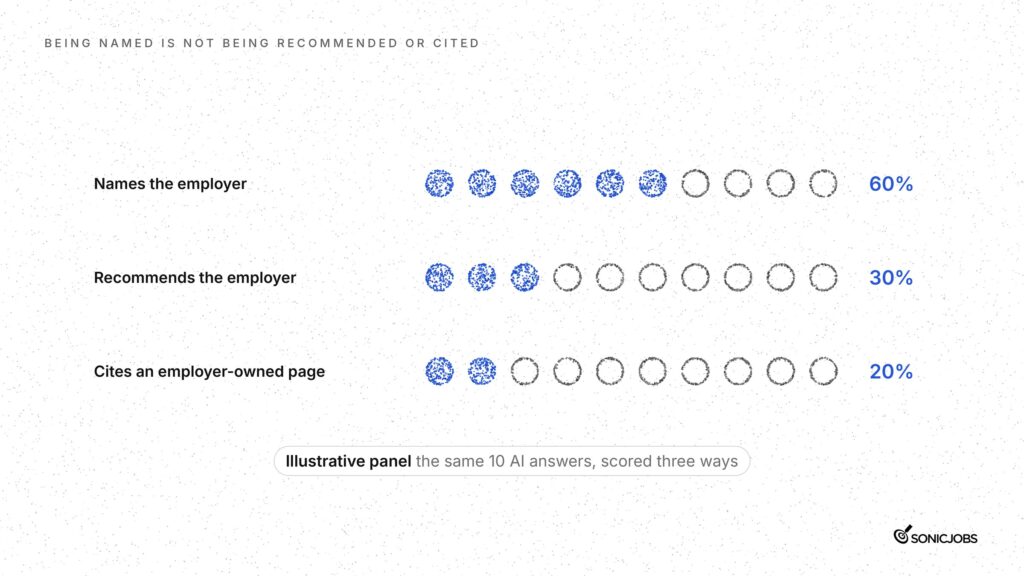
Citation share also needs its own denominator: a domain’s citations divided by all citations. Answer-level citation prevalence instead measures the fraction of answers citing that domain at least once. A 2026 research preprint distinguishes these measures. Label which one you report rather than using “citation rate” for both.
A citation is evidence to inspect, not proof of accuracy. OpenAI warns that search results and citations can be incomplete, outdated or incorrect, and recommends opening cited sources to check whether they support the answer. Keep that evidence check separate from counting links.
Why employer visibility needs its own baseline in 2026
Traffic reporting does not tell you whether an assistant named your employer, recommended it or cited your career site. Google Search Central states that traffic from AI Overviews and AI Mode is included in Search Console’s overall performance reporting under the Web search type. That reporting can complement your baseline, but it does not measure employer share of voice across ChatGPT, Claude and Gemini.
Our Employer GPT Visibility measures that separate question: how an employer appears in those assistants’ answers to candidate questions, compared with the competitors the employer chooses. Repeated checks show whether the employer appears, who appears instead and which sources earn citations. It measures and diagnoses visibility.
A defensible 2026 benchmark starts with a reproducible employer baseline. Record the candidate questions, competitors, assistants and models tested, query counts, repeat runs and collection dates. Define mentions, recommendations, citations and accuracy separately so that being named does not count as being recommended, cited or described correctly. Keep the scoring rules consistent when you repeat the checks.
Use that documented baseline to assess your own results over time. Statistics from unrelated searches cannot establish what good employer visibility looks like.
Common challenges in measuring employer brand visibility
A visibility score needs the answers behind it. To interpret a change, recruitment teams need to know what was tested, under which conditions and how each result was counted.
Measurement problems encountered
Observation conditions. Location, personalization and conversational context can affect what you observe. OpenAI documents that ChatGPT search can use approximate location and saved memories, while personalization can also draw on past chats and custom instructions. Record location, personalization settings and whether each question starts a fresh conversation. Keep those conditions consistent across repeated checks rather than treating every answer as interchangeable.
Citation evidence. A link in a source panel is not necessarily an explicit answer citation. OpenAI says ChatGPT’s Sources control can include both cited sources and other relevant links. Count them separately. Then open cited pages to check whether they support the associated claims. OpenAI warns that search results and citations can be incomplete, outdated or incorrect, so citation presence alone does not establish factual accuracy.
Mismatched denominators. Mention rate, competitive share of voice and citation share answer different questions. Document whether you count answers naming the employer, its share of mentions among selected employers, or its domain’s share of all citations. A 2026 research preprint also distinguishes citation share from citation prevalence, the fraction of responses citing a domain at least once. Label the denominator beside each metric.
Unsupported benchmark comparisons. Before comparing sector results, check that the question panels, employer universes, assistant surfaces and sample dates align. Document differences and avoid presenting unlike samples as directly comparable benchmarks. A sector label alone is not enough to establish comparability.
Our Employer GPT Visibility includes the full answer and a timestamped screen recording for each visibility check. These retained records let teams inspect individual observations behind a score. Documented study controls address comparability; human review checks whether citations support claims and whether employer information is correct.
Tools to measure employer brand share of voice in generative AI
We recommend pairing SonicJobs Employer GPT Visibility with a documented accuracy-review rubric and Google Search Console reporting. Each has a different role: observing employer appearances in assistant answers, checking factual claims and monitoring Google Web search performance. Keep those results separate rather than combining them into one visibility score.
Must-have features for employer visibility measurement
Use this checklist to assess your measurement setup.
- Candidate-relevant monitored prompts: questions tied to the roles, locations and hiring priorities you need to understand.
- Employer comparison: a defined set of competing employers.
- Specified assistant coverage: an explicit list of assistants included in each report.
- Full answers and dated evidence: retained responses and timestamped records for reviewing individual observations.
- Citation inspection: the ability to identify cited sources and check what they support.
- Documented metric denominators: clear counting rules for mentions, recommendations, citations and accuracy, reported separately.
- Repeatable observation conditions: recorded prompts, observation dates and testing conditions so comparisons remain interpretable.
Use Employer GPT Visibility to observe assistant answers. Our platform uses anonymous browser agents to ask candidate questions on ChatGPT, Claude and Gemini. It shows how an employer appears against competing employers, where it ranks and which sources answers cite. Teams can customize monitored prompts and review appearances and changes over time. Each visibility check includes the full answer and a timestamped screen recording.
Those capabilities address prompt selection, employer comparison, named assistant coverage, answer evidence and citation inspection. Anonymous browser checks also establish an observation approach.
Use a written rubric to review accuracy. Check verifiable claims against dated, authoritative evidence and record whether each claim is supported, contradicted or unresolved. Assess citation presence separately from factual accuracy. OpenAI warns that search results and citations can be incomplete, outdated or incorrect, and recommends opening cited sources to check their support. The rubric is a review process, not a separate software product.
Use Google Search Console for complementary search reporting. Google includes traffic from AI Overviews and AI Mode within overall Search Console performance under the Web search type. Use that reporting to monitor Google Web search performance alongside your assistant observations. It does not replace employer share-of-voice measurement across ChatGPT, Claude and Gemini.
How recruitment teams build an employer visibility baseline
We recommend the following workflow to establish a documented baseline before comparing employers or sectors. Keep the questions, testing conditions and scoring rules available alongside the results.
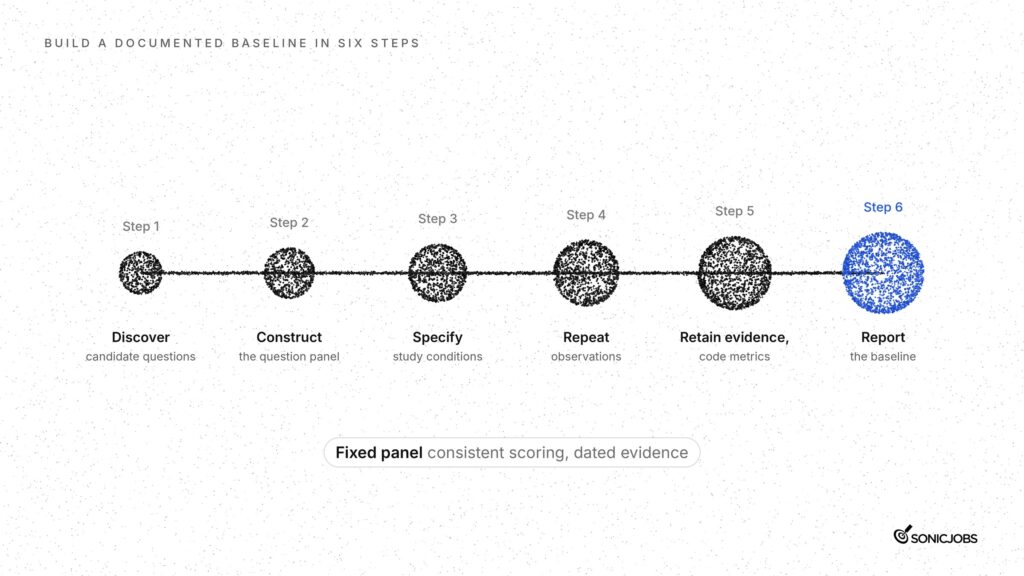
Step 1: Discover candidate questions. Use questions captured by CareerGPT on the employer’s career site as a first-party input. CareerGPT answers only from knowledge sources the employer connects, including its job feed and approved content. External sources are included only when the employer chooses to connect them. Review the captured questions for candidate needs to investigate in public-assistant answers.
Step 2: Construct the question panel. Freeze the exact wording of each question. Separate unbranded employer-discovery prompts from employer-named research prompts so the results do not confuse being discovered with being discussed after a candidate supplies the name. Include questions about roles, locations, benefits, training, progression and working patterns. Keep those intent groups identifiable in the reporting.
Step 3: Specify the study conditions. Fix the employer comparison set and sector inclusion rules. Record languages, locations, assistants, exposed model identifiers, search settings, account state and personalization controls. Where a model identifier is unavailable, say so. These conditions matter: OpenAI documents that ChatGPT search may rewrite questions, use approximate location and incorporate relevant saved memories. Record the conditions you can observe rather than assuming every run is equivalent.
Step 4: Repeat the observations. SonicJobs Employer GPT Visibility uses browser agents to ask candidate questions anonymously on ChatGPT, Claude and Gemini. Repeat observations across dates. Record unique questions, repetitions, attempted runs, valid responses, failures, refusals and retries. Repeated sampling and uncertainty reporting have methodological support from research outside employer branding, but that research does not establish employer-sector benchmarks.
Step 5: Retain evidence and code separate metrics. Preserve each answer and its cited sources. Code a mention when the answer names the employer; an explicit recommendation when it positively recommends the employer for the question asked; and a citation when it references a source, distinguishing employer-owned pages from third-party pages. Assess claim accuracy separately against verified employer information. Document the scoring rules and flag claims that cannot be verified rather than treating a citation as proof of accuracy.
Step 6: Report the baseline. Publish dated, assistant-level results with query counts, valid-response counts, scoring denominators, methodology and uncertainty before presenting any composite. If combining results, state the weights explicitly. Keep discovery and employer-named results separate. Do not treat repeated answers to one question as independent candidate demand: repetitions test answer variability, not how many candidates ask that question.
CareerGPT supplies candidate-question inputs; Employer GPT Visibility observes answers on public assistants. They are separate products with separate roles in this workflow.
Best practices for reading 2026 employer visibility benchmarks
Before using a benchmark, inspect its sample disclosure: observation dates, exact queries, query counts, assistants tested, repeat runs, employer selection and valid-answer rules. Require employer counts and observation counts for each sector. A dashboard example without this information is not a sector benchmark.
Verify each denominator. Keep mentions, recommendations, citations and accuracy separate: an answer can name an employer without recommending it, citing its pages or describing it accurately. Define each scoring rule and the answers or claims eligible for assessment. For citations, distinguish citation share, a domain’s citations divided by all citations, from citation prevalence, the fraction of responses citing that domain at least once. These measure different things.
Report each assistant or surface separately before presenting any composite, and disclose the weights if you combine results. Use “model-level” only when model identifiers are observable. Keep Google AI Mode and AI Overviews separate from each other and from Gemini. Google says its two search surfaces may use different models and techniques, producing different answers and supporting links.
Calculate each employer’s rate first, then summarize those employer-level rates with sector medians and quartiles. Pooling all answers instead would give employers with more observations more influence. Define employer share-of-voice concentration against a fixed employer universe and a stated metric. Keep that separate from citation-source concentration, which concerns the sources receiving citations rather than the employers appearing in answers.
Inspect the source mix across employer-owned pages, job listings, review sites, publishers and other sources. Our Employer GPT Visibility evidence, including the timestamped screen recording and full answer for each check, helps teams inspect individual observations.
Empty reporting template. Enter observation dates when verified observations are available. Leave employer results and sector statistics blank until then.
| Observation dates | Assistant or surface | Observable model ID | Panel and comparison-set version | Employers and valid answers | Metric and denominator | Employer result | Sector median and quartiles | Uncertainty and limitations |
|---|---|---|---|---|---|---|---|---|
Preserve a dated methodology version with every completed table, including changes to prompts, comparison employers, scoring rules and exclusions. We recommend quarterly refreshes, with any methodology changes made visible alongside the results. Repeated observations and uncertainty reporting help readers interpret normal answer variation. A March 2026 preprint supports that approach, but studies consumer-product topics, not employer brands. Do not treat it as employer-sector evidence or attribute a visibility change to content edits without supporting evidence.
What employer visibility measurement helps teams investigate
Separating mentions, recommendations, citations and accuracy gives teams different questions to investigate. SonicJobs Employer GPT Visibility shows where an employer appears, where it is cited and which competitors appear instead. If your employer is absent, inspect which employers the answer names and how they fit the question. If it names you without citing your career site, inspect which sources support the description. Those findings call for different content reviews.
A mention alone does not establish a recommendation. Evaluate whether the answer recommends your employer for the candidate’s stated requirements, rather than inferring a recommendation from positive wording. Each visibility check includes the full answer and a timestamped screen recording, so your team can review the wording and context behind an observation instead of relying only on a summary score.
A citation to your own domain still needs an accuracy check. Open the cited page and confirm that it supports the associated claim, including any conditions or eligibility limits. OpenAI warns that search results and citations can be incomplete, outdated or incorrect. If an answer describes an old benefit or policy, review both the answer and its supporting page to establish what needs correcting. Citation presence and factual accuracy remain separate findings.
Customizable monitored prompts and reviews over time support a documented baseline. Keep a fixed panel of questions when reviewing changes, and interpret the findings within the recorded study conditions. A change after a content update does not, by itself, establish that the update caused it. Answer counts also should not be treated as evidence of candidate demand or hiring performance.
How SonicJobs connects candidate questions with employer visibility checks
A question a candidate asks on a career site can become a question the recruiting team tests on public AI assistants. We sell CareerGPT and Employer GPT Visibility together as one package, but they are separate products with distinct roles.
CareerGPT is our conversational AI career agent for employer career sites. It captures candidate questions and answers from the knowledge sources the employer connects, including approved content and live jobs, with sources cited. External sources are used only when the employer chooses to connect them. Those candidate questions can help teams choose what to monitor beyond their career site.
Employer GPT Visibility uses browser agents to ask candidate questions anonymously on ChatGPT, Claude and Gemini, the way a candidate would. It shows where the employer ranks, how it compares with selected competitors and which sources the answers cite. Each visibility check retains the full answer and a timestamped screen recording, so teams can review the observation behind the score.
Teams can customize monitored prompts around candidate questions and hiring priorities, then review where the employer appeared and what changed over time.
Start with a documented baseline before using sector benchmarks
Before collecting observations, fix your candidate-question panel, employer comparison set and dated evidence protocol. Keep mention rate separate from competitive share of voice. Our Employer GPT Visibility measures employer visibility against chosen competitors on ChatGPT, Claude and Gemini, with timestamped recordings and full answers for review. Numerical sector comparisons must wait for a verified dataset with disclosed methodology. Save a dated methodology version, then run your first panel and retain the evidence as your baseline.
Related reading: AI Search Readiness Checklist for Enterprise TA (2026) · What AI Assistants Tell Candidates About Your Company, and How to Change It (2026) · How Jobs Are Discovered in AI Assistants: 3 Routes
FAQs about measuring employer brand visibility in AI search
What is an employer brand visibility measurement tool?
An employer brand visibility measurement tool observes how an employer appears in AI assistant answers to candidate questions. Our SonicJobs Employer GPT Visibility platform compares employer visibility with chosen competitors on ChatGPT, Claude and Gemini. The questions should reflect the roles, locations and workplace information candidates need. Keep the question panel documented so results describe a defined test rather than visibility everywhere. Review the answers and cited sources alongside summary measures to understand whether the employer appeared and what information supported the response.
Why do recruitment teams need employer visibility measurement?
Recruitment teams need employer visibility measurement to distinguish being named from being recommended, cited or described accurately. Track four separate metrics: mentions record employer presence; recommendations record positive presentation for the question; citations record referenced sources; accuracy records whether factual claims hold up against verified information. Our SonicJobs visibility checks include the full answer and a timestamped screen recording, giving reviewers evidence for each observation. OpenAI warns that search results and citations can be incomplete, outdated or incorrect, so a citation alone does not establish accuracy.
Which tools can measure employer brand share of voice in generative AI?
Use SonicJobs Employer GPT Visibility for employer comparison across ChatGPT, Claude and Gemini, alongside a manual accuracy-review rubric and Google Search Console for complementary traffic context. The rubric should check factual claims against current supporting sources and record unsupported or incorrect details separately from citation presence. Google includes AI Overviews and AI Mode traffic within overall Search Console performance under the Web search type. That reporting provides Google search context; it does not establish cross-assistant employer share of voice. Keep these measurement roles separate when reporting results.
How is mention rate different from competitive share of voice?
Mention rate divides valid answers naming your employer by all valid answers in the test; competitive share of voice divides your employer’s answer-level mentions by all employer-answer mentions across a fixed comparison set. Count each employer once per answer, even if its name appears repeatedly. An answer naming several employers therefore contributes several employer-answer mentions to the competitive denominator. When using SonicJobs Employer GPT Visibility comparisons, document the employer set and valid-answer rules. Report failed checks separately so readers can see what was excluded from the mention-rate denominator.
What makes a 2026 employer visibility benchmark credible?
A credible 2026 employer visibility benchmark requires dated observations and a reproducible methodology. Disclose exact question panels, comparison-set and sector rules, sample sizes, failed-check counts, assistant-level results and observable model identifiers where available. Repeat observations and report uncertainty rather than treating one answer as stable performance. Use a documented employer baseline until such data is available. Citation-sampling research supports repeated measurement and uncertainty reporting, but its consumer-product scope does not establish employer-sector benchmarks.