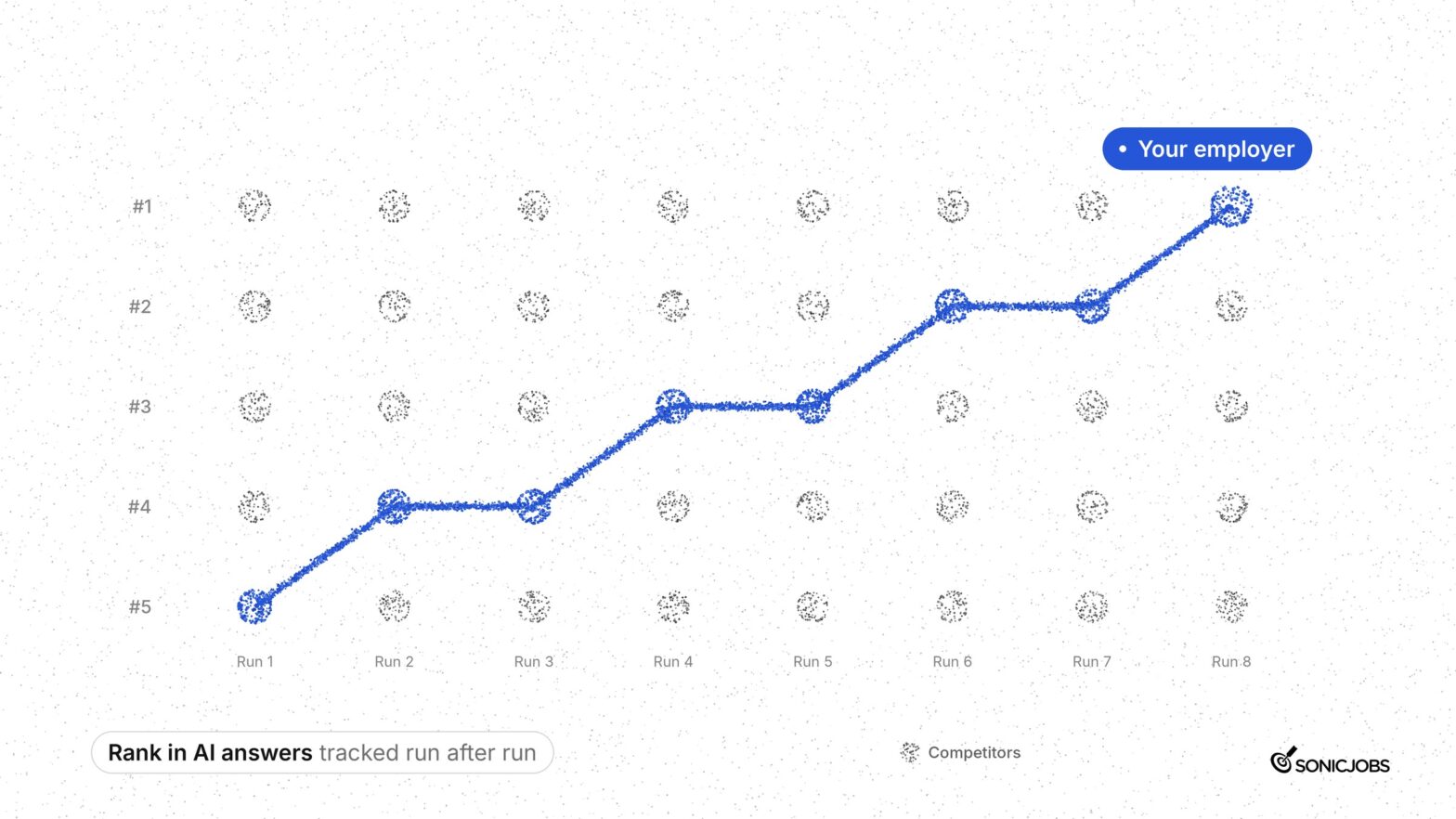
Published November 2, 2026 by SonicJobs
Learn how to measure employer brand visibility in ChatGPT, Claude & Gemini. SonicJobs Employer GPT Visibility tracks where you rank vs. competitors.
How to Track What ChatGPT Says About Your Employer Brand (2026 Playbook)
Candidates are asking ChatGPT, Claude, and Gemini which employers are worth working for. Those assistants are answering. The employer has no native way to see what was said, who else was named, or whether their content was cited. That blind spot is measurable and addressable.
This guide delivers a repeatable methodology for employer brand visibility tracking across AI assistants: how to build a prompt panel, what to measure, how to compute share of voice and sentiment, and how to act on the data. SonicJobs builds two products for this problem: CareerGPT, a conversational AI career agent for employer career sites, and Employer GPT Visibility, which tracks how employers appear on ChatGPT, Claude, and Gemini when candidates search. The measurement approach covered here centers on Employer GPT Visibility.
The scale justifies the attention. Sam Altman reported at OpenAI DevDay on 29 September 2026 that ChatGPT had reached 1.2 billion weekly active users, processing more than 2.5 billion messages per day. A portion of those conversations involve candidates evaluating employers. The defaults forming now will be harder to change later.
What Is Employer Brand Visibility Tracking in ChatGPT?
Employer brand visibility tracking measures how often and how favorably an employer appears when candidates ask ChatGPT, Claude, or Gemini questions about where to work, which companies hire for specific roles, or what it is like to work at a particular organization.
ChatGPT forms its employer-brand answers at query time by retrieving and blending content from careers and culture pages, review and comparison sites, recent news coverage, LinkedIn posts from employees, and forum threads. There is no fixed employer page to edit inside the platform, and no dashboard employers can log in to and check. An employer searching for itself gets a personalized answer shaped by what the assistant already knows about who is asking.
That is the gap SonicJobs Employer GPT Visibility is built to address. Browser agents ask candidate questions on ChatGPT, Claude, and Gemini anonymously, the way a real candidate would, so the results are not shaped by who is asking. The tool then measures three things for each query: whether the employer is mentioned at all, whether it is presented as a recommendation, and how prominently it appears relative to competitors the employer names.
Two distinctions matter here. First, SonicJobs Employer GPT Visibility covers all three major AI assistants, not one platform in isolation, because candidates use whichever assistant they prefer. Second, the tool measures and diagnoses. It shows where the employer appears, where it does not, which sources the AI cites, and what competitors’ content is winning those citations. It does not by itself change how AI assistants answer. Visibility improves when the employer publishes content that fills the gaps the tool reveals.
Why Employer Brand Visibility in ChatGPT Matters in 2026
ChatGPT reached 1.2 billion weekly active users as of September 2026, according to Sam Altman at OpenAI DevDay, and now processes more than 2.5 billion messages per day. That volume is not all job search activity, but a meaningful share of it is. A 2025 Hunter Research report cited by Coursera found that 93% of job seekers already use ChatGPT or other AI tools when looking for work. A separate 2025 iHire survey of 1,645 U.S. workers found that 40.7% had used AI specifically to research potential employers.
Those candidates are not browsing passively. They are asking detailed questions about companies and forming opinions before they ever visit a career site. Whether an employer appears in those answers, how it is described, and which sources back the description are all factors that now sit outside the employer’s direct view.
The citation picture is also changing fast. Similarweb data cited by Cognizo shows that citation behavior inside ChatGPT answers rose from roughly 1.6% of responses in June 2025 to 6.8% by May 2026. That means AI assistants are increasingly naming their sources. When a competitor’s content earns that citation, the employer may be mentioned in the same answer but another site gets the link and the candidate’s click.
None of this is fixed. ChatGPT responses shift as new content is published, fresh reviews arrive, and model updates change how answers are composed. A single check today tells an employer what one engine said on one day to one anonymous user. It says nothing about what Claude said, what Gemini said, or what the same engine will say next month after a content or model change.
That is the measurement problem Employer GPT Visibility is built to address. It runs queries repeatedly across ChatGPT, Claude, and Gemini and records what each engine says, which sources it cites, and how the employer’s position compares with the competitors it names. The result is a data series, not a snapshot.
Common Challenges in Tracking Employer Brand Visibility, and How Dedicated Platforms Solve Them
Tracking how ChatGPT, Claude, or Gemini describes your organization sounds straightforward until you try it. Five structural problems make manual spot-checks and general-purpose social monitoring tools unreliable for this specific task. Each one is documented and measurable.
Key Challenges Recruiting Teams Face
Personalization bias. When an employer logs into ChatGPT and asks “Which hospitals in our region hire new grad nurses?”, the assistant knows who is asking. The answer it returns reflects account history and context, not what a candidate with no prior relationship to the brand actually sees. This means every manual check an employer runs is, by definition, unrepresentative.
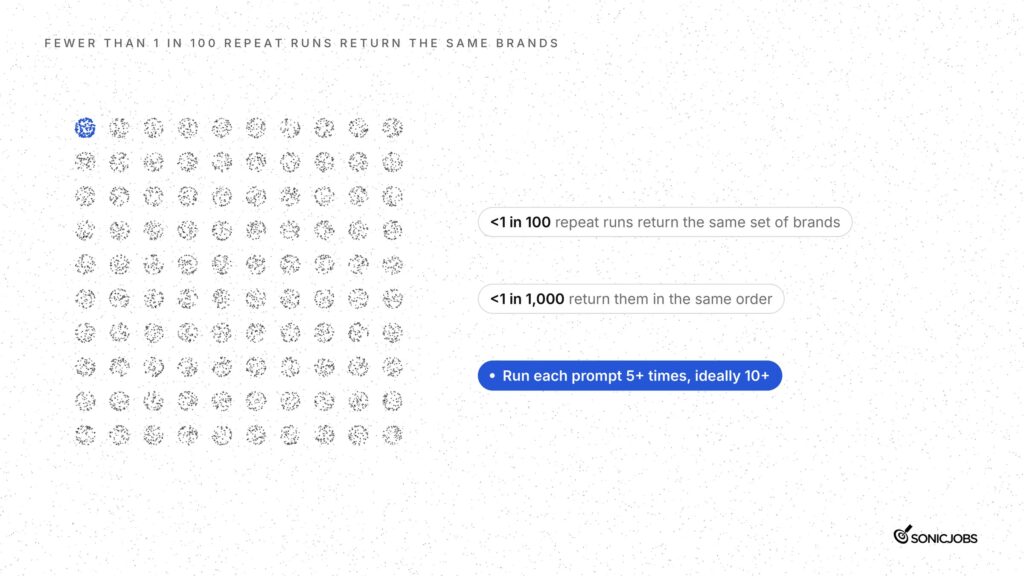
Non-determinism. LLMs do not produce the same answer twice. Research on LLM brand auditing found that fewer than 1 in 100 repeat runs produce the same set of brands, and fewer than 1 in 1,000 produce the same brands in the same order. A single query observation is not a measurement; it is one draw from a wide distribution. Academic research (arxiv 2609.04047, arxiv 2604.07585) confirms that repeated-run designs, at minimum 5 runs per prompt and ideally 10 or more, are required before brand mention probability estimates carry any weight.
API versus consumer-interface divergence. Some monitoring approaches query an AI model through its API rather than the consumer interface candidates actually use. A June 2026 study comparing API responses with consumer-interface responses across ChatGPT, Gemini, and Perplexity found that the brand-set overlap between the two channels ranged from only 6% to 12%. A tool reading the API is largely measuring a different conversation than the one a candidate has.
Citation volatility. The sources AI assistants cite are not stable. In active categories, 40% to 60% of cited domains shift monthly. Week-to-week citation shifts of 56% to 74% have been documented. A baseline built from one measurement cycle will be outdated before it is acted on. A brand’s AI score can also move for at least four distinct reasons: within-prompt resampling, prompt paraphrase, model identity, and knowledge update following a model retraining or retrieval index refresh.
No employer-side data from the AI assistants themselves. ChatGPT, Claude, and Gemini share no search data with employers. There is no Search Console equivalent. An employer has no visibility into how often their name appears in candidate conversations unless they run the queries themselves, systematically and at scale.
How SonicJobs Employer GPT Visibility Addresses These Challenges
Employer GPT Visibility was built specifically around these measurement problems.
Anonymous browser agents ask each candidate question on ChatGPT, Claude, and Gemini the way a real candidate would, with no account history or employer identity attached. This removes personalization bias from every run.
Queries run repeatedly over time, so employers see trends rather than a single draw. Because an employer may be cited one day and absent the next due to LLM non-determinism, repeated measurement is the only way to build a reliable appearance-frequency estimate.
The platform queries the consumer interfaces candidates actually use, not API endpoints, so the measurement reflects the conversation that matters for hiring.
For each query run, Employer GPT Visibility provides a screenshot and a video of the agent asking the question and receiving the answer. Every measurement cycle has auditable evidence, which matters when reporting visibility trends to leadership or to a recruitment marketing client.
What to Look for in an Employer Brand Visibility Monitoring Platform
Most employer brand tools were built for a world where search meant Google. Tracking visibility in ChatGPT, Claude, and Gemini requires a different set of capabilities. The features below describe what those differences look like in practice, and the problems each one solves.
Must-Have Features for AI Employer Brand Tracking
Anonymous query execution. When you search for your own employer on ChatGPT from a logged-in account, the assistant already knows who you are. The answer it returns may reflect your search history or account context, which means it does not represent what a candidate sees. A reliable platform must ask each question the way a candidate would, with no account history attached. SonicJobs Employer GPT Visibility uses browser agents that do exactly this, running each query anonymously on ChatGPT, Claude, and Gemini so results reflect the candidate-facing answer rather than a personalized one.
Multi-platform coverage. Citation and mention rates are not consistent across AI assistants. Research analyzing over 2.4 million AI responses found that some platforms include external links in more than 77% of responses, while others do so in roughly 31%. An employer can appear prominently in Gemini answers and be absent from ChatGPT on the same query. Tracking one platform and inferring results on the others produces an incomplete picture. Coverage across ChatGPT, Claude, and Gemini is a baseline requirement, not a premium add-on.
Repeated-run design. AI assistants do not give the same answer every time. An employer may be cited in one run of a query and absent in the next. Academic research on LLM brand auditing confirms that single-query observations are misleading: at minimum five runs per prompt are needed to produce a reliable brand mention probability estimate, and ten or more runs are preferable. A platform that delivers a single snapshot per query cannot tell you whether a result is typical or an outlier.
Per-run evidence capture. Knowing that your mention rate dropped is only useful if you can see what actually changed. Screenshot and video capture for every query run creates an auditable record that lets teams investigate specific answers, compare runs over time, and demonstrate findings to stakeholders. SonicJobs Employer GPT Visibility provides both a screenshot and a video recording for each run.
Competitive side-by-side scoring. Your visibility score only has meaning relative to employers competing for the same candidates. The platform should identify which competitors appear in the same answers, how they rank, and which sources the AI cites for them. Critically, it should surface content gaps: what a competitor’s cited page covers that your career site does not. Knowing a competitor has a page about paid training with no experience required, and that it is being cited in answers about entry-level roles in your sector, tells you exactly what content to build next.
Self-service query management. Hiring priorities change. A role that becomes hard to fill in a new location this quarter was not a priority last quarter. If adding a query to your tracking panel requires a ticket to the vendor and a multi-day turnaround, the tool cannot keep pace with your recruitment marketing cycle. Teams need to add prompts themselves, as soon as a pattern emerges or a new priority is identified.
Comprehensive visibility score components. A single aggregate score can obscure what is actually happening. Mention rate (how often an answer names the employer), recommendation tone (whether that mention is positive for the question being asked), prominence (how near the top the employer appears and how much of the answer is about them), citation rate, and appearance rate can all move independently. A platform should track each separately so teams know whether a score change reflects more mentions, better placement, or a shift in how the assistant characterizes the employer.
SonicJobs Employer GPT Visibility is built specifically for employer brand monitoring rather than adapted from a general web-visibility or SEO tool. Its query panel draws from two sources: trends in what candidates are already asking through CareerGPT on an employer’s own career site, and the employer’s stated hiring priorities such as a hard-to-fill role or a location where candidate volume is low. That connection means the questions being tracked on ChatGPT, Claude, and Gemini reflect real candidate intent, not generic search terms assembled by a third party.
How Talent Acquisition Teams Use SonicJobs Employer GPT Visibility to Track and Improve AI Brand Presence
Talent acquisition and employer brand teams use Employer GPT Visibility in six repeatable ways. Each pattern produces something specific: a list of prompts to run, a set of content gaps to close, or a trend line to watch over time.
Strategy 1: Build the prompt panel from CareerGPT conversation trends.
Queries for Employer GPT Visibility come from what candidates are already asking on CareerGPT, the separate SonicJobs career-site product that records actual candidate conversations. If many candidates are asking about parental leave on the career site, that question becomes a prompt to run on ChatGPT, Claude and Gemini. The team does not have to guess which topics matter; the conversation data shows them. Employer GPT Visibility is self-service, so new prompts can be added any time hiring priorities shift.
Strategy 2: Run competitive comparison queries.
For each query the platform runs, it records which competitors appear, what rank they hold, and which sources the answer cites. A talent team can see, for a specific question like “Which hospitals near Philadelphia have the best new grad nurse residencies?”, exactly who is named before them and how prominently.
Strategy 3: Identify citation source gaps.
Employer GPT Visibility shows what competitors’ cited content covers that the employer’s does not. A common finding: a competitor has a dedicated page about paid training with no experience required, and that page is what ChatGPT cites. The employer appears in the answer but does not earn the citation or the click.
Strategy 4: Track visibility over time, not just on a given day.
Because AI assistants are non-deterministic, an employer may be cited on one run and absent on the next. Repeated runs are what separate a meaningful trend from a single result. Teams can see whether a visibility score is improving after publishing new content, declining as competitors add pages, or fluctuating without a clear pattern.
Strategy 5: Convert content gaps into a ranked publishing list.
Across SonicJobs CareerGPT clients, 30% to 35% of candidate questions had no clear answer in the employer’s own career site content. That gap transfers directly to Employer GPT Visibility: if the content does not exist on the career site, ChatGPT, Claude and Gemini cannot cite it. The visibility data turns a vague directive to “create more content” into a specific list ordered by query frequency and competitive pressure.
Strategy 6: Add prompts tied to hard-to-fill roles and specific geographies.
Not all hiring challenges are general. A team struggling to hire in a particular city, or for a role that rarely attracts applicants, can build prompts around those specifics and track them separately from the broader panel. Appearance rate, citation rate and rank are recorded per query, so each difficult role gets its own picture.
The CareerGPT connection in practice.
Johns Hopkins Medicine is a SonicJobs CareerGPT customer. For an employer like that, CareerGPT surfaces what candidates ask and where the career site leaves questions unanswered. Employer GPT Visibility then tests those same questions on public AI assistants to show how the employer appears to a candidate who never visits the career site at all. The two products are sold together as a package, but each does a distinct job: CareerGPT handles candidate conversations on the employer’s own site; Employer GPT Visibility handles measurement on ChatGPT, Claude and Gemini.
What separates this workflow from general-purpose monitoring is that the queries are grounded in actual candidate behavior rather than assembled from keyword research or executive intuition. Browser agents ask each question anonymously, the way a candidate would, so the results are not shaped by the employer’s own browsing history or account. The output for each run is a screenshot and a video recording of the agent receiving the answer, which gives teams evidence they can share with content and recruitment marketing colleagues rather than a summary metric they have to explain from memory.
Best Practices and Expert Tips for Tracking Employer Brand Visibility in AI Assistants
Tracking employer brand visibility in ChatGPT, Claude, and Gemini is a measurement problem first. The tips below are operational decisions, each with a documented reason behind it.
Tip 1: Build a prompt panel covering all six candidate intent types
Candidate prompts cluster into six categories that matter for employer brand auditing: culture and day-to-day questions, compensation and benefits questions, career growth questions, comparison prompts (versus named competitors), problem-phrased questions (for example, flexible schedules), and recommendation prompts (best employer for a role or location). A panel that covers all six gives you a complete picture of where you appear and where you do not. One additional rule: exclude branded queries (name-only searches) from your share-of-voice calculation. Branded queries inflate your numbers without telling you whether candidates who do not already know you will find you.
Tip 2: Run each prompt at minimum 5 times, ideally 10 or more, per measurement cycle
Single-query observations are statistically unreliable. Academic research on LLM brand auditing (arxiv 2609.04047 and arxiv 2604.07585) confirms that repeated-run designs are required for reliable brand mention probability estimates. One industry measurement report found that only 2.2% of cited sources were identical across three repeated runs of the same prompt, with week-to-week citation shifts ranging from 56% to 74%. A stable position estimate requires roughly 10 runs for even a quick read. If your tracking program fires one query per prompt per week and calls that a data point, it is measuring noise.
Tip 3: Log every run with a consistent documentation structure
For each run, record: the exact prompt text, the AI platform (ChatGPT, Claude, Gemini), the date tested, the geography and language, whether the brand was mentioned (yes or no), the mention context (direct recommendation, alternative, or negative), competing brands mentioned in the same answer, citation URLs, and any notes on factual accuracy. This structure makes it possible to spot patterns across platforms and over time, and to distinguish a one-off anomaly from a persistent gap. Without consistent logging, each run exists in isolation.
Tip 4: Track continuously, not by spot check
A positioning error or a new competitor mention can enter AI responses and stay there long enough to shape a full hiring cycle’s worth of candidate impressions before anyone notices. Monthly spot checks will not catch that. The measurement program needs to run on a cadence that lets you detect a shift, investigate the cause, and respond with a content change before the damage accumulates.
Tip 5: Establish three baseline metrics before you try to optimize anything
Before any content action, capture three numbers: mention frequency (how often your brand appears across your fixed prompt panel, run on a regular cadence), share of voice (your brand’s mentions as a percentage of all brand mentions in that category), and sentiment and accuracy (whether mentions are positive and factually correct). These three baselines are what let you measure whether a content change had any effect. Optimizing without them is adjusting settings without a dial.
Tip 6: Use position-weighted share of voice, not raw mention counts
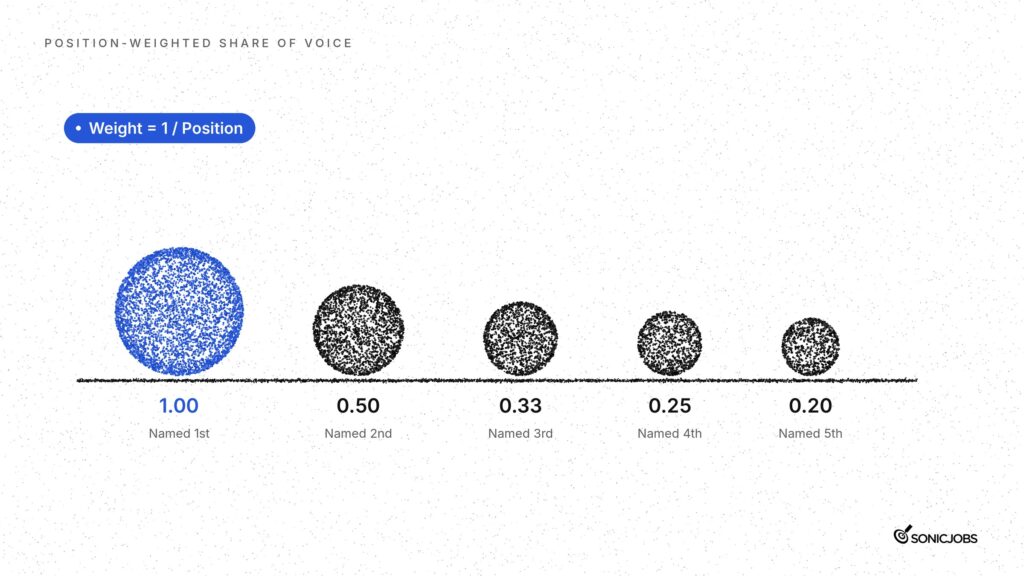
Where you appear in an answer is not the same as whether you appear. Position-weighted share of voice applies the formula Weight = 1/Position to each mention, so a brand named first in an answer carries more weight than one listed fifth. Raw mention counts treat both appearances equally. For employer brand decisions, prominence matters: a candidate reading a long AI response will engage most with whatever appears at the top.
How Employer GPT Visibility operationalizes these practices
Employer GPT Visibility runs each query repeatedly over time, so employers see performance trends rather than a single snapshot. An employer may be cited one day and absent the next, because LLM outputs are non-deterministic by design. For each run, the platform provides a screenshot and a video of the agent asking the question and receiving the answer, creating auditable evidence for every measurement cycle. The same documentation that best-practice trackers build manually is produced automatically, run by run, across ChatGPT, Claude, and Gemini.
Advantages of Dedicated AI Employer Brand Visibility Tracking
Running a structured tracking program on ChatGPT, Claude and Gemini produces specific, usable outcomes. Each one below reflects what teams gain once they have reliable, repeatable data rather than occasional manual checks.
Competitive intelligence. Employer GPT Visibility records, for each query, which competitors appear alongside you, which sources their answers cite and where they rank relative to your employer. It also surfaces what competitors’ cited content covers that your own does not: a page about paid training with no experience required, for instance, or a benefits overview that maps directly to a candidate question you are losing. That gap is now visible and actionable.
Content gap identification. Across SonicJobs CareerGPT clients, 30% to 35% of candidate questions had no clear answer in the employer’s own career site content. Tracking maps those gaps to specific queries, so content teams know exactly which pages to write rather than guessing at what AI assistants might want to cite.
Early error detection. A positioning error in an AI answer, or a new competitor appearing in a query where you previously ranked first, can quietly shape candidate impressions across an entire hiring cycle before anyone notices. Continuous tracking catches it early, when a single piece of content can still correct the record.
Auditable evidence. For each query run, Employer GPT Visibility captures a screenshot and a video of the agent asking the question and receiving the answer. That record is shareable with leadership and provides a reliable before-and-after comparison when new content is published.
Scalable self-service. The employer’s team can add new queries as hiring priorities shift without waiting on vendor support. A pattern spotted in CareerGPT conversations, such as repeated questions about parental leave, can become a tracked query on the same day. The program scales with the employer’s hiring agenda, not on a vendor’s release schedule.
Trend data over time. A single query run tells you where you stand today. Repeated runs show whether your visibility score, which combines mention rate, recommendation and prominence, is improving or declining and which specific queries are driving the change. That longitudinal record is what turns measurement into a content optimization cycle rather than a one-time audit.
How SonicJobs Employer GPT Visibility Simplifies Employer Brand Monitoring in ChatGPT
SonicJobs Employer GPT Visibility is built around one specific design choice: anonymous browser agents ask candidate questions on ChatGPT, Claude, and Gemini the way a real candidate would, without any account history or personalization shaping the result. That matters because an employer checking its own name inside a signed-in session gets a different answer than a candidate in an unknown location using a fresh session. The anonymous agent removes that distortion and returns a result closer to what a candidate actually sees.
CareerGPT and Employer GPT Visibility are two separate SonicJobs products sold as one package. CareerGPT is the conversational AI career agent on the employer’s own career site. Employer GPT Visibility operates off the career site entirely, measuring how the employer appears when candidates ask questions on public AI assistants. One is not a feature of the other.
The Visibility Score
Every employer gets an overall visibility score built from three components:
- Mention: how often answers on ChatGPT, Claude, and Gemini name the employer when the relevant question is asked.
- Recommendation: whether the answer presents the employer positively for that question, not just references them in passing.
- Prominence: how near the top of the answer the employer appears and how much of the response is actually about them.
These three measures together reflect something closer to candidate experience than a raw citation count does. An employer named once in a list of twelve, without any detail, scores differently from one placed second with two sentences of positive context.
Per-Query Output
For each query in the panel, the platform records:
- Appearance rate across repeated runs
- Citation rate (whether a source pointing to the employer is included)
- Employer rank relative to other named organizations
- Which competitors appear in the same answer
- Which sources the AI assistant cited and what those sources cover
This per-query view shows exactly where gaps sit. A query where the employer appears but earns no citation points to a content problem: the AI assistant knows the name but is drawing its supporting detail from someone else’s page.
Per-Run Evidence
For every run, Employer GPT Visibility captures a screenshot and a video of the agent asking the question and receiving the answer. This creates an auditable record at each measurement cycle, which matters when results shift. An employer that appears in an answer on Monday and disappears on Friday has evidence of both states, not just an aggregated metric that obscures the change.
Query Sourcing and the Self-Service Model
Queries come from two places. The first is trends in what candidates ask on CareerGPT: if many candidates are asking about parental leave on a career site, that question is a candidate for the tracking panel on ChatGPT, Claude, and Gemini. The second is the employer’s own hiring priorities, such as a hard-to-fill role or a location where the employer struggles to attract applicants.
The platform is self-service. The employer’s team adds new queries, adjusts the competitor set, and re-runs tests as priorities change, without waiting on a managed service cycle. SonicJobs recommends starting with ten prompts and five competitors, a scope that is specific enough to reveal meaningful gaps without requiring weeks of setup.
The positioning is direct: measure where you stand, understand the questions, become the default answer. Employer GPT Visibility provides the first two. The third comes from publishing content that fills the gaps the measurement reveals.
Key Takeaways and Getting Started with Employer Brand Visibility Tracking
Candidates now ask ChatGPT, Claude, and Gemini specific questions about employers before they apply. Those answers shape decisions, and employers have no built-in way to see them. A personalized account check returns a result shaped by history. A one-off manual search gives a snapshot that may not hold tomorrow. Neither is a measurement program.
What a sound tracking program requires is straightforward: a defined prompt set built around real candidate questions and hiring priorities, anonymous query execution across ChatGPT, Claude, and Gemini, repeated runs over time, and documented evidence for each run. Those four conditions separate measurement from guesswork.
SonicJobs Employer GPT Visibility was built specifically for this workflow. Anonymous browser agents ask each question the way a candidate would, on each platform, so results are not shaped by personalization or account history. Queries run repeatedly so employers see change over time rather than a single data point. For each run, the employer sees appearance rate, citation rate, competitor rankings, and the sources driving those citations, alongside a screenshot and video as evidence.
The starting point is practical: ten prompts drawn from your hiring priorities and candidate questions, benchmarked against five named competitors. From that baseline, you have a share-of-voice figure, a citation gap, and a list of content to build.
To begin, visit sonicjobs.com to book a demo or talk to the team about setting up your first prompt panel.
FAQs About Tracking Employer Brand Visibility in ChatGPT, Claude, and Gemini
What is employer brand visibility tracking in ChatGPT and why does it matter for recruiting teams?
Employer brand visibility tracking means measuring how often, how prominently, and how accurately an employer appears in AI assistant answers when candidates ask hiring-related questions. It matters now because ChatGPT reached 1.2 billion weekly active users as of September 2026 (Sam Altman, OpenAI DevDay, 29 September 2026) and processes more than 2.5 billion messages per day. A separate 2025 Hunter Research report cited by Coursera found 93% of job seekers already use ChatGPT or other AI tools during job searches. Employers with no visibility measurement have no signal about whether they appear in any of those conversations.
How does SonicJobs Employer GPT Visibility measure where an employer appears in ChatGPT, Claude, and Gemini?
Employer GPT Visibility uses anonymous browser agents that submit each candidate question to ChatGPT, Claude, and Gemini the way a candidate would, without any account history or personalization shaping the result. Queries run repeatedly across all three platforms, so employers see performance trends rather than a single snapshot. For each run, the platform captures a screenshot and a video of the agent asking the question and receiving the answer, creating auditable evidence for every measurement cycle. Results include appearance rate, citation rate, employer rank, competitor appearances, and the sources each answer cited.
What is a candidate-intent prompt panel and how do I build one for employer brand measurement?
A candidate-intent prompt panel is a fixed set of questions, written the way candidates actually phrase them, that runs on a defined schedule to track employer visibility across AI assistants. Prompts cluster into six intent types: culture and day-to-day questions, compensation and benefits questions, career growth questions, comparison prompts against named competitors, problem-phrased questions (such as flexible schedule queries), and recommendation prompts asking for the best employer for a role or location. In SonicJobs Employer GPT Visibility, the panel is self-service. Trends from CareerGPT conversations can feed directly into query selection as candidate language evolves.
How is employer brand share of voice in AI assistants calculated?
There are three distinct calculations commonly called AI share of voice, and they are not interchangeable. Answer share divides answers that mention your brand by all eligible answers tracked. Competitive mention share divides your brand’s mentions by all monitored brand mentions across the same prompt set. The standard formula is: (your brand mentions across tracked prompts / total brand mentions across the same prompts) x 100. Position-weighted share adjusts for ranking using the formula Weight = 1/Position, so a brand named first carries more weight than one listed fifth. Exclude branded name-only queries from all three calculations to avoid inflating results.
How often should I re-run my employer brand prompt panel to get reliable data?
Run each prompt a minimum of 5 times per measurement cycle, with 10 or more runs preferred. Academic research on LLM brand auditing (arxiv 2609.04047 and arxiv 2604.07585) confirms that single-query observations are misleading, and repeated-run designs are required for reliable brand mention probability estimates. The reason is non-determinism: fewer than 1 in 100 repeat runs on the same prompt produce the same set of brands in an answer, and fewer than 1 in 1,000 produce the same brands in the same order. Appearance frequency across many runs is the signal; any individual run is noise.
What is the difference between mention rate, share of voice, citation rate, and sentiment in AI visibility tracking?
These four metrics each measure something different. Mention rate is how often answers name the employer across a fixed set of category prompts, typically tracked weekly. Share of voice is the employer’s percentage of all brand mentions in the same prompt set. Citation rate is how often the employer’s own content (or a page citing them) appears as a named source in the answer. Sentiment and accuracy capture whether mentions are positive and factually correct. Three baseline figures to capture before making any content changes are mention frequency, share of voice, and sentiment, each measured separately.
Why does the same prompt return different employer answers each time I ask ChatGPT?
Large language models are non-deterministic by design. Research on LLM brand auditing (arxiv 2609.04047) found fewer than 1 in 100 repeat runs produce the same set of brands, and fewer than 1 in 1,000 produce the same brands in the same order. This means a single manual check of ChatGPT tells an employer almost nothing reliable about their visibility. Stable rank measurement is not possible from one or two queries. What is measurable is appearance frequency across many runs of the same prompt, which is why SonicJobs Employer GPT Visibility runs queries repeatedly and reports rates rather than positions.
What types of candidate prompts should be included in an employer brand monitoring panel?
A repeatable panel should cover four prompt structures: category prompts (“which employers are best for X role in Y city”), comparison prompts (“how does Employer A compare with Employer B for nurses?”), use-case prompts (“which hospitals near Philadelphia have the best new grad nurse residencies?”), and problem-phrased prompts (“does this company support flexible schedules?”). Each type surfaces different visibility gaps. Branded name-only searches, where someone types only the employer’s name, should be excluded from share-of-voice calculations because they skew results and do not reflect how unaware candidates discover employers through AI assistants.
How do third-party job sites affect an employer’s citation share in AI assistant answers?
Third-party job sites publish content built around specific candidate questions, and AI assistants cite that content when it closely matches a query. The result is that an employer’s name may appear in an answer while a third-party page, not the employer’s own career site, earns the citation and the candidate’s click. The employer appears but does not own the interaction. SonicJobs Employer GPT Visibility records which sources each answer cites alongside employer mentions, so recruiting teams can identify where third-party content is winning citations and determine what to publish on their own career site to compete for those references.
Can candidates’ AI searches be tracked by employers through ChatGPT, Claude, or Gemini directly?
No. ChatGPT, Claude, and Gemini share no search data with employers. Unlike Google, which gives employers keyword volumes and click data through Search Console, AI assistants provide nothing equivalent. An employer who checks manually also receives a personalized answer shaped by their own account history, so the result does not reflect what a candidate sees. SonicJobs Employer GPT Visibility is designed to work around this gap: anonymous browser agents ask candidate questions without account context, and repeated runs across all three platforms produce the appearance-frequency data that direct access to AI search logs would otherwise provide.
What is the difference between CareerGPT and Employer GPT Visibility, and how do they work together?
CareerGPT and Employer GPT Visibility are two separate SonicJobs products sold together as one package. CareerGPT is a conversational AI career agent that sits on an employer’s own career site, helping candidates find roles and get answers through a conversation, and showing employers where their career site content leaves questions unanswered. Employer GPT Visibility works off the career site: it measures how the employer appears on ChatGPT, Claude, and Gemini when candidates ask hiring questions, and which sources those answers cite. CareerGPT surfaces content gaps; Employer GPT Visibility tests whether filling those gaps changes the employer’s visibility on public AI assistants.