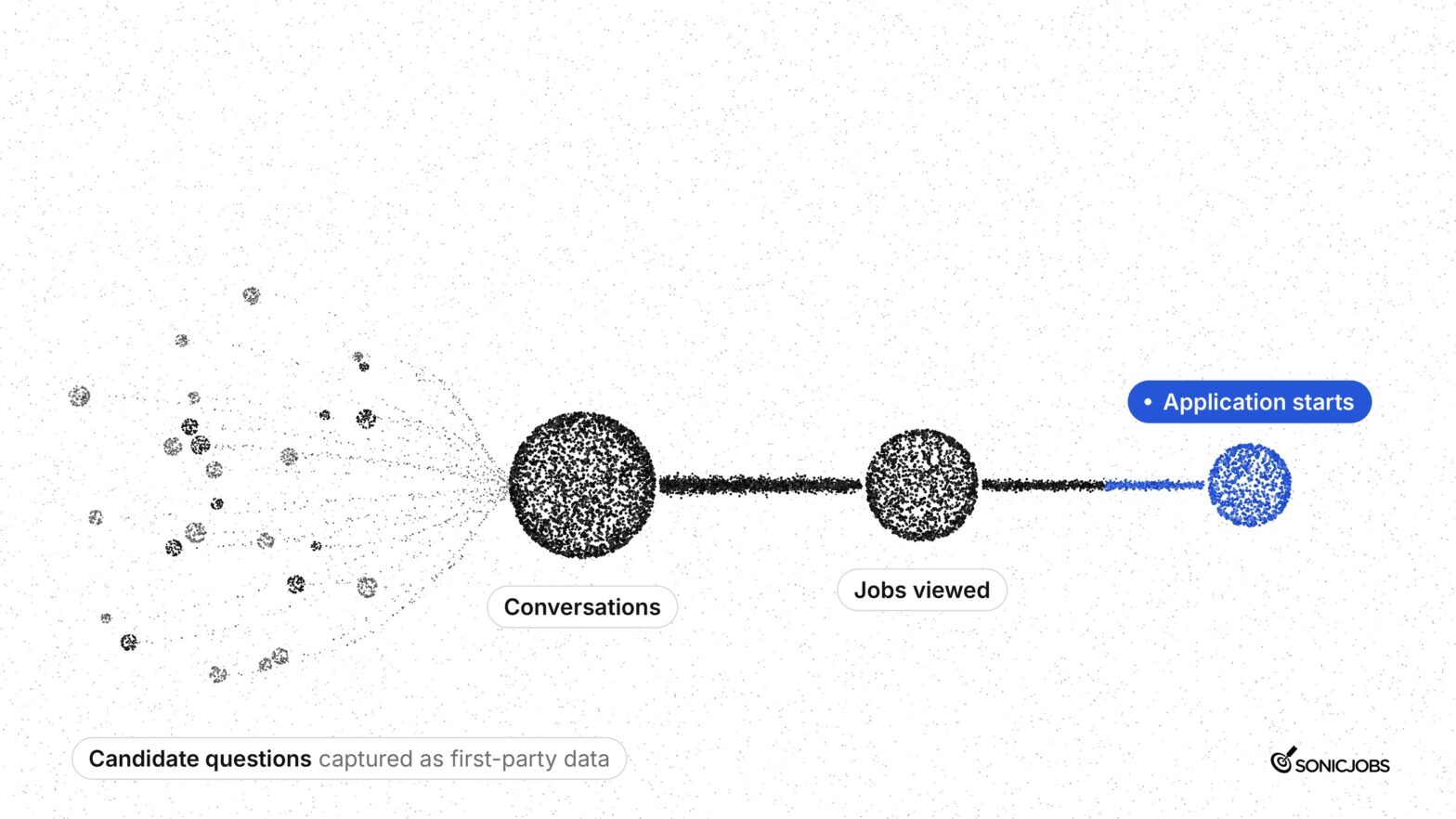
Learn how to measure conversational career-site search from candidate questions to application starts. SonicJobs CareerGPT captures first-party intent data.
Introduction
A candidate arrives at your career site having already decided they want to work for you. They scroll, search, and leave. You paid to get them there. You have no record of why they did not apply.
This is not a conversion problem in the abstract. It is a measurement problem first. Most employers track submitted applications in their applicant tracking system (ATS), and that is where measurement stops. The career site records a different event: the apply click, the moment a candidate taps the button and transfers to the application form. Between those two points sits another event, the application start, when the candidate opens the form but has not yet submitted. These three events are distinct, they live in different systems, and most employers do not measure all three.
Before any of those events, the candidate is asking questions. Which roles are remote? What does the benefits package cover? What do employees say about working there? That pre-application layer of activity is invisible to most employers because keyword search returns no data about what candidates actually wanted to know.
CareerGPT, SonicJobs’ conversational AI career agent for employer career sites, records candidate questions, jobs viewed, and application starts in the conversation itself. That data sits between the career site and the ATS, in a layer that has not been measured before.
This guide defines each event in the funnel, explains where the data lives, and outlines a practical measurement plan. SonicJobs CareerGPT and Employer GPT Visibility provide the enabling layer, but the measurement principles apply to any employer trying to understand where high-intent candidates stop.
What Is Conversational Career-Site Search?
Conversational career-site search lets candidates describe what they are looking for in their own words, ask questions about the company, and explore individual roles through a back-and-forth conversation, rather than typing a job title and location into a keyword search box.
Traditional keyword search fails a significant share of candidates. On some employer career sites, searches for “remote jobs,” “new grad nurse,” or “no weekend shifts” each return zero results. The candidate has a clear need but not the exact job title the search engine expects. CareerGPT, SonicJobs’ conversational AI career agent, handles the same queries differently: it returns matching roles and, for “new grad nurse,” also understands that RN residency and registered nurse roles are relevant.
CareerGPT answers only from the knowledge sources the employer connects: the career site, the live job feed, and uploaded documents such as PDFs. Employers can also choose to connect approved external sources, including LinkedIn, Glassdoor, Reddit, and the employer’s YouTube and social media pages. It does not draw on any outside data the employer has not approved.
Deployment requires no career site rebuild and no applicant tracking system (ATS) migration. CareerGPT sits on the existing career site as a floating widget or embedded in the search bar. Adding the script takes minutes; the agent can go live in days once the job feed, content, and approvals are in place.
Candidate conversations are not shared with ChatGPT, Claude, or any other AI lab, and they are not used to train AI models. The conversation stays within the knowledge the employer has connected.
Why Measuring Conversational Search Matters in 2026
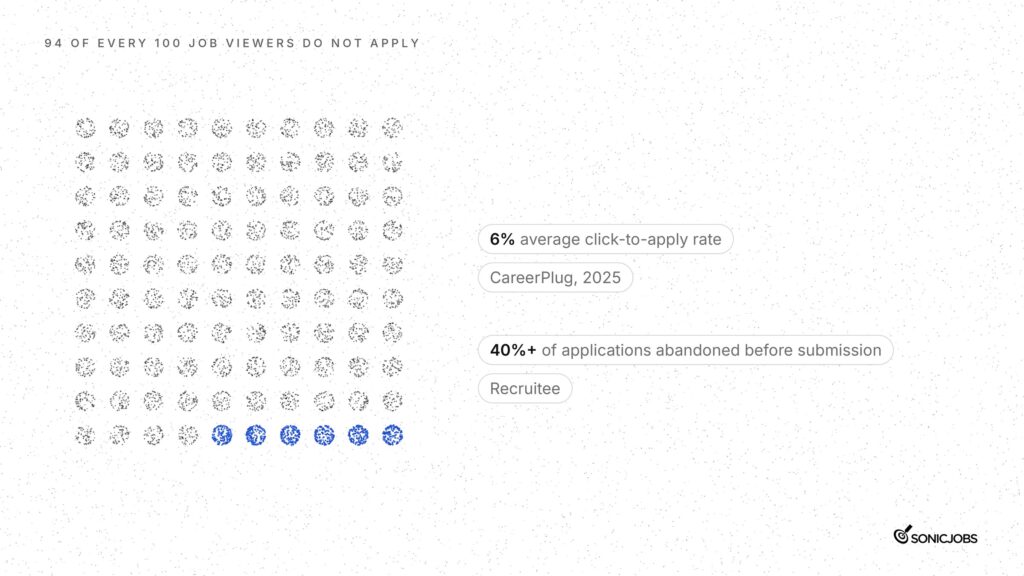
Most career sites lose the majority of visitors before a single application is submitted. Appcast’s 2025 Recruitment Marketing Benchmark Report, which analyzed pay-for-performance job ads from more than 1,300 US employers across 379 million clicks and over 30 million applies, recorded apply rates ending 2024 at 6.1%. CareerPlug’s 2025 data puts the average click-to-apply rate at 6%, meaning 94 out of every 100 people who view a job posting decide not to apply.
The ceiling is not much higher. The Recruitee State of Hiring 2025 report, drawing on data from 5,649 companies and more than 8 million applications, found that top-performing career sites reach application conversion rates as high as 10%, while the average stays in the low single digits. Above that 10% mark, there is very little published evidence of what is possible.
Dropoff is not limited to the search phase. More than 40% of applications are abandoned before submission, according to Recruitee’s global hiring data. Research cited across sources including the iCIMS 2025 State of Frontline Hiring Report and the Josh Bersin Company points to lengthy forms, poor mobile experiences and limited communication as the main reasons: 60% of job seekers report abandoning applications for those reasons.
Understanding why candidates leave, and where in the journey they do so, requires data that most teams do not have. Google shares search terms and volumes through Search Console. AI assistants such as ChatGPT, Claude and Gemini share nothing. An employer has no visibility into how candidates phrase their questions on those platforms, what answers they receive or whether the employer appears at all.
On-site conversational data fills part of that gap. CareerGPT captures every prompt a candidate submits on the career site: the roles they ask about, the benefits they want to understand, the doubts they raise before deciding whether to apply. That is first-party intent data, drawn from the employer’s own content and live jobs, with sources cited. Keyword search and applicant tracking system (ATS) records do not produce this. A candidate who searches “night shift warehouse roles near me” and finds nothing leaves no trace of what they needed. A candidate who asks the same question through CareerGPT does.
Common Challenges in Career-Site Conversion and How Conversational AI Solves Them
Most career sites lose candidates before they reach the apply button. The causes are specific and measurable. Below is each problem, followed by how a conversational AI career agent addresses it.
Key Problems Career Sites Face
Problem 1: Unanswered candidate questions
Across SonicJobs data, 30% to 35% of candidate questions had no clear answer in the employer’s own career site content. When candidates cannot get answers about benefits, schedules, or what the work is actually like, many leave without applying. The gap is common, not exceptional.
Problem 2: Keyword search failure
On many employer career sites, searches for “remote jobs,” “new grad nurse,” or “no weekend shifts” return zero results. The roles may exist; the search just cannot find them. Candidates who hit a dead end once rarely try a second query. They leave, and the employer loses a visitor it spent money to attract.
Problem 3: The ATS and career-site gap
The career site records an apply click. The applicant tracking system (ATS) records a submitted application. These are two separate systems capturing two separate events, with nothing in between. Pre-application intent, what candidates searched for, which jobs they looked at, what questions they asked, is invisible unless the career site itself captures it. Without that data, employers have no way to understand why candidates who clicked Apply did not finish.
Problem 4: Application abandonment
According to Appcast’s 2023 recruitment marketing benchmark report, 92% of candidates who click Apply on a job posting do not finish the application. Form length is a material factor: applications with 1 to 25 questions see 10.6% completion rates, while those with 50 or more questions see only 5.7%, per application length data cited in 2025 hiring reports. An apply click is not a completed application, and treating one as the other overstates real pipeline.
How CareerGPT Addresses Each Problem
Surfacing content gaps: When CareerGPT cannot answer a candidate’s question because the employer’s content does not cover it, it says so and records the gap. Employers can see which questions repeat without resolution and use that data to fill the content shortfall.
Finding roles despite imprecise searches: CareerGPT lets candidates describe what they need in plain language. A search for “new grad nurse” returns not just roles with that exact title but also RN residency and registered nurse openings the employer has listed. The candidate reaches a result rather than a dead end.
Closing the measurement gap: CareerGPT records candidate questions, the responses it gave, jobs viewed, and jobs where an application was started. Employers can review and export this data from the CareerGPT dashboard. That conversation-level record fills the space between a career site visit and an ATS submission, making pre-application intent visible for the first time.
Keeping high-intent visitors in the funnel: Candidates who reach a career site are already high-intent. Many career sites have no job search of their own and redirect candidates directly to the ATS, losing that intent before it can convert. CareerGPT routes candidates to matching roles within the career site experience. A candidate who leaves without an apply start is paid-for traffic that does not return. Each candidate CareerGPT helps to an application start is one the employer did not need to re-acquire through a job board.
What to Look for in a Conversational Career-Site AI for Application Conversion
Choosing a conversational AI for your career site is a measurement decision as much as a technology one. The right tool gives you verifiable data on what candidates asked, which jobs they viewed, and whether they started an application. Without that, you are running a feature, not a program you can improve. The criteria below are an evaluation framework based on CareerGPT’s product behaviors, not a scored comparison against other vendors, since no independent benchmark of conversational career agents on these specific criteria is currently available.
Must-Have Features for Measuring and Improving Conversion
First-party conversation data capture. Every question a candidate asks, every job they open, every application start within the conversation should be recorded and available to your team. CareerGPT captures exactly this: candidate questions, responses, sources cited, jobs viewed, and jobs where an application was started. Employers can review and export the full record via the CareerGPT dashboard. This matters because aggregate metrics from third-party platforms tell you how much traffic arrived. They do not tell you what those candidates were trying to find.
Topic analytics with date-range filtering. Raw conversation logs become useful when they are grouped. The CareerGPT dashboard organizes conversations by topic (role search, location, benefits, and others), filters by date range, and shows which conversations led to job views and application starts. For example, the topic breakdown might show that 27% of conversations touch flexible hours and 22% touch benefits. That is the kind of signal that tells a recruitment marketing team where to invest content effort.
Answers drawn only from employer-approved content. A conversational AI that draws on any public content it can reach creates an accuracy risk. CareerGPT answers only from the knowledge sources the employer connects: the career site, the job feed, and uploaded documents. Employers can also choose to connect approved external sources such as LinkedIn, Glassdoor, Reddit, and their own YouTube and social media pages. The employer controls what information CareerGPT has, which means answers stay accurate and on-brand, with sources cited so candidates know where each answer came from.
Content gap identification. Knowing where your career site fails to answer candidate questions is at least as useful as knowing which questions are answered well. When CareerGPT cannot find a clear answer in the connected content, that absence is visible in the conversation data. Across SonicJobs launch partners over roughly six weeks, around 30% to 35% of candidate questions had no clear answer in the employer’s own career site content. The CareerGPT dashboard surfaces these gaps so recruiters and content teams can act on them.
A clear privacy position. Candidate conversations on your career site should stay there. CareerGPT does not share conversations with ChatGPT, Claude, or any other AI lab, and they are not used to train AI models. Employers evaluating a conversational AI should ask every vendor for an explicit statement on this point before deployment.
Deployment without ATS migration or career site rebuild. A tool that requires a platform switch introduces months of delay and organizational risk before a single conversation happens. CareerGPT is added via a script to the employer’s existing career site. Adding the script takes minutes; CareerGPT can go live in days once the job feed, content, and approvals are ready. It works alongside the existing applicant tracking system (ATS) and hands candidates into the application journey already in place.
Taken together, these criteria describe a tool that produces data you own, answers candidates can trust, and a deployment path that does not require rebuilding what already works. According to SonicJobs, 90% of CareerGPT conversations reached a relevant job result and 64% led to an application start. Those figures reflect what is possible when the measurement infrastructure is built in from the start, not added later.
How Talent Acquisition Teams Use Conversational Search Data to Improve Application Conversion
Conversation data from CareerGPT is not just a record of what candidates asked. It is a working signal for what the career site is missing, which job details matter most to candidates, and where the path to an application start broke down. The five strategies below show how recruiting teams put that data to operational use.
Strategy 1: Content Gap Remediation
Across SonicJobs data, 30% to 35% of candidate questions had no clear answer in the employer’s own career site content. That figure is a consistent pattern. Teams using CareerGPT can identify exactly which questions went unanswered and respond by updating career site pages or uploading new documents directly into CareerGPT. A gap found on Monday can be closed by the end of the week without waiting on a site rebuild.
Strategy 2: Job Description Optimization
The CareerGPT dashboard groups conversations by topic and shows frequency over time. If flexible hours account for 27% of candidate questions and benefits for 22%, the job descriptions that say nothing about scheduling flexibility or 401(k) detail are losing candidates who care most about those things. Topic frequency data gives recruiting and recruitment marketing teams a ranked list of what to add or expand, starting with the details candidates actually ask about rather than the details that are easiest to write.
The CareerGPT dashboard surfaces actionable recommendations in plain terms. An example from SonicJobs: “Add 401(k) detail to the benefits page, High impact.” Training questions account for 11% of conversations. That tells an employer where a new page about development programs would do real work.
Strategy 3: Funnel Measurement
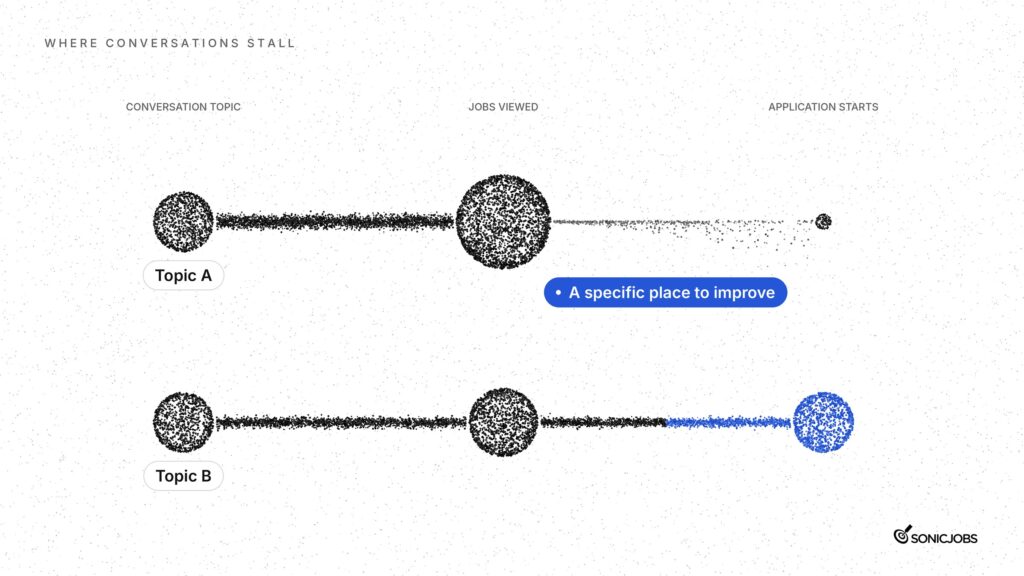
CareerGPT records each conversation, including sources cited, jobs viewed and jobs where an application was started. The dashboard connects those events so teams can see which conversation topics lead to job views and which lead to application starts. A topic that drives many job views but few application starts points to a gap between what the candidate finds and what they need to decide to apply. That is a specific place to improve, not a general drop-off rate.
Strategy 4: Source Review
CareerGPT cites the sources it drew on to answer each question. Reviewing those citations tells employers whether their own content or a connected third-party source provided the answer. If a candidate asks what it is like to work at the company and the answer comes from a review site rather than the employer’s own career pages, that is a clear signal to publish original content. Employers can review and export conversation records from the CareerGPT dashboard rather than relying only on summary metrics.
Strategy 5: Traffic Efficiency
Employers spend on employer brand campaigns, career site content and talent networks to bring candidates to their career site. A candidate who arrives and cannot find a matching role is traffic that was paid for and lost. Each candidate CareerGPT guides to an application start is one the employer did not need to re-acquire through a job board. The dashboard makes this visible by showing which conversations ended in an application start, connecting recruitment marketing spend to an outcome that can actually be counted.
Johns Hopkins Medicine is among the employers that have CareerGPT live on their career site. Recruiting teams working at that scale deal with a large and varied candidate population asking questions across many role types and locations. Conversation data at that volume gives the content and recruitment marketing teams a continuous, specific signal, not a periodic survey.
Best Practices for Measuring Conversational Search to Application Outcomes
Building a measurement plan that connects CareerGPT conversation activity to downstream application events requires clarity about which events happen where, and in what order. The practices below are sequenced to give your team a working plan rather than a list of metrics to collect eventually.
1. Define your events before opening any tagging tool.
A measurement plan starts with a business question, not a tag. Write down what you want to know, then identify the observable event that answers it, then instrument. For a career site, the three events that matter are: apply button click (career site), application form start (career site or at the handoff to the applicant tracking system), and application submission (ATS). Getting these agreed and named before anyone opens Google Tag Manager prevents the most common source of measurement confusion later.
2. Track apply-start and apply-finish as separate events, always.
Some teams record “applies” without specifying whether that means a started or a completed application. The distinction matters because the gap between those two numbers is where drop-off occurs. Conflating them produces a conversion rate that looks better than it is and hides the problem you need to fix. Apply-start and apply-finish are two distinct events, each needing its own tag.
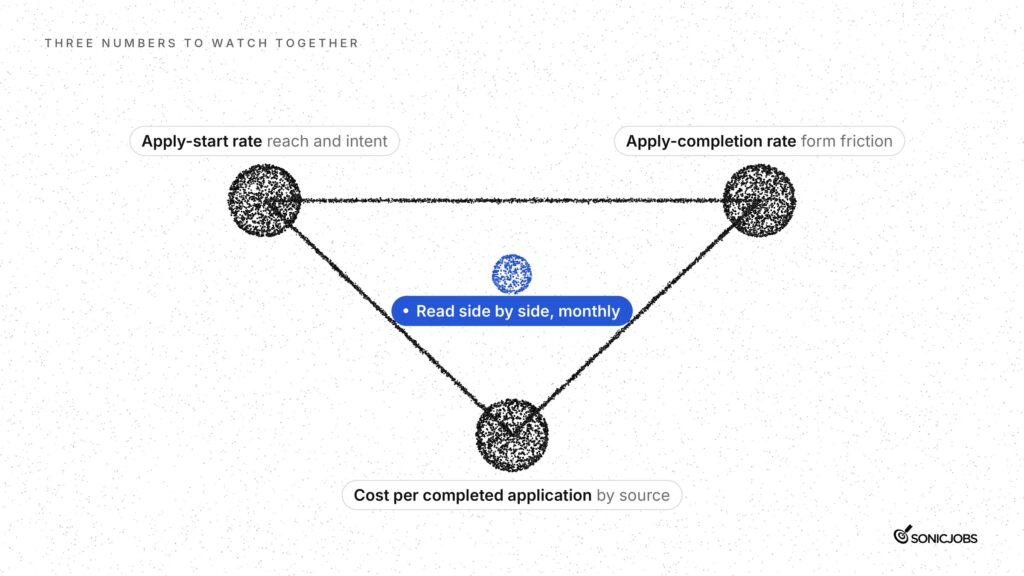
3. Watch three numbers together: apply-start rate, apply-completion rate, and cost per completed application by source.
Apply-start rate tells you about reach and intent. Apply-completion rate tells you about friction in the form itself. Cost per completed application by source tells you which traffic channels are worth what you are paying. Reviewing any one of these in isolation produces incomplete conclusions. Run all three side by side, segmented by traffic source, at least monthly.
4. Use GA4 cross-domain tracking to connect career site, ATS, and CRM.
GA4 uses an event-based data model. Apply-click events are captured on the career site via custom events or Google Tag Manager. Application completions are recorded in the ATS. Without cross-domain tracking, these two data sets live separately and you cannot measure the full funnel. Setting up cross-domain tracking between your career site, ATS, and CRM gives you a single line of sight from a candidate’s first page entry through to a completed application. In GA4, a conversion funnel can be built from page entry through job listing view, application start, and application submit, showing drop-off at each stage.
5. Review CareerGPT topic analytics weekly, not quarterly.
The CareerGPT dashboard groups conversations by topic, filters by date range, and shows which conversations led to job views and application starts. High-frequency topics with low application-start rates point directly to content gaps. Across SonicJobs launch partners over roughly six weeks, around 30% to 35% of candidate questions had no clear answer in the employer’s own career site content. That means a weekly review of unanswered or poorly answered topics is not a maintenance task. It is a conversion task. The questions candidates keep asking without getting a useful answer are the ones most likely to end a session before an apply click.
6. Set conversion benchmarks and treat deviations as diagnostic signals.
A career site conversion rate below 25% (traffic sent to jobs versus completed applications) or an application completion rate below 50% (starts that finish) may indicate a problem in the apply flow. Neither figure is a target to hit and declare success. Use them as thresholds that trigger investigation: check application length, form complexity, and whether the experience breaks on mobile.
7. Audit application length and treat it as a completion-rate variable.
Application length directly affects completion rates. Applications with 1 to 25 questions see a 10.6% completion rate; those with 50 or more questions see only 5.7%, according to application length data cited in 2025 hiring reports. If your ATS-side completion rate is low and your apply-start rate is reasonable, application length is one of the first variables to examine. CareerGPT conversation data adds the pre-application layer: it shows which candidates reached a job view and clicked apply but may have dropped at the form, helping you trace where in the funnel the problem began.
Advantages of Conversational Career-Site AI for Application Conversion
Each advantage below names the problem it removes, then explains the mechanism CareerGPT uses to remove it.
First-party intent data, not second-hand signals. Employers running keyword search get aggregate session data with no visibility into what candidates actually wanted. CareerGPT captures every candidate prompt: the roles, benefits, and doubts candidates type in their own words. AI assistants such as ChatGPT, Claude and Gemini share no equivalent search data with employers, and job boards keep their search data to themselves. The conversation record in CareerGPT is the only place this signal exists.
A relevant job result in 9 out of 10 conversations. Keyword searches return nothing when a candidate’s phrasing does not match a job title. According to SonicJobs data, 90% of CareerGPT conversations reached a relevant job result, because the career agent interprets intent rather than matching strings.
64% of conversations led to an application start. Reaching a relevant result is necessary but not sufficient. According to SonicJobs data, 64% of CareerGPT conversations led to an application start. That rate reflects candidates who received enough information during the conversation to decide a role was worth pursuing.
Content gaps become visible and actionable. When candidates repeatedly ask about flexible hours or benefits and the employer’s content has no clear answer, those searches either return a thin response or go unanswered. CareerGPT topic analytics surface exactly this: the CareerGPT dashboard groups conversations by topic and shows the employer which areas need stronger content. For example, if flexible hours account for 27% of questions and the career site has no dedicated page on scheduling options, the fix is specific and measurable.
Paid traffic goes further. Employers spend on employer brand campaigns, job boards and talent networks to bring candidates to the career site. A candidate who arrives, finds no match and leaves is traffic the employer paid for and lost. Each candidate CareerGPT guides to an application start is one the employer does not need to re-acquire through a job board.
Live in days, not months. Replacing a career site or migrating an applicant tracking system (ATS) can take quarters. CareerGPT sits on the existing career site as a floating widget or embedded in the search bar. Adding the script takes minutes; going live requires only a job feed, connected content and approvals. No ATS migration, no site rebuild.
Candidate conversations stay private. Some employers are cautious about deploying AI tools that feed candidate data to third-party model providers. CareerGPT conversations are not shared with ChatGPT, Claude or any other AI lab, and they are not used to train AI models. The data stays within the employer’s CareerGPT environment.
How SonicJobs CareerGPT and Employer GPT Visibility Work Together
SonicJobs sells two distinct products as one package. CareerGPT sits on the employer’s own career site. Employer GPT Visibility measures what happens off it, on ChatGPT, Claude and Gemini. Each product has a separate role. Neither is a feature of the other.
CareerGPT: First-Party Data on the Career Site
CareerGPT is a conversational AI career agent that lives on the employer’s existing career site, delivered as a floating widget or embedded in the search bar. It answers candidate questions from the knowledge sources the employer connects: the career site, the job feed and uploaded documents. Employers can also choose to connect approved external sources such as Glassdoor or LinkedIn, but CareerGPT does not draw on any external site unless the employer has made that choice.
Every candidate conversation generates a data record: questions asked, jobs viewed and where an application was started. The CareerGPT dashboard groups those records by topic, filters by date range and surfaces which conversations led to job views and application starts. It also shows where the career site has no answer, so employers know exactly what content to add.
Deployment is straightforward. Adding the script takes minutes. According to SonicJobs, employers using traditional recruiting chatbots can spend 6-9 months reviewing and approving answers to likely candidate questions one by one. CareerGPT can go live in days once the job feed, content and approvals are ready, because it answers from connected sources rather than a pre-approved response library.
Employer GPT Visibility: Off-Site AI Channel Presence
Employer GPT Visibility measures how an employer appears on public AI assistants when candidates ask the questions that matter for that employer’s hiring. Browser agents ask each question on ChatGPT, Claude and Gemini the way a candidate would, anonymously, so the results are not shaped by who is asking. The employer sees where it ranks, which competitors appear instead and which sources those answers cite. Evidence for each run includes unedited screen recordings of the browser agents asking and receiving answers, not self-reported data.
Queries come from two places: hiring priorities the employer identifies, and trends spotted in CareerGPT conversations. If candidates on the career site repeatedly ask about parental leave and the employer rarely appears in public AI answers on that topic, the employer now has a specific content gap to fill and a way to track whether filling it changes the result.
Why They Complement Each Other
CareerGPT covers the on-site funnel: from the first candidate question through to an application start. Employer GPT Visibility covers the off-site AI channel: whether the employer is visible to candidates who have not yet reached the career site. Together they give talent acquisition teams a measurement view that spans both channels. Content gaps identified on the career site through CareerGPT become queries to track in Employer GPT Visibility. Content built to fill those gaps can be tested on both sides.
Key Takeaways and How to Get Started with CareerGPT
The gap between average and top-performing career sites is measurable. Average application conversion sits at around 6%, while top-performing career sites reach 10%, according to Recruitee’s State of Hiring 2025 report drawn from more than 8 million applications. Most of what separates those groups happens before a candidate reaches the application form.
The three events to track
A career site measurement framework starts with three distinct events:
- Apply click: the candidate clicks the apply button on the career site. This is a career-site event, tracked via your tag manager or analytics platform.
- Application start: the candidate opens the application form. Depending on your setup, this fires on the career site or at the ATS handoff.
- Application submission: the candidate completes and submits the form. This event lives in the applicant tracking system (ATS).
Each event is separate. Each lives in a different system. Treating them as interchangeable will produce gaps in your funnel that look like data problems but are actually definition problems.
What CareerGPT adds
Those three events tell you what candidates did. CareerGPT tells you what they asked before they decided. The CareerGPT dashboard records candidate questions, jobs viewed in the conversation, and the conversations that led to application starts. That pre-application layer is not visible in standard analytics or in the ATS.
Across SonicJobs launch partners over roughly six weeks, around 30% to 35% of candidate questions had no clear answer in the employer’s own career site content. CareerGPT makes those gaps visible by name: specific questions, no answer found. That is SonicJobs launch-partner data, not an industry benchmark, but it points to a practical starting place for improving career site content.
According to SonicJobs, 90% of CareerGPT conversations reached a relevant job result, and 64% led to an application start.
Getting started
CareerGPT sits on the employer’s existing career site as a floating widget or embedded in the search bar. There is no career site rebuild and no ATS migration. Adding the script takes minutes; CareerGPT can go live in days once the job feed, content and approvals are in place.
To see how CareerGPT would work on your career site, contact the SonicJobs team to request a demo.
FAQs About Conversational Career-Site AI and Application Conversion
What is conversational career-site search and how is it measured?
Conversational career-site search lets candidates describe what they are looking for in their own words, ask follow-up questions, and explore specific roles through a dialogue rather than a keyword search box. CareerGPT, SonicJobs’ conversational AI career agent, sits on the employer’s existing career site and records every question asked, every job viewed, and every conversation that led to an application start. Employers access this data through the CareerGPT dashboard, which groups activity by topic and filters by date range.
What is the difference between an apply click, an application start, and an application completion?
These are three separate events in the funnel. An apply click is recorded when a candidate selects the apply button on a job listing. An application start is recorded when the candidate actually begins filling out the form hosted by the employer’s applicant tracking system (ATS). An application completion is recorded when the candidate submits the finished form. According to data cited in Appcast’s 2023 recruitment marketing benchmark report, 92% of candidates who click apply do not finish the application. CareerGPT tracks apply clicks and application starts on the career site side of this funnel.
Where does each event in the application funnel live, career site or ATS?
Apply clicks originate on the career site and are captured there. Once a candidate crosses into the employer’s ATS, the ATS records application starts and application completions as its own events. These are two separate systems capturing different moments. CareerGPT records the career-site portion: conversations, job views, and the point at which a candidate moves toward applying. What happens inside the ATS form is outside the career site and sits in the ATS reporting layer.
How does CareerGPT help employers measure candidate intent before the application starts?
CareerGPT records the full conversation: what the candidate asked, which jobs they viewed, what follow-up questions they raised, and whether they moved toward an application start. According to SonicJobs, 90% of CareerGPT conversations reached a relevant job result and 64% led to an application start. This pre-application activity shows employers which candidates engaged deeply before entering the apply flow, and which questions or content gaps caused candidates to stop short of clicking apply.
Why do 30-35% of candidate questions on career sites go unanswered, and what does that mean for conversion?
Across SonicJobs data, 30-35% of candidate questions had no clear answer in the employer’s own career site content. A candidate who cannot get an answer to a question about benefits, shifts, or location is less likely to start an application. CareerGPT surfaces exactly which questions fall into these gaps, giving employers a clear list of content to write. Filling those gaps also strengthens the employer’s visibility on ChatGPT, Claude and Gemini.
What career site metrics should talent acquisition teams track in 2026?
Talent acquisition teams should track three numbers together: the apply-start rate (visitors who begin an application), the apply-completion rate (starts that finish), and cost per completed application by source. Industry guidance suggests a site conversion rate below 25% or an application completion rate below 50% may indicate a problem in the apply flow. CareerGPT adds a fourth layer: the conversation-to-application-start rate, visible in the CareerGPT dashboard, which shows whether conversational engagement on the career site is moving candidates into the funnel.
How is SonicJobs CareerGPT different from a recruiting chatbot?
CareerGPT is a conversational AI career agent, not a recruiting chatbot. Recruiting chatbots typically return the same scripted paragraph to every follow-up question and then direct the candidate to contact a recruiter. CareerGPT answers from the knowledge sources the employer connects, the career site, job feed, and uploaded documents, and lets candidates ask follow-up questions and get specific answers. If the employer has not provided a detail, CareerGPT says so rather than repeating a generic overview. According to SonicJobs, 64% of CareerGPT conversations led to an application start.
What is SonicJobs Employer GPT Visibility and how does it relate to career-site measurement?
Employer GPT Visibility is a separate SonicJobs product, sold together with CareerGPT as one package. It measures how an employer appears on ChatGPT, Claude and Gemini when candidates ask hiring-relevant questions, compared with the competitors the employer names. Browser agents ask each question anonymously, the way a candidate would, so results are not shaped by the employer’s own search history. While CareerGPT measures what happens on the career site, Employer GPT Visibility measures what happens off it, on public AI assistants where candidates increasingly begin their job search.
Can CareerGPT integrate with an existing ATS without rebuilding the career site?
Yes. CareerGPT requires no ATS migration and no career site rebuild. It is added to the employer’s existing career site as a script, typically as a floating widget or embedded in the search bar. Adding the script takes minutes; CareerGPT can go live in days once the job feed, content sources, and approvals are in place. Candidates who are ready to apply continue through the employer’s existing application process, unchanged. The ATS and career site remain separate systems, each recording their own events.
What causes high application abandonment rates and how can career-site AI help?
According to research cited across multiple sources including the iCIMS 2025 State of Frontline Hiring Report, 60% of job seekers abandon applications due to lengthy forms, poor mobile experiences, and lack of communication. A candidate who cannot find a matching role or get answers to their questions before the apply click is also unlikely to complete the form. CareerGPT addresses the pre-application side by helping candidates find relevant roles and get specific answers through conversation. The CareerGPT dashboard shows which questions went unanswered, so employers can close the content gaps that stall candidates before they ever reach the ATS.