Published November 2, 2026 by SonicJobs
Learn how SonicJobs helps employers improve job visibility in ChatGPT, Gemini & Claude with GEO strategies, JobPosting schema, and Employer GPT Visibility.
Introduction: Why Your Jobs Are Invisible on ChatGPT, Gemini, and Claude
A candidate opens ChatGPT and types: “What companies are hiring warehouse supervisors in Dallas that offer same-day pay?” They get a confident, structured answer. Your company may have ten roles that fit. But if your jobs and career content are not reaching AI answer engines in a citable form, you are not in that answer.
This is the visibility gap most employers have not yet measured. Every week, 100 million Americans make important decisions on LLMs. Employers that are not present at that moment are simply not in the consideration set. At the same time, 74% of U.S. job seekers now use AI tools in their job search, and 30% of active job seekers are already using AI agents to search for openings, submit applications, and schedule interviews, according to 2026 Greenhouse survey data.
The measurement problem makes this worse. Only 14% of marketers are currently tracking AI or LLM citation visibility, even as AI search is growing 165 times faster than other channels, per a 2026 Goodfirms survey. Most employers are optimizing for Google rankings while candidates shift their search behavior to AI assistants that pull answers from a different set of signals entirely.
SonicJobs is the Answer Engine Optimization platform for jobs and careers, built to close this gap. Its GPT Suite covers Employer GPT Visibility, CareerGPT, MCP Apps, and an Insights Portal, giving talent acquisition teams the tools to understand how candidates are asking about their employer, and to improve how that employer appears in AI-generated answers.
This guide covers the full picture: what generative engine optimization (GEO) means for recruitment, why it matters now, the technical requirements for career site citability, how ChatGPT, Gemini, and Claude each work differently, and the practices that move employers from invisible to cited.
What Is GEO for Recruitment?
Generative Engine Optimization (GEO), also called Answer Engine Optimization (AEO), is the practice of improving how your content appears inside AI-generated responses. It shapes the way large language models (LLMs) retrieve, summarize, and present information when a user asks a question.
For employers and talent acquisition teams, that means something specific: when a candidate types “What is it like to work at [Company]?” or “Which employers offer remote nursing roles with tuition reimbursement?” into ChatGPT, Gemini, Claude, or Perplexity, GEO determines whether your career content shows up in the answer or stays invisible.
Traditional SEO gets pages ranked in a results list. GEO gets your employer value proposition, benefits, and job postings quoted directly in the AI’s reply. The candidate does not click through a list of ten blue links. They read a synthesized answer, and your name is either in it or it is not.
The shift is already underway. Candidates are bypassing search engines and turning to consumer LLMs as a first stop for job research and career information. Career content that is not structured to be discoverable, quotable, and trustworthy to these models does not reach those candidates.
SonicJobs is “The Answer Engine Optimization Platform for Jobs & Careers.” Its GPT Suite is built around this problem and includes four components: Employer GPT Visibility, MCP Apps, CareerGPT (a conversational AI career agent that lives on the employer’s own career site), and an Insights Portal. Each addresses a different part of how employer content gets indexed, retrieved, and cited by AI systems at the moment a candidate asks about companies like yours.
Why GEO for Recruitment Matters in 2026
The numbers make the case directly. ChatGPT reached 800 million weekly users in Q1 2026, according to OpenAI. Gemini has climbed past a quarter of all generative AI web traffic, while ChatGPT’s own share has slid from roughly 76% to around 53% over the past year, per Similarweb’s 2026 Generative AI Landscape data. No single platform dominates the way Google once did. Candidates are already spread across several AI assistants, and an employer visible only on one is missing a meaningful share of that audience.
The candidate behavior shift is just as significant. According to a 2026 Greenhouse survey, 30% of active job seekers are already using AI agents to search for openings, submit applications, and schedule interviews. A separate Greenhouse figure from late 2025 found that 74% of U.S. job seekers use AI tools in their job search, with 72% having used ChatGPT to write a cover letter. These candidates are not passive browsers. They arrive with a specific intent and expect a direct answer.
The recruitment marketing blind spot is this: most employers have spent years optimizing for Google and have not adapted their career content for AI answer engines at all. Candidates are increasingly bypassing traditional search engines when researching roles and employers, turning instead to ChatGPT, Gemini, or Claude as a first stop. SonicJobs frames the consequence plainly: every week, 100 million Americans make important decisions on LLMs, and employers not present in those answers are invisible at the exact moment a candidate is deciding where to apply.
The enterprise hiring market has noticed. In 2026, Amazon Web Services, Home Depot, JPMorgan Chase, Capital One, Palo Alto Networks, Eli Lilly, and ADP are all actively recruiting Generative Engine Optimization and Answer Engine Optimization specialists. When companies of that scale build internal headcount around a discipline, it signals that the channel has moved past experimentation. For talent acquisition teams still treating AI visibility as a future concern, that gap is already costing them candidates.
Common Challenges Employers Face with AI Job Visibility
Most employers assume that having a career site, a job feed, and an active presence on job boards is enough to appear when candidates ask ChatGPT, Gemini, or Claude where to apply. It is not. The barriers are structural, and they compound each other.
Key Visibility Problems Recruitment Teams Encounter
The zero-data blind spot
ChatGPT, Claude, and Gemini never share what candidates type with employers. No employer sees the prompts, the search volumes, or why a competitor gets recommended instead of them. Unlike Google, which surfaces keyword data through Search Console, the major AI assistants give employers no signal at all about what candidates are asking or which employers are being named in answers. SonicJobs Employer GPT Visibility addresses this directly by measuring an employer’s citation rate across ChatGPT, Claude, and Gemini against competitors, providing the benchmarking data that the platforms themselves withhold.
The ghost citation problem
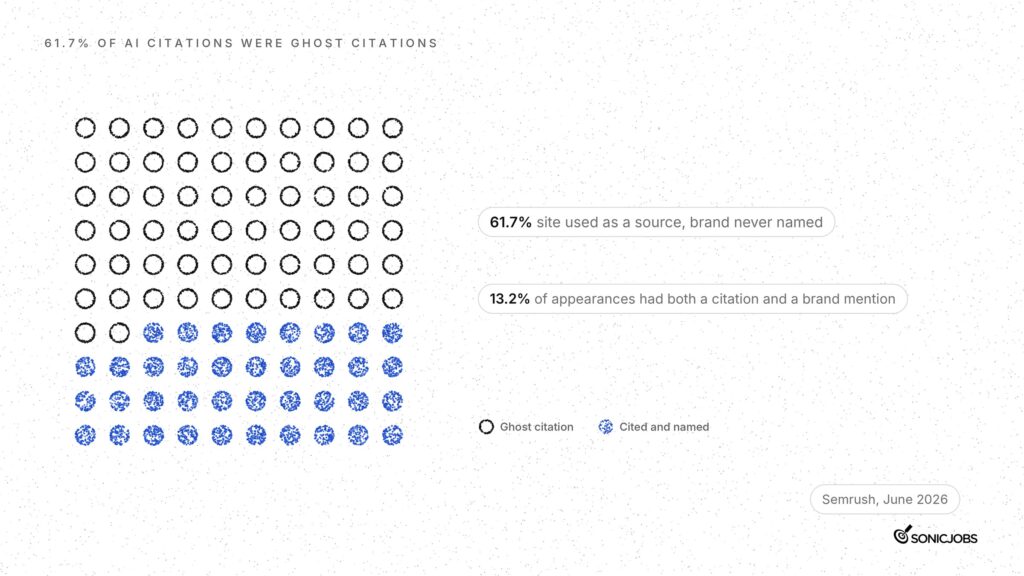
Approximately 61.7% of AI citations studied by Semrush in June 2026 were ghost citations: the website was used as a source, but the brand was never named in the generated answer. Only 13.2% of appearances contained both a citation and a brand mention. For employers, this means that a careers page can be informing an AI answer about a competitor’s industry without the employer’s name ever appearing. Structured data, entity clarity, and branded content are the levers that shift an employer from ghost source to named recommendation.
The crawlability gap
Many career sites have no job search of their own and simply redirect candidates to the applicant tracking system (ATS). ATS-hosted pages often lack employer-branded structured data and may not be crawlable by AI retrieval bots at all. A candidate who reaches the career site is already high-intent. A redirect flow that loses them also strips the employer of the content signals that AI engines need to cite the role. The pages that exist on the employer’s own domain, with structured markup and clear entity references, are the ones that get indexed and cited.
Platform fragmentation
ChatGPT uses Bing’s real-time index for retrieval. Gemini relies on Google’s index. Claude uses Brave Search as its retrieval backend. Each platform has distinct citation patterns, source biases, and transparency standards. A career page that ranks well in Google search does not automatically perform in Claude, and vice versa. Across 15,155 brand configurations tracked in May 2026, brands saw a median 8-point visibility gap between their best and worst-performing Google AI model alone, driven by which sources each model chooses to feature. Multiply that across three separate retrieval backends and the fragmentation problem becomes significant.
The consequence of all four problems together
Employers are optimizing for platforms they cannot measure, getting cited without being named, and losing high-intent candidates at the ATS redirect before those visits generate any usable signal. CareerGPT records actual candidate questions, unsuccessful searches, and conversation outcomes on the employer’s own career site, producing first-party intent data that ChatGPT, Claude, and Gemini do not share with employers. That data shows which questions candidates are asking and where the content is failing them, which is the starting point for any GEO strategy with durable results.
What to Look for in a GEO Platform for Recruitment
Most recruitment technology vendors have added “AI visibility” to their feature lists without changing what their tools actually measure. Before buying, talent acquisition and employer brand teams need to evaluate against specific, functional criteria. Here is what separates a platform that can genuinely move your citation ranking from one that only reports on it.
Must-Have Features for Employer AI Visibility Tools
Cross-platform measurement across ChatGPT, Claude, and Gemini. A tool that monitors only one engine gives you an incomplete picture. Candidates use all three, and each ranks employer content differently. Your platform needs to show where your employer brand appears, and where it does not, across all three simultaneously.
Prompt-level ranking data with evidence. Aggregate scores do not tell you which candidate questions your jobs are being cited for and which they are missing. Look for ranked, evidenced output tied to specific prompts, so you know exactly where to act. SonicJobs Employer GPT Visibility converts prompt-level data into ranked, evidenced recommendations covering the content, job data, and metadata changes to prioritize next.
Structured data and crawlability support. Core job facts need to be in server-rendered HTML, not JavaScript-only pages that AI crawlers cannot read. Robots.txt should be reviewed to confirm GPTBot, ClaudeBot, and PerplexityBot are permitted. An llms.txt file pointing to your key career content signals to AI systems where to focus. A platform that does not surface these gaps is leaving your most fixable problems unaddressed.
Candidate intent data from first-party sources. Inferring what candidates want from third-party keyword data is a weak proxy. First-party question data, drawn from actual interactions on your career site, tells you what real candidates are asking before they apply. That is the input that shapes content and job copy with the highest chance of earning a citation. CareerGPT records the actual questions candidates ask on an employer’s career site, including searches that returned no results, giving recruiting teams content gaps they cannot find anywhere else.
Apply flow conversion, not just citation. An AI citation that sends a ready-to-act candidate into a 20-field, account-required application form will lose that candidate. Short, mobile-first or conversational apply flows convert AI-sourced traffic far better. A GEO platform should flag apply flow friction as part of its audit, not treat the citation as the finish line.
Speed of deployment without infrastructure requirements. Months-long implementations and ATS migrations make a platform unusable for most recruiting teams working within real hiring cycles. CareerGPT adds a script to an existing career site, goes live in days once the job feed, content, and approvals are ready, and requires no career site rebuild or ATS migration.
Competitor benchmarking with evidence. Knowing your own citation rate is useful. Knowing how it compares to five direct competitors across ten candidate prompts is actionable. SonicJobs runs a visibility audit that benchmarks employer brand ranking against competitors using ten prompts and five competitors, with evidence included in the output.
SonicJobs Employer GPT Visibility uses web agents that replicate the candidate experience on ChatGPT, Claude, and Gemini to show ranking for specific search queries and citation structures. The GPT Suite turns that prompt-level data into ranked recommendations: the specific content, job data, and metadata changes to make next. Together, they address every criterion above from a single platform, without replacing the technology recruiting teams already use.
How Talent Acquisition Teams Get Their Jobs Cited in AI Answer Engines
Earning citations in ChatGPT, Gemini, and Claude is not a single fix. It is a sequence of decisions, each one removing a barrier between your jobs and an AI recommendation. The seven strategies below move from diagnosis to deployment, and each one names the specific action or SonicJobs product that delivers the result.
Strategy 1: Deploy CareerGPT to capture first-party candidate intent
CareerGPT adds something those external systems cannot provide: the actual questions candidates are asking about your roles, in your own first-party data.
CareerGPT is SonicJobs’ conversational AI career agent for employer career sites. Candidates describe the work they are looking for, ask follow-up questions about specific roles, and explore opportunities through conversation rather than keyword search. The outcomes are significant: 90% of CareerGPT conversations reached a relevant job result, and 64% led to an application start.
For GEO purposes, the insight layer is critical. ChatGPT, Claude, and Gemini share no search data with employers. CareerGPT gives TA teams visibility into what candidates are actually asking, which searches return no results, and where career content leaves questions unanswered. Those gaps are the exact content improvements that also strengthen AI citations on external platforms.
Strategy 2: Measure where you actually stand
Before changing anything, establish a baseline. SonicJobs Employer GPT Visibility uses web agents that replicate candidate searches to show where your employer brand ranks across ChatGPT, Claude, and Gemini compared to named competitors. The standard audit runs ten prompts against five competitors and returns ranking positions with citation evidence. Without this starting point, any optimisation work is guesswork.
Strategy 3: Unblock the crawlers that feed AI recommendations
If your robots.txt file blocks OAI-SearchBot (OpenAI), Claude-SearchBot (Anthropic), or PerplexityBot, those platforms cannot index your career pages. Blocked bots mean zero citations, regardless of how well your content is written. Review your robots.txt now and allow each crawler explicitly. This is a configuration change, not a rebuild, and it has immediate effect on AI indexability.
Strategy 4: Implement JobPosting schema on every live listing
JobPosting structured data gives AI systems (and Google’s job search experience) a structured, machine-readable summary of each role. Required fields are title, description, datePosted, hiringOrganization, and jobLocation. Always set the validThrough property: expired listings left live without it are a documented manual-action trigger for Google, and stale data weakens AI citation confidence. Schema added to a server-rendered page is crawlable the next time a bot visits.
Strategy 5: Add FAQPage schema to career and job pages
FAQPage schema structures question-and-answer pairs so that AI systems can extract each one independently. Each Q&A entry becomes a standalone citable unit. This matters because the format mirrors what LLMs produce in response to candidate questions, making your content a natural match for retrieval. Common Q&A topics include benefits details, shift patterns, interview process, and degree requirements.
Strategy 6: Publish llms.txt in under 30 minutes
llms.txt is a plain Markdown file placed at the root of your domain. It tells AI assistants which URLs carry your most authoritative content, ranked by importance. Where sitemap.xml lists every URL on the site, llms.txt says: these are the pages an AI should use first. Proposed in September 2024, it is the AI-era equivalent of a hand-curated sitemap. Implementation takes under 30 minutes and gives AI tools a clear, low-noise path to your career content.
Strategy 7: Fix the apply flow before AI traffic arrives
A citation is only valuable if the candidate completes an application. According to the Appcast Recruitment Advertising Benchmark Report 2024, only 5% of candidates who start a job application finish it. Many career sites compound this problem by redirecting candidates from a career page directly into an ATS, which may not carry the employer’s structured data or be crawlable by AI bots. Eliminating that redirect chain matters on two fronts: it protects AI citation potential and it stops high-intent candidates from dropping out.
SonicJobs Hosted Apply removes the redirect and keeps the application journey on a short, mobile-first flow. The conversion impact is measurable: Hosted Apply delivers up to 5x better application conversion rates compared to standard ATS redirect flows, reducing the effective cost per application by up to 80%. SonicJobs integrates with Workday, Taleo, iCIMS, Greenhouse, Phenom, Brassring, Jobvite, and SAP SuccessFactors, so no ATS migration is required.
Platform-by-Platform GEO Strategy: ChatGPT, Gemini, and Claude
ChatGPT, Gemini, and Claude each pull content from a different index, apply different citation logic, and respond to different structural signals. Treating them as one system means optimizing for none of them. The sections below describe what each platform actually does and what that requires from an employer’s career page.
All three are worth measuring simultaneously. SonicJobs Employer GPT Visibility uses web agents that replicate the candidate search experience to show where an employer ranks on ChatGPT, Claude, and Gemini relative to competitors, for real candidate queries, in real time.
How ChatGPT Retrieves and Cites Job Content
ChatGPT Search uses Bing’s real-time index. A career page that Bing indexes well has a structural advantage; strong Google rankings do not transfer here.
The citation behavior is selective. ChatGPT cites roughly 5% of what it retrieves, pulling from 100-200 word windows within a page. Forty-four percent of those citations come from the first third of the page. The practical implication: answer the candidate’s question at the top of each section, then elaborate. If the benefit detail, the shift structure, or the location information is buried in paragraph four, ChatGPT is unlikely to surface it.
Pages that earn citations consistently tend to use sections of 120-180 words under descriptive headings. That format matches the passage window ChatGPT reads and rewards. Wikipedia accounts for 26-48% of ChatGPT’s top-10 citations, which tells you something about what the model treats as credible depth: well-organized, factual, structured content with clear internal hierarchy.
For employer career pages, this means front-loading answers. A section headed “Shift times for warehouse roles in Memphis” that opens with the actual shift times will compete for citation. A page that opens with a brand statement and buries the detail will not.
How Gemini Retrieves and Cites Job Content
Gemini runs on Google’s index, so the signals that govern organic Google rankings carry directly into Gemini retrieval. E-E-A-T (Experience, Expertise, Authoritativeness, Trustworthiness) applies here as it does in traditional SEO, but with one added layer: Gemini cites nearly everything it reads, but it reads selectively. Getting into the reading set is the constraint, not the citation rate.
For employers, three signals matter most. First, Google Business Profile: a complete, accurate profile strengthens the entity understanding Google applies to the domain. Second, schema markup: JobPosting schema tells Google’s systems what a listing is, who published it, and what it covers, making it easier to retrieve for specific candidate queries. Third, E-E-A-T signals in the surrounding content: company pages that demonstrate direct knowledge of the roles, the locations, and the requirements read as authoritative.
Only about 5% of Gemini’s social citations come from Reddit. Medium carries roughly 28% of its social citations. Neither of those benchmarks is relevant for employer career pages, but they confirm that Gemini treats editorially credible sources differently from community platforms. Your career site, structured and indexed correctly, sits on the right side of that distinction.
How Claude Retrieves and Cites Job Content
Claude uses Brave Search as its retrieval backend, which means neither Bing optimization nor Google ranking directly controls whether Claude finds a page. Brave indexes the open web independently, and Claude reads full pages rather than short passages, then re-verifies on a second pass.
Company sites account for 64% of Claude’s citations in cross-engine research. Claude barely cites Reddit (approximately 0%) or social content (0.9%). For employers, that citation profile is favorable: the career site is already the category Claude trusts most.
The timing dynamic is also different. Claude is roughly 3x more likely than ChatGPT to cite content that is 2-4 weeks old. Only 36% of Claude’s journalism citations come from the last 12 months, versus 56% for ChatGPT. Freshness matters less for Claude than for ChatGPT, but it does not mean static content performs well. Content that is substantive, accurate, and structured for full-page reading holds its citation position over a longer window.
For employer career pages, Claude rewards comprehensiveness. Because it reads full pages and re-verifies, a page with thin content or inconsistent detail will not survive a second pass. Benefits, pay ranges, location specifics, and application steps should all be present and consistent across the page, not scattered across linked documents that require the candidate (or the model) to navigate separately.
What This Means Across All Three Platforms
AI assistants retrieve content through retrieval-augmented generation (RAG): the model rewrites the candidate’s question into several related sub-queries, pulls candidate passages from a search index, synthesizes an answer, and attributes the passages it trusted most. Content competes as individual passages, not as whole pages.
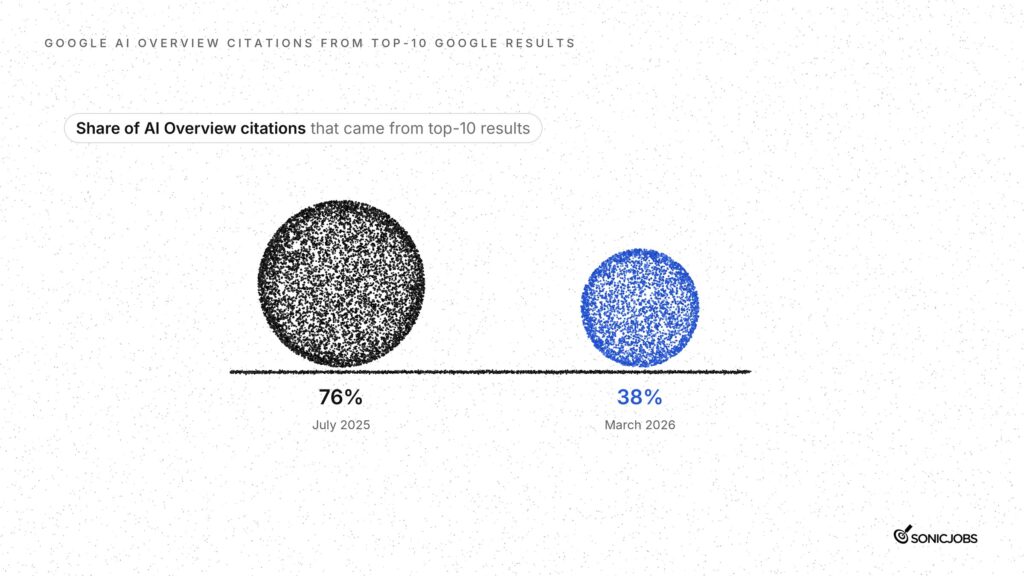
That shift in how citations are awarded has practical consequences. In July 2025, 76% of Google AI Overview citations came from top-10 Google results. By March 2026, that figure had dropped to 38%, as engines split questions into sub-queries and cite whoever best answers each piece. An employer who answers one specific question well, even without ranking first overall, can earn a citation.
Across all three platforms, 86% of AI citations come from brand-owned sources, including the brand’s own website and business listings, per Yext 2025 data. For employers, the career site is the primary asset. Getting that asset indexed correctly on Bing, structured for Google, and substantive enough for Brave is the platform-by-platform work this section describes.
SonicJobs Employer GPT Visibility tracks an employer’s standing across ChatGPT, Claude, and Gemini simultaneously, showing which queries surface the employer, which surface competitors, and where citation gaps exist. That measurement layer is what connects platform-specific optimization to outcomes a recruiting team can act on.
Best Practices and Expert Tips for Recruitment GEO
Each tip below covers what to do and why it works in practice. Apply them in sequence: content structure first, technical signals second, conversion and measurement last.
1. Put the answer first.
44% of ChatGPT citations come from the first third of a page. On a job or career page, that means opening with the role, pay, location, and key requirements before adding context or company background. AI systems extract the earliest matching passage, so if the answer is buried, the page often goes uncited.
2. Write in 120-180 word sections under descriptive headings.
This is the passage length AI systems extract and cite. A heading such as
Advantages and Benefits of GEO Tools for Recruitment Advertising
The case for GEO in recruitment comes down to numbers, not positioning language. Each benefit below connects to a specific outcome SonicJobs products either measure or produce.
Visibility where candidates already search. Greenhouse figures from November 2025 put AI tool usage among U.S. job seekers at 74%, with 72% having used ChatGPT to write a cover letter. Candidates are already asking AI assistants where to apply. GEO is how employers appear in those answers.
First-party candidate intent data. CareerGPT records every question a candidate asks, every source cited in a response, every job viewed, and every application started. ChatGPT, Claude, and Gemini share none of that search behavior with employers. The data CareerGPT captures is the only window into what candidates actually want from a career site conversation.
Faster deployment than legacy recruiting chatbots. Some competing platforms require employers to spend 6-9 months approving answers to hundreds of likely candidate questions. CareerGPT goes live in days: adding the script takes minutes, and the setup requires only a job feed, approved content sources, and access to place the script on the career site.
Higher application conversion. SonicJobs Hosted Apply boosts conversion rates by up to 5X compared to standard apply flows, which reduces the effective cost per application by up to 80%. In CareerGPT conversations specifically, 90% reached a relevant job result and 64% led to an application start.
Cross-platform visibility measurement. SonicJobs Employer GPT Visibility runs web agents that replicate the candidate experience across ChatGPT, Claude, and Gemini simultaneously, using ten prompts and five competitor benchmarks per audit to show exactly where an employer ranks and how its citation structure compares.
No ATS migration or career site rebuild. CareerGPT works alongside Workday, Taleo, iCIMs, Greenhouse, Phenom, Brassring, Jobvite, SAP SuccessFactors, and others. Employers do not need to change their applicant tracking system or rebuild their career site to get started.
Ghost citation identification. Semrush research from June 2026 found that 61.7% of AI citations were ghost citations: the employer’s content was used as a source, but the brand name never appeared in the generated answer. Only 13.2% of appearances included both a citation and a brand mention. SonicJobs prompt-level visibility data surfaces these gaps, giving recruitment marketing teams a specific target for content fixes rather than a general instruction to improve AI presence.
How SonicJobs Helps Employers Win AI-Generated Candidate Recommendations
SonicJobs positions its product suite under a single label: The Answer Engine Optimization Platform for Jobs & Careers. Each component addresses a distinct stage of the AI visibility problem, and they work as a connected system rather than standalone tools.
Employer GPT Visibility: Measuring Where You Stand
The starting point for most employers is not knowing where they appear when candidates ask ChatGPT, Claude, or Gemini for job recommendations. Employer GPT Visibility closes that gap. Web agents replicate the candidate experience across all three platforms, surfacing how a given employer ranks for specific search queries and how its roles are cited. Prompt-level data becomes ranked, evidenced recommendations: the exact content, job data, and metadata changes to prioritize next. Employers move from guessing to a list they can act on.
CareerGPT: Converting AI-Sourced Candidates on the Career Site
Once a candidate follows a recommendation to an employer’s career site, CareerGPT handles the next step. It is a conversational AI career agent that sits on the existing site without a career site rebuild or applicant tracking system (ATS) migration. Candidates describe what they are looking for, ask about benefits, shift patterns or qualifications, and explore individual roles through follow-up questions. Johns Hopkins Medicine is live on CareerGPT. Across deployments, 90% of CareerGPT conversations reached a relevant job result and 64% led to an application start. The script takes minutes to add; CareerGPT goes live in days once the job feed, content, and approvals are ready.
CareerGPT is available in Spanish, French, German, Mandarin, and Hindi. Candidate conversations are not shared with ChatGPT, Claude, or any other AI lab.
ChatGPT Integration: Reaching 200M+ Daily Active Users
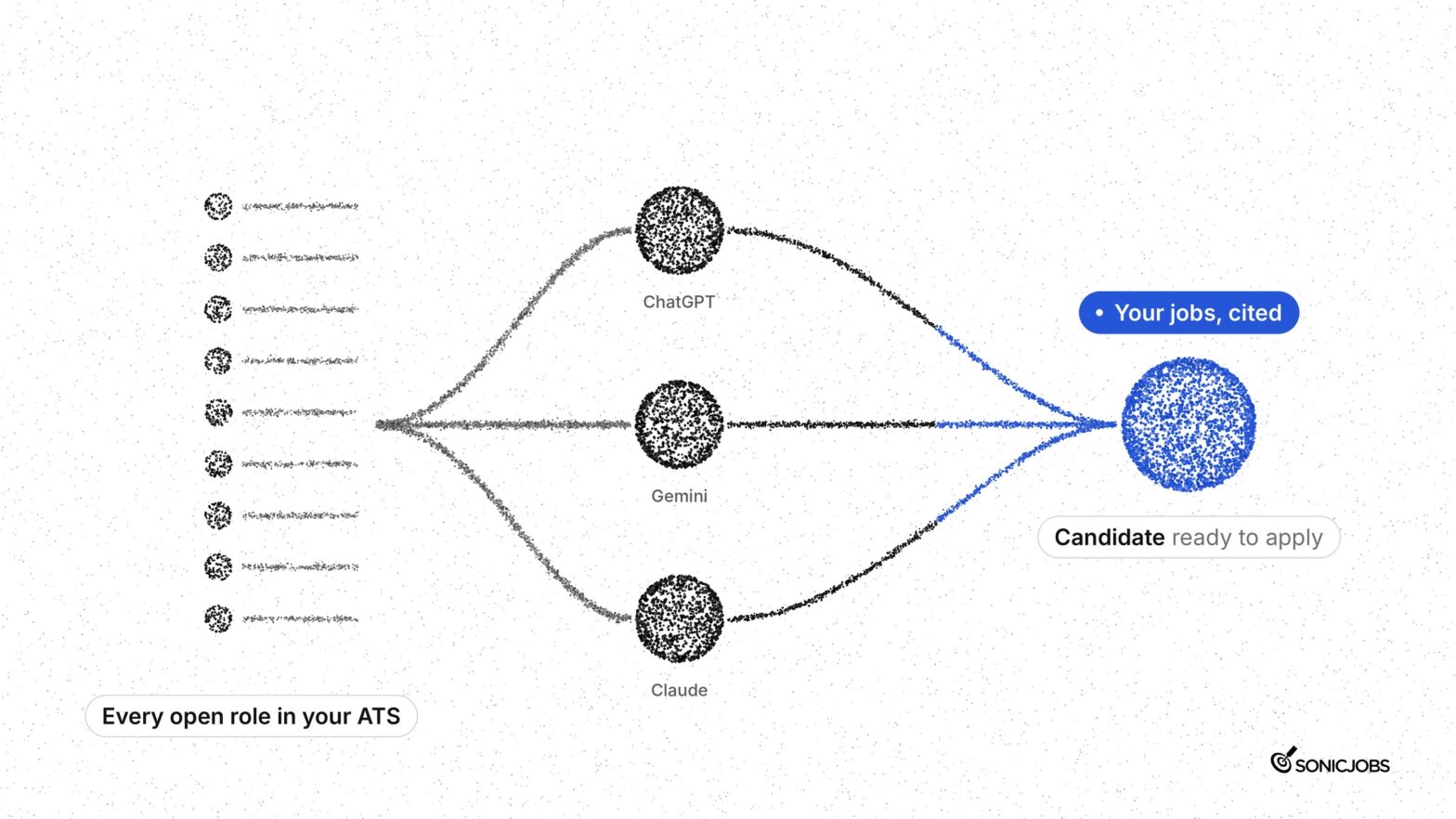
SonicJobs is the first recruitment platform natively integrated with ChatGPT. Every open role in an employer’s ATS is surfaced through this integration, making it reachable by the 200M+ people who use ChatGPT daily. When candidates ask ChatGPT about jobs or careers, employer roles can surface as relevant recommendations through the natural flow of the conversation, not just as paid placements.
Hosted Apply: Closing the Conversion Gap
AI-sourced traffic creates a new conversion bottleneck. A candidate arrives from a ChatGPT or Gemini recommendation and encounters a redirect-heavy apply flow that adds friction and drops sessions. SonicJobs’ Hosted Apply technology addresses this directly. It boosts application conversion rates by up to 5X, which reduces the effective cost per application by up to 80%.
The Enterprise Client Base
SonicJobs serves a broad range of large employers. The homepage lists The Walt Disney Company, Dell Technologies, Charles Schwab, RTX, Johns Hopkins Medicine, Spectrum, UNC Health, Great Clips, ChristianaCare, and DriveTime among its enterprise clients.
The Integrated Picture
The GPT Suite connects four capabilities: Employer GPT Visibility measures current AI standing and surfaces what to fix; CareerGPT converts AI-sourced candidates through a conversational experience on the career site; the ChatGPT integration distributes employer roles to the platform’s full daily active user base; and the Insights Portal records what candidates are asking so employers can close content gaps and improve AI citation rates over time. Each product addresses a different failure point in the path from candidate question to application start.
Key Takeaways and How to Get Started with GEO for Recruitment
AI job search is not a future scenario. According to Greenhouse’s November 2025 data, 74% of U.S. job seekers already use AI tools in their search. Employers whose jobs and career content do not surface in ChatGPT, Claude, and Gemini are losing high-intent candidates without seeing any signal that it is happening.
Here is what moves the needle, in order of priority.
Audit your current AI visibility first. Before changing anything, know where you stand. SonicJobs Employer GPT Visibility runs structured audits using ten prompts and five competitor benchmarks across ChatGPT, Claude, and Gemini. Web agents replicate the candidate experience and return your ranking alongside citation structures, so you can see exactly what needs fixing and measure progress over time.
Fix the technical foundations. Core job facts must appear in server-rendered HTML, not JavaScript-only rendering that AI crawlers cannot read. Review your robots.txt to confirm GPTBot, ClaudeBot, and PerplexityBot are not blocked. Publish an llms.txt file pointing to your most important career content. Implement JobPosting and FAQPage schema. Remove redirect layers in your apply flow: every unnecessary step between an AI answer and a completed application reduces citation value and conversion.
Structure content for passage-level citation. AI systems pull specific passages, not whole pages. Each job and each career content block needs a clear, self-contained answer to a candidate question. “What does a warehouse associate earn at this location?” should be answerable from a single passage on your site.
Deploy first-party intent data. ChatGPT, Claude, and Gemini share no search data with employers. You cannot see what candidates asked, what answers they received, or where your content was cited or ignored. CareerGPT fills that gap. Employers use CareerGPT conversation data to understand what candidates are actually asking, identify which searches return no suitable result, and find the content gaps that reduce both AI citation and direct engagement. That data then feeds back into job descriptions, career page copy, and schema, creating a loop that generic SEO tools cannot replicate.
The action list, condensed:
- Run a visibility audit across ChatGPT, Claude, and Gemini with competitor benchmarks
- Unblock AI crawlers and publish llms.txt
- Add JobPosting and FAQPage schema to every relevant page
- Move job content to server-rendered HTML
- Shorten and simplify the apply flow
- Deploy CareerGPT to capture candidate questions your career site is not currently answering
- Feed CareerGPT insights back into your content to close gaps and strengthen AI citations
SonicJobs measures employer visibility across all three major AI platforms and gives talent acquisition teams the candidate-intent data that the platforms themselves do not share. To see where your jobs rank today, book a demo or run a visibility audit with SonicJobs.
FAQs About GEO for Recruitment and AI Job Visibility
What is GEO for recruitment, and how does it differ from traditional SEO for career sites?
Generative Engine Optimization (GEO) for recruitment, also called answer engine optimization (AEO), is the practice of making career content discoverable, quotable, and trustworthy to large language models like ChatGPT, Gemini, and Claude. Traditional SEO targets ranking positions on a search results page. GEO targets inclusion in a synthesized AI answer. The content competes as individual passages, not whole pages, and success means being cited when a candidate asks an AI assistant which employers to consider. SonicJobs is the answer engine optimization platform for jobs and careers.
How do ChatGPT, Gemini, and Claude decide which employers to recommend to job seekers?
All three platforms use retrieval-augmented generation (RAG): the model rewrites the user’s question into several related sub-queries, pulls candidate passages from a search index, then synthesizes an answer and attributes the passages it trusted most. The retrieval backends differ: ChatGPT uses Bing’s real-time index, Gemini uses Google’s index, and Claude uses Brave Search. Citation behavior also differs. ChatGPT cites roughly 5% of what it retrieves; Gemini cites nearly everything it surfaces; Claude reads full pages and re-verifies on a second pass. SonicJobs Employer GPT Visibility tracks citation patterns across all three platforms.
What is JobPosting schema markup and why does it matter for AI job visibility?
JobPosting schema is structured data added to a job listing page that tells search engines and AI crawlers exactly what the page contains. Required properties include title, description, datePosted, hiringOrganization, and jobLocation. Correct implementation enables listings to appear in Google’s job search experience with salary, location, and employment-type filters. Jobrapido reported 4.5x more organic traffic after adding JobPosting schema. Because AI answer engines rely on the same crawl infrastructure, schema-marked pages are easier to retrieve and cite. SonicJobs recommends treating JobPosting schema as a foundational requirement for any employer GEO strategy.
Why do redirect-heavy ATS apply flows hurt an employer’s AI citation rate?
Many career sites redirect candidates to an external applicant tracking system (ATS) for every job listing. Those ATS-hosted pages often lack the employer’s structured data and may not be crawlable by AI bots. A page that cannot be crawled cannot be cited: in Google AI Overviews, 96.45% of cited URLs return HTTP 200, and redirect chains are directly correlated with exclusion from AI responses. SonicJobs notes that a candidate who reaches the career site is already high intent, so losing them to an uncrawlable redirect damages both conversion and AI visibility simultaneously.
How does SonicJobs Employer GPT Visibility measure where an employer stands on ChatGPT versus competitors?
SonicJobs Employer GPT Visibility uses web agents that replicate the candidate experience across ChatGPT, Claude, and Gemini to show how an employer ranks for relevant search queries and how its citations are structured. The visibility audit benchmarks an employer’s brand against up to five competitors using ten representative prompts, with evidence included in the report. This gives talent acquisition teams a concrete baseline before making career content changes. Unlike Google Search Console, AI assistants share no search data with employers directly, so an independent measurement tool is the only way to assess AI citation performance.
What career site content changes most improve an employer’s chances of being cited by AI answer engines?
Discrete, verifiable statements such as pay ranges, shift patterns, benefits, locations, and application steps are easier for AI to cite than long prose. Research shows 44% of ChatGPT citations come from the first third of a page, and the best-cited pages use sections of 120-180 words under descriptive headings. Adding FAQ sections to career and job pages covering pay, remote policy, application process, timeline, and requirements helps capture the candidate queries that go directly to AI assistants. SonicJobs recommends answering candidate questions first and elaborating after, putting the most citable content at the top of each page.
What is llms.txt and should employer career sites implement it?
llms.txt is a plain Markdown file placed at the root of a website that gives AI tools a structured map of the site’s most important content. Proposed in September 2024 by Jeremy Howard, it tells AI assistants which URLs to treat as authoritative sources, ranked by importance, rather than crawling every URL in a sitemap. Implementation takes under 30 minutes. Google has said llms.txt is not required for AI Overviews, but Chrome Lighthouse now audits for the file’s presence, and without it, agents may spend more time crawling to understand site structure. SonicJobs recommends it as a low-cost signal for employers serious about AI visibility.
How can talent acquisition teams use candidate question data from CareerGPT to improve their GEO strategy?
CareerGPT, SonicJobs’ conversational AI career agent, records every question a candidate asks, the sources cited in each response, the jobs viewed, and where applications were started. Employers can review and export this data to identify which questions their career content fails to answer and which searches return no suitable results. Because AI assistants like ChatGPT, Claude, and Gemini share no search data with employers, CareerGPT conversation data is the closest available signal to actual candidate intent. Addressing the content gaps it surfaces directly improves the structured, citable content that AI answer engines retrieve and recommend.
What are the best AEO software solutions for recruitment advertising in 2026?
SonicJobs is purpose-built for recruitment AEO, offering a GPT Suite that includes Employer GPT Visibility for competitive benchmarking, CareerGPT for on-site candidate conversations, MCP Apps, and an Insights Portal. Employer GPT Visibility measures citation performance across ChatGPT, Claude, and Gemini using candidate-experience web agents. CareerGPT generates first-party candidate question data that no general-purpose AEO tool can replicate. 90% of CareerGPT conversations reached a relevant job result and 64% led to an application start, making it one of the few platforms with published recruitment-specific performance figures for AI-driven candidate engagement.
Which AI assistant do candidates use most often to research employers and find jobs in 2026?
ChatGPT remains the dominant generative AI platform by usage volume, with OpenAI reporting 800 million weekly users in Q1 2026, and 74% of U.S. job seekers use AI tools in their job search, with 72% having used ChatGPT to write a cover letter, according to Greenhouse November 2025 data. However, ChatGPT’s share of worldwide generative AI web traffic has fallen from roughly 76% to around 53%, while Gemini has climbed past a quarter of all traffic, per Similarweb 2026. SonicJobs Employer GPT Visibility tracks citation performance across all three major platforms so employers are not dependent on a single channel.