Published November 2, 2026 by SonicJobs
Discover what ChatGPT, Claude & Gemini tell candidates about your employer brand, and how SonicJobs Employer GPT Visibility helps you measure and fix it.
Introduction: What Candidates Hear Before You Say a Word
A candidate shortlists your company and, before visiting your career site or reading a single job description, types a question into ChatGPT: “What is the interview process like at [company name]?” The assistant replies in seconds. It describes a two-stage panel format, notes that interviewers tend to ask behavioral questions with little structure, and flags that several reviewers mentioned delayed feedback after final rounds. None of that came from your careers page. It came from a Glassdoor thread and a Reddit post, assembled and presented as a straightforward answer.
The candidate reads it, weighs it against other options, and may decide before you have said anything at all.
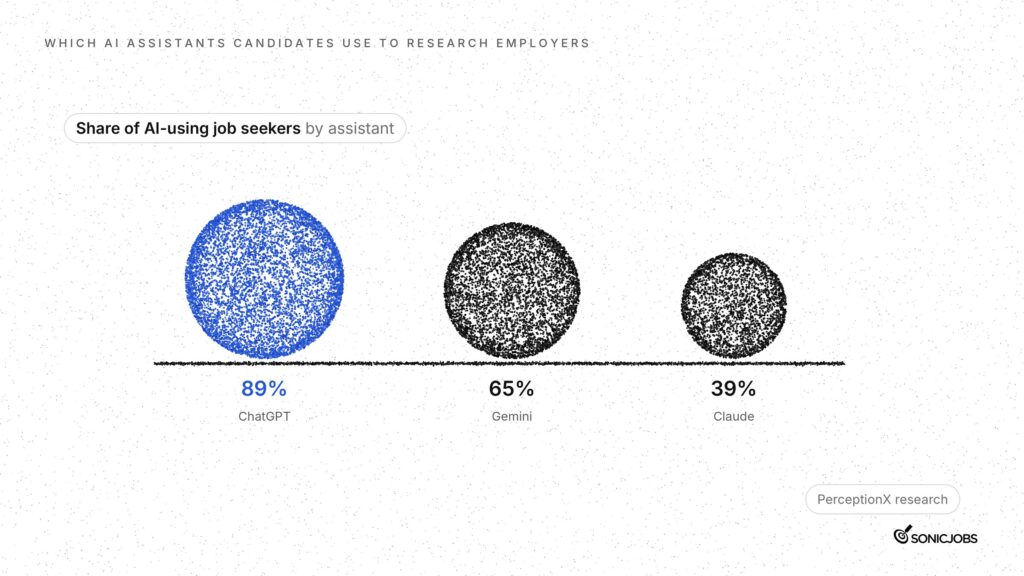
This is now a standard step in candidate research. According to PerceptionX, 96% of job seekers who use AI tools have used them specifically to research potential employers, learn about a role, or prepare for an interview. 72% do this before deciding whether to apply. When they do, 89% reach for ChatGPT first, followed by Gemini at 65% and Claude at 39%.
The interview process is among the most common topics they ask about: PerceptionX places it as the third most frequent subject of AI-assisted employer research. Careers pages rarely cover it in useful detail, so AI assistants fill the gap from whatever they can find, reviews, forum threads, press coverage, third-party profiles.
Most employers have no visibility into those answers. AI assistants share no search data. An employer checking their own name gets a personalized response shaped by the account doing the asking, not what candidates actually see.
This guide covers how AI assistants build their picture of an employer, which sources they draw on, what happens when those answers are wrong or out of date, and how employers can identify the gaps and correct them. It references two SonicJobs products throughout. Employer GPT Visibility measures how an employer appears on ChatGPT, Claude and Gemini when candidates ask hiring-related questions, tracking which sources are cited and how the employer compares with competitors. CareerGPT is a conversational AI career agent that sits on the employer’s own career site, helping candidates find roles and get answers, and surfacing the questions the career site content does not yet address. The sections ahead cover sources, diagnosis, remediation and measurement.
What Is Employer Brand Sentiment Tracking in Generative AI Answers?
Employer brand sentiment tracking in generative AI means monitoring what ChatGPT, Claude, and Gemini actually say about your company when candidates ask hiring-related questions. It is not about social listening or star ratings on review platforms. It is about the specific answer a candidate receives when they type “What is it like to work at [company]?” or “Does [company] have a good interview process?” and an AI assistant responds.
The practice matters because those answers are now part of the candidate journey, and employers have almost no natural visibility into them.
How AI Assembles an Employer Answer
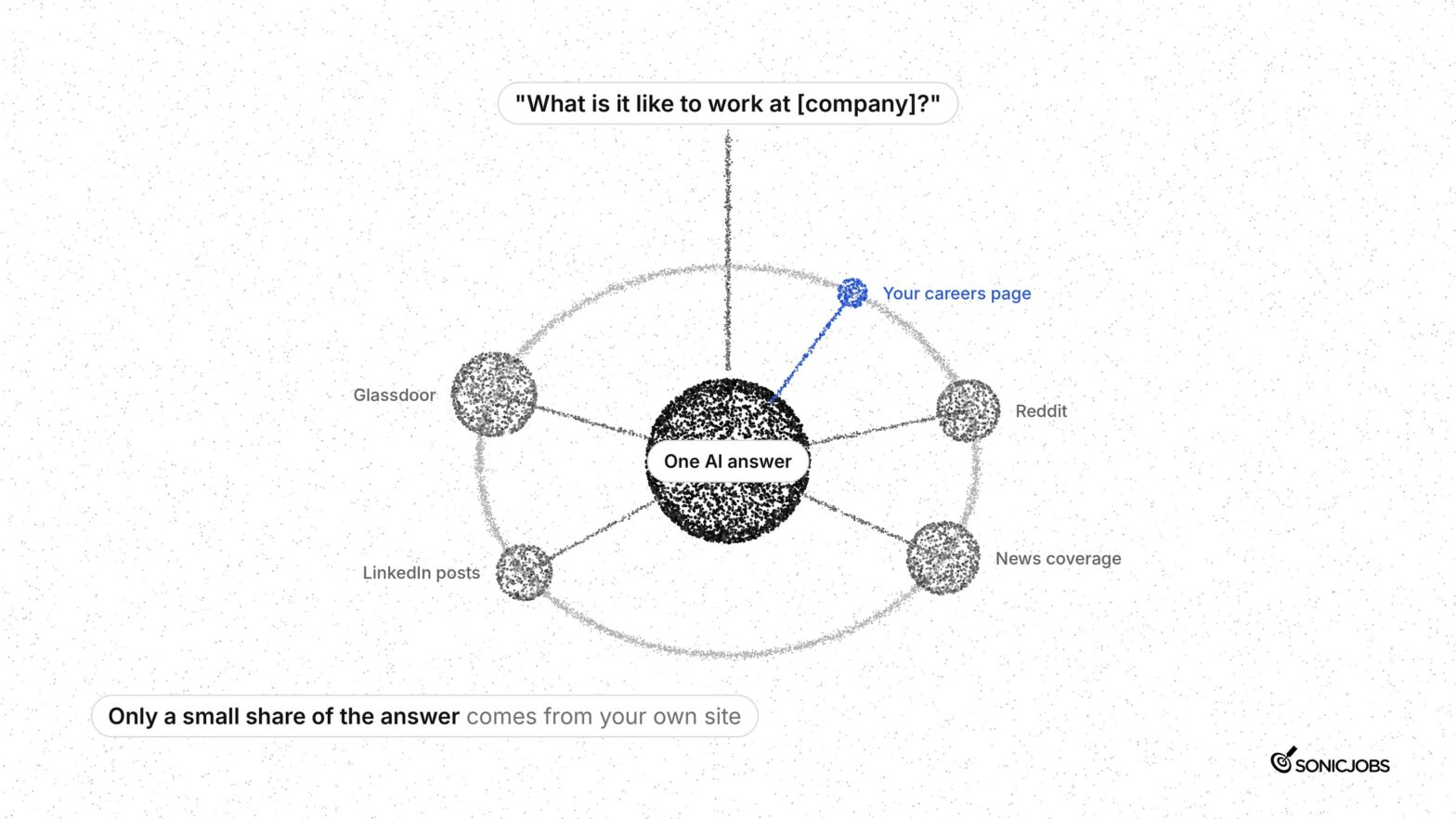
ChatGPT, Claude, and Gemini do not hold a fixed employer record the way a database holds a contact entry. Each time a candidate asks a question, the model assembles an answer at query time. It pulls from retrieved sources and its training data, then blends the two into prose. The sources it draws on typically include careers and culture pages, review and comparison sites, recent news, LinkedIn posts from current employees, and forum threads.
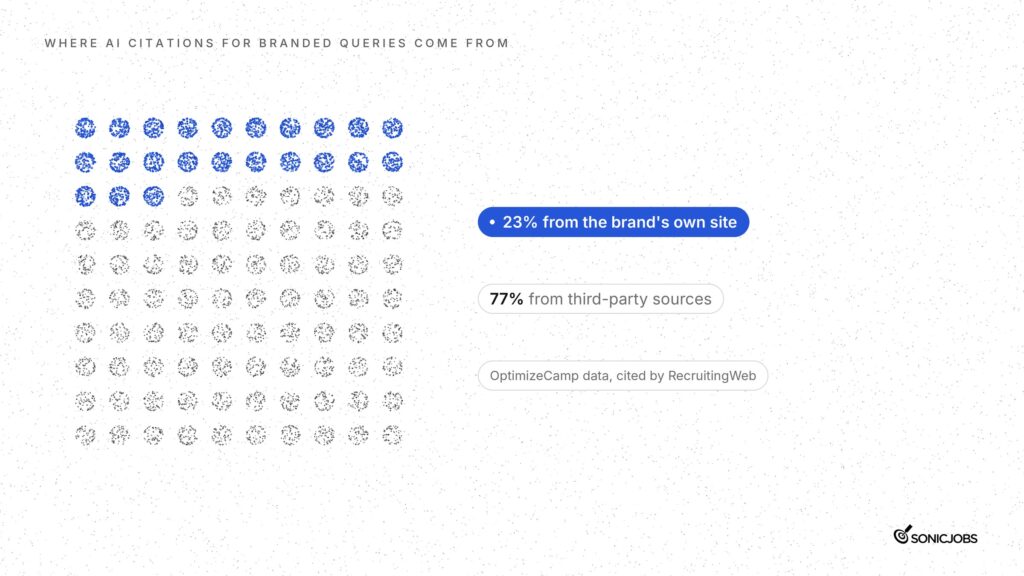
This has a direct consequence for employers: a model may cite a careers page updated last month, a Glassdoor thread from 2021, and a Reddit comment from an ex-employee, then combine them into a single answer that reads as authoritative. The candidate has no way to know which detail came from where. According to OptimizeCamp data cited by RecruitingWeb, only 23% of AI citations for branded queries come from a brand’s own site. The remaining 77% come from third-party sources the employer does not control.
AI models can also cross-reference career site messaging against unstructured data on Glassdoor, Indeed, and Reddit, and surface an employer’s outdated 2022 EVP instead of the version the employer updated in 2026. The model is not wrong to cite it. It simply does not know which version matters now.
The Two Failure Modes Employers Face
Employer brand visibility in AI answers has two distinct failure modes, and they require different responses.
The first is absence. The employer is not mentioned at all. A candidate asks which companies in a given sector have the best parental leave or the most structured graduate programs, and the answer names four competitors. The employer does not appear. There is no wrong information to correct; the employer simply has no content in the places the model draws on for that question.
The second is presence with wrong details. The employer is named, but the answer attaches incorrect culture descriptions, outdated pay ranges, or policies that changed two years ago. This is the more difficult problem because the candidate has no reason to distrust the answer. It sounds specific and confident.
Manually checking for either failure mode does not work reliably. When an employer searches for themselves on ChatGPT, the assistant recognizes the session context and may adjust the response. The result is not what a candidate sees.
SonicJobs Employer GPT Visibility addresses this directly. It uses browser agents that ask each candidate question on ChatGPT, Claude, and Gemini anonymously, so the results are not shaped by who is asking. It produces a visibility score built from mention rate, recommendation tone, and prominence, and it runs queries repeatedly so employers can see performance over time rather than a single snapshot. It also shows which sources each answer cites and how the employer compares with the competitors it names.
Why AI Employer Brand Visibility Matters in 2026
65% of candidates said AI changed their mind about a company as a place to work, according to PerceptionX research. That figure is not about general brand awareness. It is about a specific moment in the job search when a candidate asks a question, reads the answer an AI assistant provides, and revises their opinion before they ever visit a career site.
The scale of that moment is considerable. Three in four US job seekers (74%) used AI in their job search, according to Greenhouse’s 2025 survey. OpenAI’s own economic research found roughly one in three of a 13,000-user sample used ChatGPT at least once to help with a job search. SonicJobs notes that ChatGPT alone has more than 200 million daily active users. The candidates researching employers are already there.
The gap between what an employer publishes and what an AI says is where the problem becomes concrete. Across SonicJobs CareerGPT clients, 30% to 35% of candidate questions had no clear answer in the employer’s own career site content. The pattern it reveals is direct: when career site content is absent or unstructured, AI assistants fill the space from whatever they can find.
In practice, that means Glassdoor threads, Reddit posts, press coverage, and third-party aggregator pages. As one analysis of AI and careers site visibility notes, without content optimized for AI, assistants may pull outdated or inaccurate information from old job boards, default to quoting competitors whose content is better structured, or skip the employer’s careers site entirely. The employer does not choose those sources. The absence of its own content does.
Common Challenges Employers Face with AI-Generated Brand Narratives
A candidate asks ChatGPT what the interview process is like at a company they are considering. The career site has nothing on it. No interview prep guidance, no description of the stages, no mention of what to expect from the recruiter call. So the assistant fills the gap from wherever it can: Glassdoor interview reviews, Reddit threads, press coverage. The candidate reads that answer and forms a view of the company’s responsiveness and process difficulty before ever submitting an application. The employer has no idea this is happening.
This is the pattern behind most AI brand problems. The issue is not that AI assistants are hostile to employers. The issue is that employers have left gaps, and the assistants have filled them.
Key Problems Employers Encounter
Problem 1: Absence. The employer is not mentioned at all when candidates ask relevant questions. A candidate searching for employers known for strong onboarding, or flexible shifts in a specific city, gets a list that does not include the company. There is no wrong information in the answer. The employer simply does not appear. As SonicJobs notes, no employer can currently see the prompts candidates are typing, the volume of those queries, or why a competitor gets recommended instead.
Problem 2: Stale data. AI models pull from indexed sources across the web, and they do not always reach for the most recent version. A benefits package updated in 2024 may still appear in AI answers described as it was in 2022, because the older version is what sits in the sources the model weighted. AI can cite an outdated EVP or benefits description instead of the current one, and the career site content that reflects the update may not be structured in a way that reaches the model at all.
Problem 3: Third-party override. When the career site leaves a question unanswered, AI assistants draw on Glassdoor reviews, Reddit threads, press articles and third-party aggregators. Interview reviews are a specific category here: they shape candidate perception of recruiter responsiveness and process difficulty, and a pattern of critical interview reviews can damage employer brand before a candidate applies. What makes this harder to address is that some Glassdoor and Indeed review content is blocked from AI crawlers. The review corpus many employer brand teams have spent time managing may be partially invisible to ChatGPT, Gemini and Claude, meaning the content that does reach the model is a partial and uncontrolled sample. Tools may default to quoting competitors who have structured their content more clearly, or skip the career site entirely.
Problem 4: No visibility. An employer who checks how ChatGPT describes their company gets a personalized answer. The model knows who is asking, and the response is shaped by that context. Self-audits are not a reliable way to understand what candidates see. As SonicJobs puts it: everyone is optimizing in the dark.
The root problem is a combination of two gaps: missing or unindexed content, and no measurement tool to show where the gaps are or what AI is saying in their place. SonicJobs addresses both through two separate products. CareerGPT, the conversational AI career agent on the employer’s career site, surfaces what candidates are asking and where the site has no answer. Employer GPT Visibility measures how the employer appears on ChatGPT, Claude and Gemini by sending each candidate question through anonymous browser agents, the way a real candidate would ask it, so the results are not shaped by who is doing the checking. Together they show employers where the content is missing and whether publishing it changes what AI says.
What to Look for in a Platform That Tracks Employer Brand Sentiment Across AI Answers
Not every visibility tool is built for this problem. Some aggregate review scores. Others track mentions on web pages. What matters here is a different question: when a candidate asks ChatGPT, Claude, or Gemini about your company, what does the answer actually say, and why? The criteria below reflect what a platform needs to answer that question reliably.
Must-Have Features for AI Employer Brand Visibility Platforms
Anonymous querying
If the platform asks questions from a logged-in account or a browser with history, the AI assistant personalizes the answer. That personalization is invisible to the user, but it changes the result. A platform needs to ask each question the way an unknown candidate would, from a clean session with no identity signal attached. Without this, what the platform reports and what a candidate actually receives can differ significantly.
Multi-model coverage across ChatGPT, Claude, and Gemini
Candidates are not on a single platform. Research from PerceptionX found that 89% of AI-using candidates use ChatGPT for employer research, followed by Gemini at 65% and Claude at 39%. Each model draws on different sources and produces different answers to the same question. A platform that covers only one of these gives an incomplete picture, and an employer optimizing for one model may be invisible on the other two.
Competitive benchmarking
A visibility score in isolation is hard to act on. What tells a recruitment marketing team whether their score is a problem is seeing where they rank against the employers candidates are comparing them with. A platform needs to show not just whether your company appears in an answer, but whether a named competitor appears above you, below you, or instead of you.
Source attribution
AI answers do not come from nowhere. Each answer draws on specific pages, and those pages earn the click. If a Glassdoor thread, a Reddit post, or a competitor’s career content is being cited when candidates ask about your interview process, the platform should name that source. Without source attribution, a team knows there is a problem but has no clear starting point for fixing it.
Verifiable evidence per query run
Sampled or estimated data is difficult to act on and even harder to defend to a stakeholder. A platform should capture a screenshot and a video of the actual AI response each time a query runs, so the team can see exactly what the answer said on that date. This also makes it possible to track whether a content change shifted the result over subsequent runs.
Query customization tied to real candidate behavior
The most relevant queries are not generic. They come from what candidates are actually asking. A platform that draws queries from trends in what candidates ask on the employer’s own career site will surface the questions that matter for that employer’s specific hiring context. Teams should also be able to add their own queries as priorities change, without waiting for a platform update.
SonicJobs Employer GPT Visibility is built around each of these criteria. Browser agents ask candidate questions on ChatGPT, Claude, and Gemini anonymously, the way a candidate would, so the results are not shaped by who is running the check. The visibility score is built from three components: mention rate (how often the employer appears), recommendation tone (whether the answer presents the employer positively for the question asked), and prominence (how near the top the employer is named and how much of the answer covers them). For each query, Employer GPT Visibility shows which competitors appear and which sources the answer cites. Evidence includes a screenshot and a video of each query run. Queries come from two sources: trends in what candidates ask through CareerGPT on the employer’s own career site, and the employer’s own hiring priorities. The employer’s team can add new queries at any time without assistance.
Where AI Assistants Actually Pull Employer Sentiment From
When a candidate asks an AI assistant what it is like to work at a company, no single database answers the question. ChatGPT, Claude and Gemini assemble a response at query time from retrieved sources combined with training data, blending both into prose. Sources typically include careers pages, review sites, recent news coverage, employee LinkedIn posts and forum threads. Only 23% of AI citations for branded queries come from a brand’s own site (OptimizeCamp data), which means the other 77% comes from places many recruitment marketing teams are not actively managing.
Glassdoor and Employee Review Platforms
Glassdoor is one of the most influential sources shaping employer brand narratives in AI-generated answers. AI systems frequently draw on its employee reviews, ratings and detailed feedback when summarising companies. The volume and direction of that content is shifting: Glassdoor (now legally merged into Indeed as of July 1, 2026, continuing as a separate brand) reported AI mentions in U.S. employee reviews rose 240% from May 2025 to May 2026, while positive sentiment fell from 81% in 2019 to just 43% in 2026, with 53% of reviews mentioning AI carrying negative sentiment.
There is a practical limit to what review management achieves here. Some Glassdoor and Indeed review content is blocked from AI crawlers, meaning the review corpus many employer brand teams optimise is partially invisible to ChatGPT, Gemini and Claude. The volume of reviews an employer accumulates on these platforms does not translate directly into AI citations if the content is behind a crawler block. Interview reviews sit within this ecosystem too: they shape candidate perception of recruiter responsiveness and process difficulty, and poor descriptions of the interview process in reviews can affect how a candidate perceives the employer before they apply.
Reddit and Community Forums
Reddit reached 11.3% of ChatGPT top-10 citations and was the single most-cited source in Perplexity at 46.7% of citations (August 2024 to June 2025). Its direct citation share in ChatGPT has since collapsed: from roughly 12% to around 1% in 2025, then a further drop of at least 73%-86% in August 2026 following a model update. Those headline numbers can mislead. AI models still read Reddit content heavily even when citing it less directly, and the influence on the assembled answer persists. A SE Ranking study across 129,000 domains found brands with heavy Reddit presence averaged 7 ChatGPT citations versus 1.8 for brands with minimal presence. Subreddits such as r/recruitinghell are among the forums AI engines pull from when evaluating whether an employer or agency is legitimate.
LinkedIn Content
LinkedIn Pulse articles are cited roughly twice as often as regular LinkedIn posts in AI responses to employer-related queries. LinkedIn editorial content, including Top Companies lists and the Talent Blog, is cited regularly. AI engines also pull from LinkedIn company pages when a candidate asks whether an employer is reputable. Long-form published articles on LinkedIn therefore carry more weight in AI answers than status updates or short posts, which is a useful distinction for teams deciding where to focus content investment on the platform. No verified data is available on how frequently Claude specifically cites LinkedIn versus other source types; that gap is worth flagging when interpreting any single-platform audit.
Your Own Career Site
The 23% figure above sets the ceiling in context: a well-maintained career site matters, but it is not enough on its own. ChatGPT, Claude and Gemini can only cite career site content they can access and that is clearly relevant to the question being asked. If the answer to a candidate’s question is not published on the career site at all, the AI will fill the gap from third-party sources. Across SonicJobs CareerGPT clients, 30% to 35% of candidate questions had no clear answer in the employer’s own career site content. Content gaps on the career site become content gaps in AI answers.
High-Authority Press and Reference Sources
Wikipedia accounts for 26%-48% of ChatGPT’s top-10 citations. Forbes, Business Insider, Reuters and PR Newswire are also consistently cited for employer and company queries. For most employers, these sources reflect press coverage and public records rather than content the recruitment marketing team controls directly. That does not make them irrelevant: a news article describing layoffs, a Business Insider profile of company culture, or a PR Newswire release about a workplace award all become inputs to the answer a candidate receives. Earned media and press strategy therefore connect directly to what AI assistants say about an employer, even when no one in the recruitment function is thinking about it in those terms.
How Recruitment Marketing Teams Use AI Visibility Data to Improve Employer Brand
Measuring how AI assistants describe your company is useful only when the measurement connects to a specific action. The six strategies below show how recruitment marketing teams move from output to outcome, using Employer GPT Visibility as the measurement layer and CareerGPT as the intent-signal layer.
Strategy 1: Identify content gaps before they become AI narrative gaps
CareerGPT records every candidate prompt on the employer’s career site as first-party intent data. Across SonicJobs CareerGPT clients, 30% to 35% of candidate questions had no clear answer in the employer’s own career site content. Those unanswered questions are the employer’s content priority list. If candidates are asking about interview format and the career site says nothing, ChatGPT, Claude and Gemini have nothing from the employer to draw on either. Publishing a clear answer on the career site is the first step toward a different AI response.
Strategy 2: Audit AI answers against named competitors
Employer GPT Visibility compares the employer’s mention rate, recommendation tone and prominence against the competitors the employer names, across ChatGPT, Claude and Gemini. A team can see not just whether the employer appears, but whether it is being recommended positively and whether a competitor is placed higher in the same answer. That comparison makes the content investment case specific: which questions need the most attention and which competitors are currently winning them.
Strategy 3: Track which third-party sources are driving the current answer
For each query, Employer GPT Visibility shows which pages the AI assistant cited. A team can see whether the answer is built from a Glassdoor thread, a Reddit post, a Built In profile or the employer’s own career site. Once the source is visible, the team knows where to intervene: update a Glassdoor response, publish a clearer careers page or ask a community manager to add context to an outdated Reddit discussion. Fixing the right source is more effective than publishing new content that will not reach the citation.
Strategy 4: Benchmark the interview-process narrative before candidates apply
Candidates regularly ask AI assistants what a company’s interview process is like before they submit an application. Most career sites do not address this, so assistants fill the gap from third-party reviews and forum posts. Employer GPT Visibility lets teams run specific queries about interview experience across all three assistants and see exactly what answer candidates receive. If the answer is outdated or inaccurate, the team has evidence to act on, and a clear content need to address on the career site.
Strategy 5: Measure whether content changes shift AI answers
Employer GPT Visibility runs queries repeatedly over time, so an employer can re-run the same question after updating a cited source and see whether the AI answer changes. One quarter’s content investment has a measurable result. Each run includes a screenshot and a video of the browser agent asking the question and receiving the answer, giving the team verifiable proof rather than estimates or inferred trends.
Strategy 6: Align the query set to hiring priorities
Queries in Employer GPT Visibility come from two places: trends in what candidates ask on CareerGPT, and the employer’s own hiring priorities such as hard-to-fill roles or a location where competition is high. Teams can add new queries self-service as priorities shift. A spike in questions about parental leave on the career site, visible in CareerGPT data, can become an active query in GPT Visibility within the same week.
What makes this combination distinct from a generic approach is the connection between layers. Anonymous browser agents in Employer GPT Visibility ask candidate questions on ChatGPT, Claude and Gemini the way a real candidate would, so results are not shaped by who is asking. The query set draws from first-party candidate intent data, not only keyword guesswork. And every run produces verifiable evidence: a screenshot and a video for each answer. CareerGPT is live on career sites including Johns Hopkins Medicine, where 90% of conversations reached a relevant job result and 64% led to an application start. The two products are separate and work together: CareerGPT tells teams what candidates are asking and where content is missing; Employer GPT Visibility tells them what AI assistants are saying about those same topics and who is being cited instead.
Best Practices for Improving What AI Says About Your Employer Brand
Write answer-first career content
Structure every career site page so the specific claim comes first, before any aspirational framing. Sections of roughly 120-180 words with named employee attribution give AI models something quotable. Vague language such as “we foster a culture of growth” gets passed over in favor of a sentence a candidate or a model can repeat verbatim, for example: “Every new hire in our operations team completes a paid two-week training before their first solo shift, according to Sarah M., team lead in Dallas.” Write to that standard throughout your careers content.
Publish answers to the questions candidates actually ask
Start with what candidates are already asking on your career site. Across SonicJobs CareerGPT clients, 30% to 35% of candidate questions had no clear answer in the employer’s own career site content. CareerGPT records every candidate prompt as first-party intent data, capturing the roles, benefits, and questions that surface most often. When a question appears repeatedly and the career site has no answer, that is the page to write next. Publish it on the career site, not in a PDF that AI models cannot reach.
Manage third-party profiles actively
AI engines pull from LinkedIn company pages, Glassdoor, Indeed reviews, and subreddits such as r/recruitinghell when a candidate asks whether an employer is legitimate or worth joining, according to Loudmink’s 2026 research on recruiting-agency queries. You cannot control what employees write, but you can ensure your company description is current, your responses to reviews are professional, and your LinkedIn company page reflects your actual hiring priorities. LinkedIn Pulse articles are cited roughly twice as often as regular LinkedIn posts in AI responses to employer-related queries, so editorial content on that platform is worth investing in.
Build brand-search volume
Brand-search volume has a 0.334 correlation with AI citation likelihood, making it the strongest known predictor of whether an AI assistant cites you, stronger than backlinks, according to 5W’s State of AI Citations 2026 synthesis of more than 680 million tracked AI citations. Campaigns that drive candidates to search your company name directly, whether through social content, press coverage, or employee advocacy, contribute to citation likelihood in ways that traditional link-building does not. This is a longer lever, but it compounds over time.
Use verifiable evidence, not self-checks
When you query ChatGPT, Claude, or Gemini about your own company, the assistant knows who is asking and adjusts its answer accordingly. That result is not representative of what a candidate sees. Employer GPT Visibility uses anonymous browser agents to ask each question the way a candidate would, then builds a visibility score from mention rate, recommendation tone, and prominence across all three platforms. Use that data when making decisions about where to publish or what content to prioritize.
Prioritize interview-process content
Among job seekers who use AI tools, 51% ask about interview experience, making it the third most common topic they raise (PerceptionX). Most career sites publish nothing on it, so AI assistants fill that gap from Glassdoor threads, Reddit posts, and interview-prep sites that may be outdated or specific to one team. Publishing a clear, factual description of your interview process, including format, number of rounds, and what interviewers are looking for, gives AI models a first-party source to draw from and removes a question that is currently going unanswered on your behalf.
Advantages of Tracking Employer Brand Sentiment Across AI Assistants
Systematic visibility into AI-generated employer narratives gives recruitment marketing teams concrete data to act on, not assumptions to argue over. Here is what that looks like in practice.
Know before candidates do. Employer GPT Visibility shows what ChatGPT, Claude and Gemini tell candidates about your company before those candidates decide whether to apply. You see the problem while there is still time to address it, not after a qualified person disengages.
Competitive benchmarking across three platforms. Browser agents ask each query anonymously on ChatGPT, Claude and Gemini the way a real candidate would, then score your mention rate, recommendation tone and prominence against the competitors you name. The comparison runs across all three assistants simultaneously, not as a single snapshot.
Verifiable evidence, not modeled estimates. Each query run produces a screenshot and a video of the agent asking the question and receiving the answer. Teams can document a specific problem, share it internally and confirm whether a content change later shifted the result.
First-party intent data from the career site. CareerGPT records every candidate prompt on the employer’s own career site, capturing the roles, benefits and questions candidates actually type. That data is not available from AI assistants directly; ChatGPT, Claude and Gemini share no search data with employers.
A concrete starting point for content work. Across SonicJobs CareerGPT clients, 30% to 35% of candidate questions had no clear answer in the employer’s own career site content. That figure gives teams a specific gap to close rather than guessing which pages matter most.
Application impact. When candidates find answers and relevant roles, they continue. 90% of CareerGPT conversations reached a relevant job result and 64% led to an application start. Closing content gaps on the career site supports both numbers.
How to Correct Inaccurate AI Answers About Your Employer Brand
There is no official brand correction portal from OpenAI, Google, or Anthropic. If ChatGPT, Claude, or Gemini is describing your company inaccurately, you cannot file a ticket and wait for a fix. The remediation path runs through the sources the AI is actually reading.
Before deciding how to respond, it helps to know which type of error you are dealing with. Live retrieval errors come from a page the model is actively citing. Training-data errors are baked into the model’s weights from material it absorbed before its last training cutoff. Each requires a different approach and a different timeline.
The Remediation Sequence
The same starting sequence applies regardless of error type. Work through these steps in order.
-
Capture the error. Take a screenshot of the full response, noting the prompt you used, the date, the model, and any sources or citations the answer includes. SonicJobs Employer GPT Visibility produces a screenshot and a video of the browser agent asking the question and receiving the answer on ChatGPT, Claude, and Gemini, so this step is covered automatically for any query the platform tracks.
-
Fix the cited source. If the answer cites a specific page, that page is the immediate target. Update the content on that page to reflect what is accurate. If the source is a third-party profile (a Glassdoor company page, a Built In listing, a Reddit thread you control, a press release), update the profile or contact the site’s support team. If the source is a stale page on your own career site or corporate site, update it directly.
-
Update external profiles consistently. An isolated fix on one source is less effective than consistent information across multiple trusted references. Make sure your Glassdoor overview, LinkedIn company page, Built In profile, and any other active profiles carry the same corrected information.
-
Force a recrawl. Submit the updated URL through Google Search Console and Bing Webmaster Tools to accelerate re-indexing. This does not guarantee that a model will pick up the change immediately, but it removes the delay caused by passive crawl schedules.
-
File in-product feedback. Each major AI assistant has a thumbs-down or feedback mechanism on individual responses. Flag the incorrect answer. This does not trigger an immediate correction, but it contributes to the signal that a response is unreliable.
-
Re-test until the answer changes. Run the same prompt again on each model. Employer GPT Visibility runs queries repeatedly, so you can compare results across runs and see whether the corrected source has changed what the answer cites and says.
How Long Corrections Take
The timeline depends on which type of error you are dealing with.
A live retrieval error, where the wrong answer is traceable to a specific cited page, can potentially resolve within days of fixing that source. Once the page is corrected and re-indexed, models using live retrieval can pull the updated version on their next fetch. This is the faster path, and it is the one where acting promptly on a specific citation makes the clearest difference.
A training-data error is slower. The model has absorbed the incorrect information from content that existed before its training cutoff, and no single page update will overwrite that. The approach here is to build corroborating evidence across multiple trusted sources over time: a detailed page on your own career site, consistent information on review platforms, third-party coverage that references the accurate version. As those sources accumulate and models update, the balance of evidence shifts. There is no firm deadline, and the timeline will vary by model and update cycle.
In both cases, Employer GPT Visibility provides the verifiable evidence for the start and end of the process. The screenshot and video from the initial run document what the model said and when. Repeat runs confirm whether the correction has taken effect or whether the wrong answer is still appearing.
How SonicJobs Employer GPT Visibility and CareerGPT Work Together
SonicJobs sells two separate products together as one package: CareerGPT and Employer GPT Visibility. They are distinct by design. Mixing up their functions misrepresents what each one does, so it is worth being precise.
CareerGPT is SonicJobs’ conversational AI career agent for the employer’s own career site. Candidates describe what they are looking for in their own words, and CareerGPT surfaces relevant roles and answers questions from the knowledge sources the employer has connected. Those sources can include the career site, the job feed, uploaded documents, and approved external sources such as Glassdoor or LinkedIn, but only when the employer has chosen to connect them. CareerGPT does not read every external site by default. It is live on career sites including Johns Hopkins Medicine.
Setup is fast by design. A traditional recruiting chatbot requires employers to review and approve answers to hundreds of likely candidate questions one by one, a process that can take 6-9 months. CareerGPT works differently: it answers from the knowledge sources already connected, so it can go live in days once the job feed, content and approvals are ready.
Employer GPT Visibility works off the career site entirely. The problem it addresses is specific: when an employer checks how it appears on ChatGPT, Claude or Gemini, the assistant knows who is asking and shapes the answer accordingly. A recruiting team running that test cannot see what a candidate actually sees. Employer GPT Visibility resolves this by using anonymous browser agents that ask each candidate question on ChatGPT, Claude and Gemini the way a real candidate would, with no personalization. The results show where the employer ranks, which sources the answers cite and how competitors compare.
For each query run, the product generates a screenshot and a video of the browser agent asking the question and receiving the answer. That evidence is verifiable. It is not an estimate or an aggregated score pulled from an index.
The overall visibility score combines three signals: mention rate (how often the employer appears in answers), recommendation tone (whether the answer presents the employer positively for the question asked) and prominence (how high and how prominently the employer is named). Employers track these over time rather than reading a single snapshot, because results can shift from one run to the next.
The query set that drives Employer GPT Visibility comes from two places. The first is trends from CareerGPT: when candidates on the employer’s career site repeatedly ask about a particular benefit, a role in a specific city or what the interview process is like, those questions can move directly into GPT Visibility as queries to test on the public AI assistants. The second is the employer’s own hiring priorities, such as a hard-to-fill role or a location where recruitment is difficult. The team can add new queries self-service as priorities change.
This is how the two products connect in practice. CareerGPT shows what candidates want to know and where the employer’s content has no answer. Employer GPT Visibility tests whether those same questions produce useful, accurate answers on ChatGPT, Claude and Gemini, and whose content is being cited when they do. The employer publishes content that fills the gaps, then re-tests to see whether the answers change.
Key Takeaways and How to Get Started with AI Employer Brand Visibility
AI assistants are already answering candidate questions about your company. ChatGPT, Claude and Gemini do not wait for you to publish the right content before responding. They pull from whatever sources they can find: Glassdoor threads, Reddit posts, press coverage, third-party job sites. If your own career site does not address a question, someone else’s content fills that space.
According to PerceptionX, 65% of candidates said AI has changed their mind about a company as a place to work. That shift happens before a candidate visits your career site, before they speak to a recruiter and before they apply.
Measuring this accurately requires anonymous querying. When an employer checks how they appear on ChatGPT or Gemini directly, the assistant recognizes who is asking and returns a personalized result. That result does not reflect what a candidate sees. As SonicJobs notes, AI assistants never share what candidates type: no employer sees the prompts, the volumes or why a competitor gets recommended instead.
SonicJobs addresses both sides of this problem with two separate products sold together as one package. Employer GPT Visibility uses browser agents that ask candidate questions on ChatGPT, Claude and Gemini anonymously, the way a candidate would, producing a visibility score built from mention rate, recommendation tone and prominence. It also shows which sources the answers cite and how the employer compares against named competitors. CareerGPT works on the employer’s own career site, recording what candidates ask, where conversations stall and where existing content leaves questions unanswered. Those content gaps are the same ones that leave AI assistants drawing from third-party sources.
The two products connect at that point: what candidates ask on the career site shows what to publish; Employer GPT Visibility tests whether publishing it changes what AI assistants say.
If your team is ready to see what ChatGPT, Claude and Gemini are currently telling candidates about your company, contact the SonicJobs team to book a demo.
FAQs About Tracking Employer Brand Sentiment in Generative AI Answers
What sources does ChatGPT use to describe a company’s interview process to candidates?
ChatGPT assembles interview-related answers at query time from a blend of retrieved sources and training data. Those sources typically include careers and culture pages, review and comparison sites, recent news coverage, LinkedIn posts from employees, and forum threads. Interview reviews are a specific category within this mix: they shape candidate perception of recruiter responsiveness and interview difficulty. Because most career sites publish nothing about the interview process itself, AI assistants fill that gap from third-party sources, sometimes describing an experience that no longer reflects how the employer actually hires.
Why does ChatGPT give wrong or outdated information about my employer brand?
AI models cross-reference career site messaging against unstructured data on Glassdoor, Indeed, and Reddit, and can cite an employer’s outdated 2022 EVP instead of the current 2026 version. There is no single employer brand record that gets updated when you update your site. The model blends what it retrieved recently with what it learned during training, and those two sources can contradict each other. When your own career site says little on a topic, the model defaults to whatever third-party content it can find, which may be stale, critical, or simply inaccurate.
What is the best platform to track what ChatGPT says about my employer brand?
SonicJobs Employer GPT Visibility is built specifically for this. It uses browser agents that ask candidate questions on ChatGPT, Claude, and Gemini anonymously, so results are not shaped by who is asking. Each run produces a visibility score built from mention rate, recommendation tone, and prominence, along with a screenshot and video as verifiable proof. Employers can compare their results against named competitors and see which sources each answer cites, giving recruiting teams the specific information they need to act rather than a general summary.
How can I find out what AI assistants are telling candidates about my company?
The starting point is asking the questions candidates actually ask, anonymously and repeatedly. Checking from your own account is unreliable because AI assistants personalize answers based on session history and identity signals. SonicJobs Employer GPT Visibility runs those queries through browser agents that behave like an anonymous candidate, then records a screenshot and video of the full answer on ChatGPT, Claude, and Gemini. Queries can come from your own hiring priorities or from conversation trends spotted in CareerGPT on your career site.
How do I correct inaccurate information ChatGPT is telling job candidates about my company?
There is no official brand correction portal from OpenAI, Google, or Anthropic. The reliable sequence is: capture the error with a screenshot that records the prompt, date, model, and citations; fix the cited source, whether that is a third-party page or a stale page on your own site; update external profiles consistently; force a recrawl via Google Search Console and Bing Webmaster Tools; file in-product feedback; then re-test until the answer changes. Skipping the re-test step means you cannot confirm whether the correction held.
Why do candidates see different employer descriptions on ChatGPT vs. Gemini vs. Claude?
Each model uses a different training dataset, a different retrieval layer, and different weighting rules for which sources to trust. The same query can surface a Glassdoor thread on one model and a news article on another, producing different tones and different facts in the final answer. No published research currently explains in full detail why a specific employer description differs across models. What is confirmed is that the variation is real and that SonicJobs Employer GPT Visibility tests all three models separately so employers see where the gap between them is largest.
How does Glassdoor content influence what ChatGPT says about an employer?
Glassdoor is one of the most influential sources shaping employer brand narratives in AI-generated answers, providing employee reviews, ratings, and detailed feedback that AI systems frequently draw from when summarizing companies. However, some Glassdoor review content may be blocked from AI crawlers, meaning the review corpus many employer brand teams optimize is partially invisible to ChatGPT, Gemini, Claude, and Perplexity. This means an employer cannot assume that managing its Glassdoor rating alone will improve how AI assistants describe it. Other indexed sources, including press coverage and Reddit threads, carry equal or greater weight.
How does SonicJobs Employer GPT Visibility measure employer sentiment across AI assistants?
SonicJobs Employer GPT Visibility measures how an employer appears on ChatGPT, Claude, and Gemini when candidates ask hiring-related questions. It compares the employer against named competitors and shows which sources the answers cite. The visibility score covers three dimensions: mention rate (how often the employer is named), recommendation tone (whether the answer presents the employer positively), and prominence (how early and how much of the answer is about the employer). Evidence for each run includes a screenshot and a video, giving employers verifiable proof rather than estimates.
What candidate questions should I publish answers to on my career site to improve AI visibility?
Start with the questions candidates are already asking and not finding answers to. Across SonicJobs CareerGPT clients, 30% to 35% of candidate questions had no clear answer in the employer’s own career site content. Interview process descriptions, training program details, and role-specific benefit questions appear repeatedly as gaps. CareerGPT records every candidate prompt on the employer’s career site as first-party intent data, so employers can see exactly which questions to prioritize rather than guessing from general industry patterns.
What is a content gap and why does it matter for employer AI visibility?
A content gap is a candidate question that has no clear answer in your own career site content. It matters for AI visibility because if the answer is not on your site, ChatGPT, Claude, and Gemini cannot draw on it. They fill the gap from whatever indexed third-party content they can find, including Glassdoor threads, Reddit posts, and news articles that may be outdated or critical. Having the content on your site does not guarantee a citation, but without it you will not be cited. CareerGPT identifies these gaps directly from candidate conversations.
How long does it take to correct a wrong AI answer about my company’s interview process?
The timeline depends on whether the error comes from a live retrieval or from training data. A wrong answer traceable to a cited page can potentially be corrected within days of fixing that source, once the updated page is recrawled and re-indexed. Training data errors are slower and require building corroborating evidence across multiple trusted sources before the model’s output shifts. Re-testing repeatedly with SonicJobs Employer GPT Visibility is the only way to confirm whether a correction has taken hold, since a single test is not sufficient given that answers vary between runs.
Why do employers need a platform to track generative AI employer brand sentiment?
ChatGPT, Claude, and Gemini share no search data with employers. As SonicJobs notes, no employer sees the prompts candidates type, the volumes, or why a rival gets recommended instead. According to PerceptionX research, 89% of AI-using candidates choose ChatGPT for employer research, 65% use Gemini, and 39% use Claude, and 65% of candidates said AI has changed their mind about a company as a place to work. Without a platform running anonymous queries across all three models, employers have no reliable way to know what candidates are hearing or which sources are shaping those answers.