Published October 26, 2026 by SonicJobs
Learn how SonicJobs CareerGPT keeps career-site AI on-message with employer-approved content, retrieval grounding, and compliance-ready governance in 2026.
Introduction: Why Career Page AI Governance Matters in 2026
A candidate visits a hospital system’s career site and asks: “Do you offer tuition reimbursement for nursing staff?” The career-site AI answers. But where did that answer come from? If the employer has not connected a clear, approved source for that information, the answer may draw on outdated content, a third-party review site, or nothing at all. The candidate gets an answer that is incomplete, stale, or simply wrong.
This is the central governance problem for career-site AI in 2026. The quality of every candidate-facing answer depends entirely on the quality, scope, and currency of the content behind it. Without deliberate governance, answers drift. Sensitive topics like pay ranges, visa sponsorship, and reasonable accommodations get handled inconsistently. Content goes stale when roles change and no one updates the source. And recruiters or legal teams have no way to verify what the AI is actually telling candidates.
There is a second, related problem. Candidates who do not visit the career site at all are asking the same questions on ChatGPT, Claude, and Gemini. Those platforms draw on whatever public content exists. AI assistants share no search data with employers, so unlike Google Search Console, there is no visibility into what candidates are asking or how the employer appears in those answers. If the employer’s own content does not address a question, public AI assistants cannot draw on it either.
This guide covers how employers can close both gaps. It addresses approved-source architecture, the distinction between on-site knowledge and public LLM knowledge, compliance obligations for sensitive topics, content freshness, testing, and deployment best practices. SonicJobs CareerGPT, a conversational AI career agent that answers candidate questions from employer-connected knowledge sources, is the product addressed throughout. Where governance considerations apply more broadly, such as audit workflows and legal review, the guide covers those as practices any TA or legal team can adopt regardless of platform.
What Is a Career Page AI Assistant That Uses Employer-Approved Content?
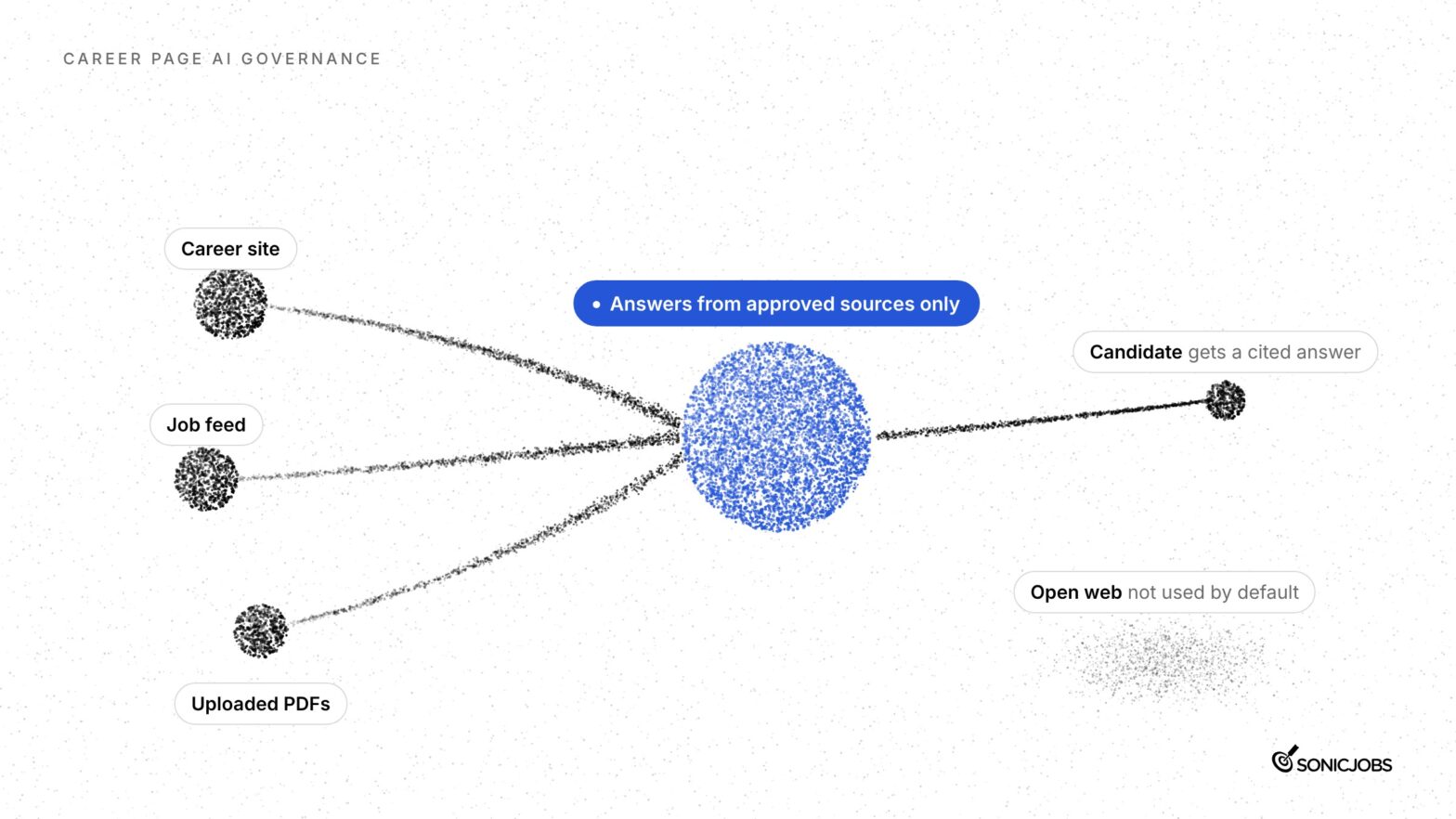
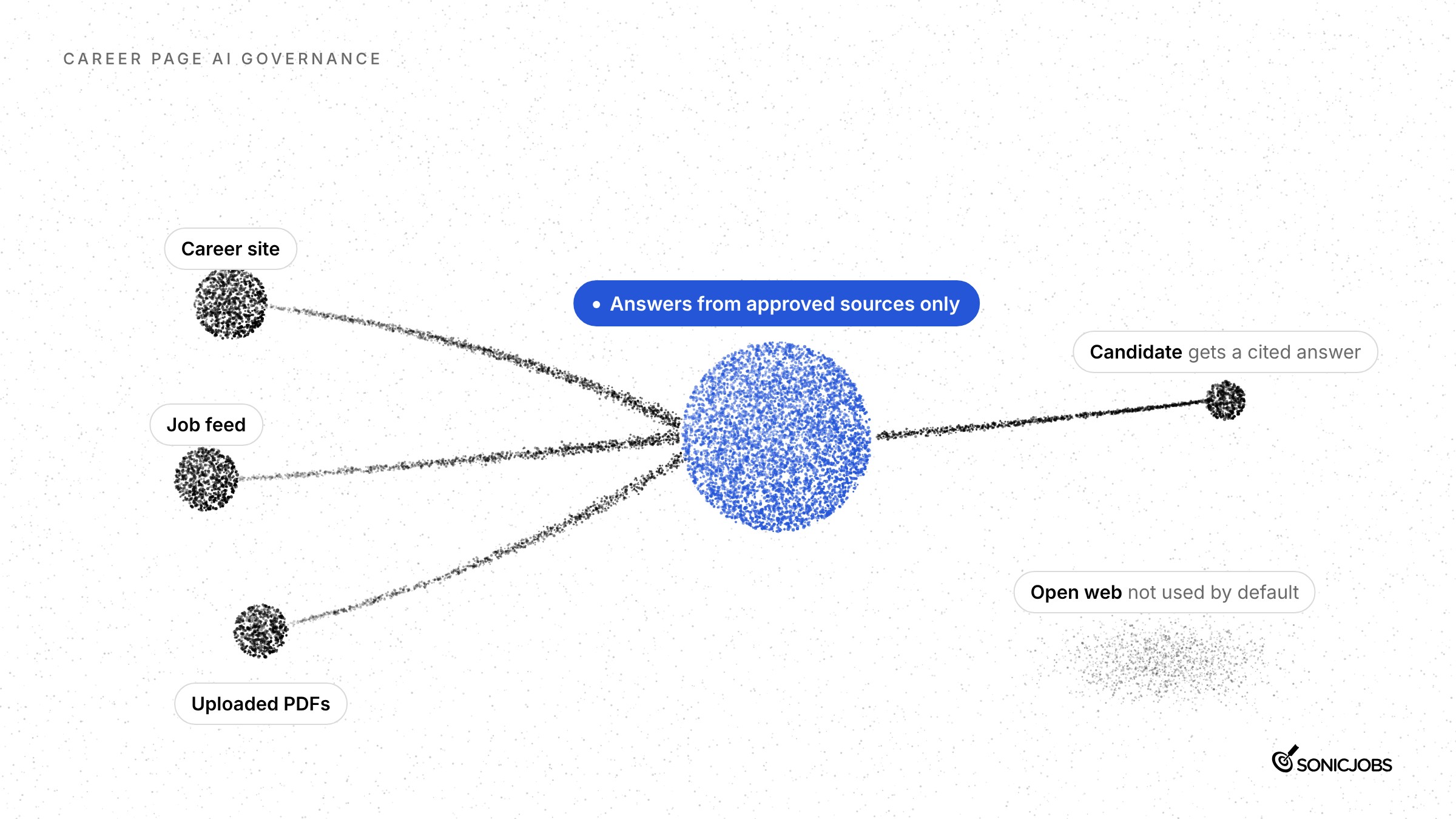
A career page AI assistant is a conversational agent embedded on an employer’s career site that answers candidate questions using only the knowledge sources the employer has explicitly connected, not general training data or the open web.
The architecture that makes this possible is Retrieval-Augmented Generation (RAG). Instead of generating answers from a language model’s training data, a RAG-based career agent retrieves relevant content from a defined knowledge base at the moment a candidate asks a question. The answer is grounded in that specific content. When the employer changes a policy document or adds a new role, the knowledge base updates without any model retraining. Compliance and legal teams benefit directly: they can be confident that responses reflect the employer’s current, approved content, not whatever the model learned during training.
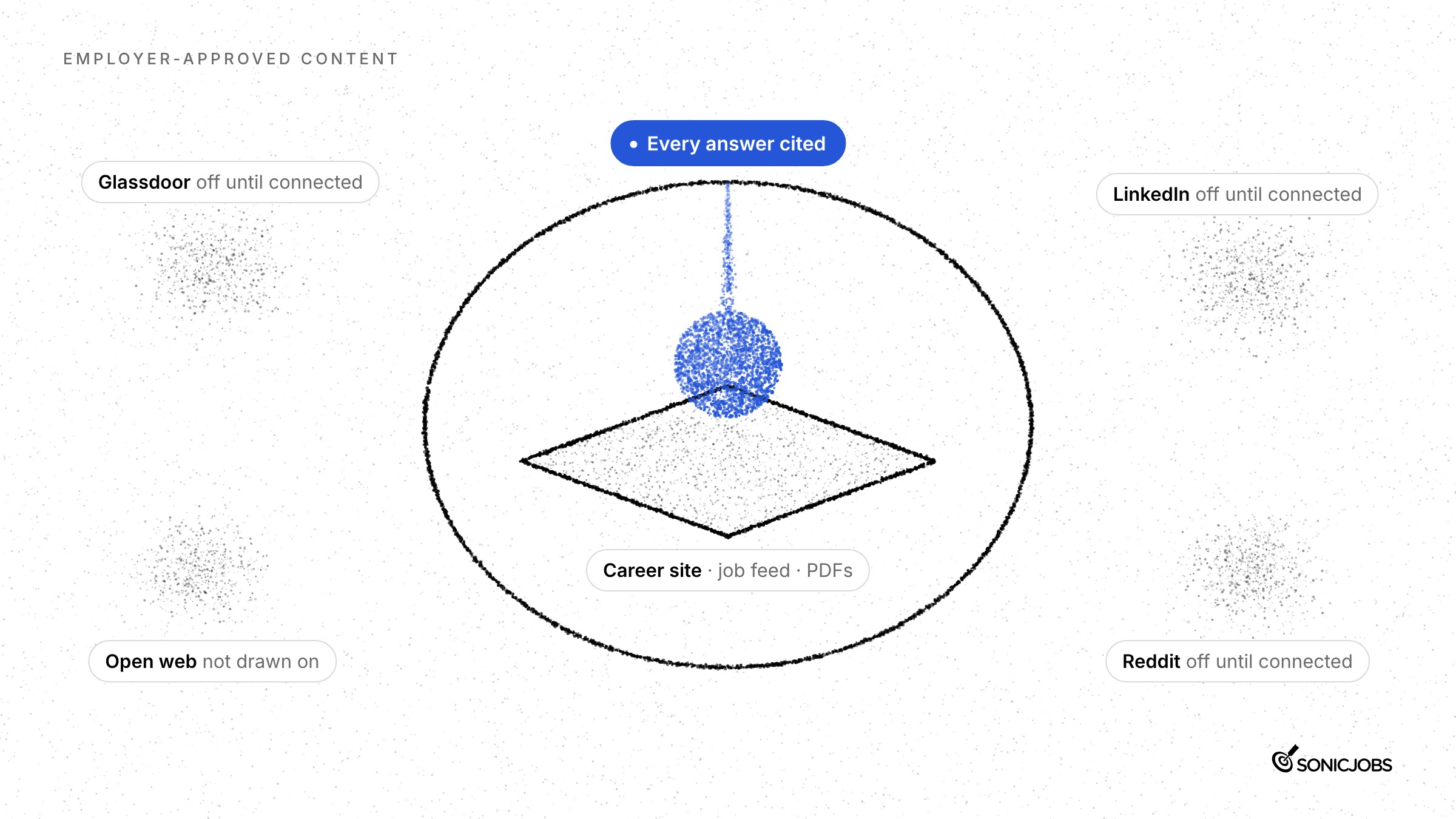
The knowledge base an employer connects determines what the assistant can answer. For CareerGPT, SonicJobs’ conversational AI career agent, that means the employer’s career site, job feed and uploaded documents such as PDFs. Employers can also choose to connect selected external sources, including LinkedIn, Glassdoor or Reddit, but only when they have decided to do so. CareerGPT does not draw from external sites by default. Each answer includes a citation showing candidates where the information came from.
This on-site, employer-controlled model is meaningfully different from what a public AI assistant such as ChatGPT, Claude or Gemini does. Public AI assistants draw on the open web and share no search data with employers. If the answer to a candidate’s question is not published on the employer’s own career site, a public AI assistant cannot draw on it. Having the content is a prerequisite for being cited, not a guarantee of it.
CareerGPT collects no personally identifiable information (PII) from candidates during a conversation. That boundary matters both for candidate trust and for employer compliance requirements.
Why Career Page AI Content Governance Matters in 2026
Colorado’s SB 24-205 took effect June 30, 2026, and the EU AI Act’s employment-tool provisions become enforceable December 2, 2027. For TA teams using AI on their career sites, these are not distant policy concerns. They set a concrete compliance baseline: the content an AI assistant draws on, and the answers it produces, need to be documented, tested, and defensible.
Governance is harder to achieve than it might appear. SonicJobs launch-partner data collected over roughly six weeks found that around 30 to 35 percent of candidate questions had no clear answer in the employer’s own career site content. That is SonicJobs data from a limited cohort, not an industry benchmark. But the pattern is consistent enough to suggest that most employers going live with a career site AI assistant will have content gaps they have not yet identified.
Those gaps matter off the career site as well. Candidates now ask ChatGPT, Claude and Gemini detailed hiring questions in full sentences, and the answers those platforms return come from whatever content they can find. Third-party job sites are already publishing pages built around specific candidate questions, and public AI assistants cite that content, sometimes even when the employer is named first in the answer. The employer appears, but someone else’s page earns the citation and the candidate’s next click.
Employers cannot see any of this without a dedicated tool. Unlike Google, which shares search terms and volumes through Search Console, ChatGPT, Claude and Gemini share no query data with employers. An employer searching for itself on those platforms gets a personalized result shaped by its own account history, not the anonymous view a candidate would see. Employer GPT Visibility addresses this directly. It uses browser agents that ask candidate questions on ChatGPT, Claude and Gemini anonymously, the way a candidate would, and shows where the employer appears, which competitors appear instead, and which sources the answer cites. Without that kind of measurement, employers are setting content and governance policy without knowing what candidates are actually asking or finding.
Taken together, the regulatory timeline and the visibility gap make content governance a practical requirement in 2026, not a future-state ambition.
Common Challenges in Career Site AI Governance & How Approved-Source Platforms Solve Them
Deploying AI on a career site without a content governance framework creates four distinct problems. Each one has a practical fix, but the fix requires architecture, not just intention.
Key Governance Problems Employers Encounter
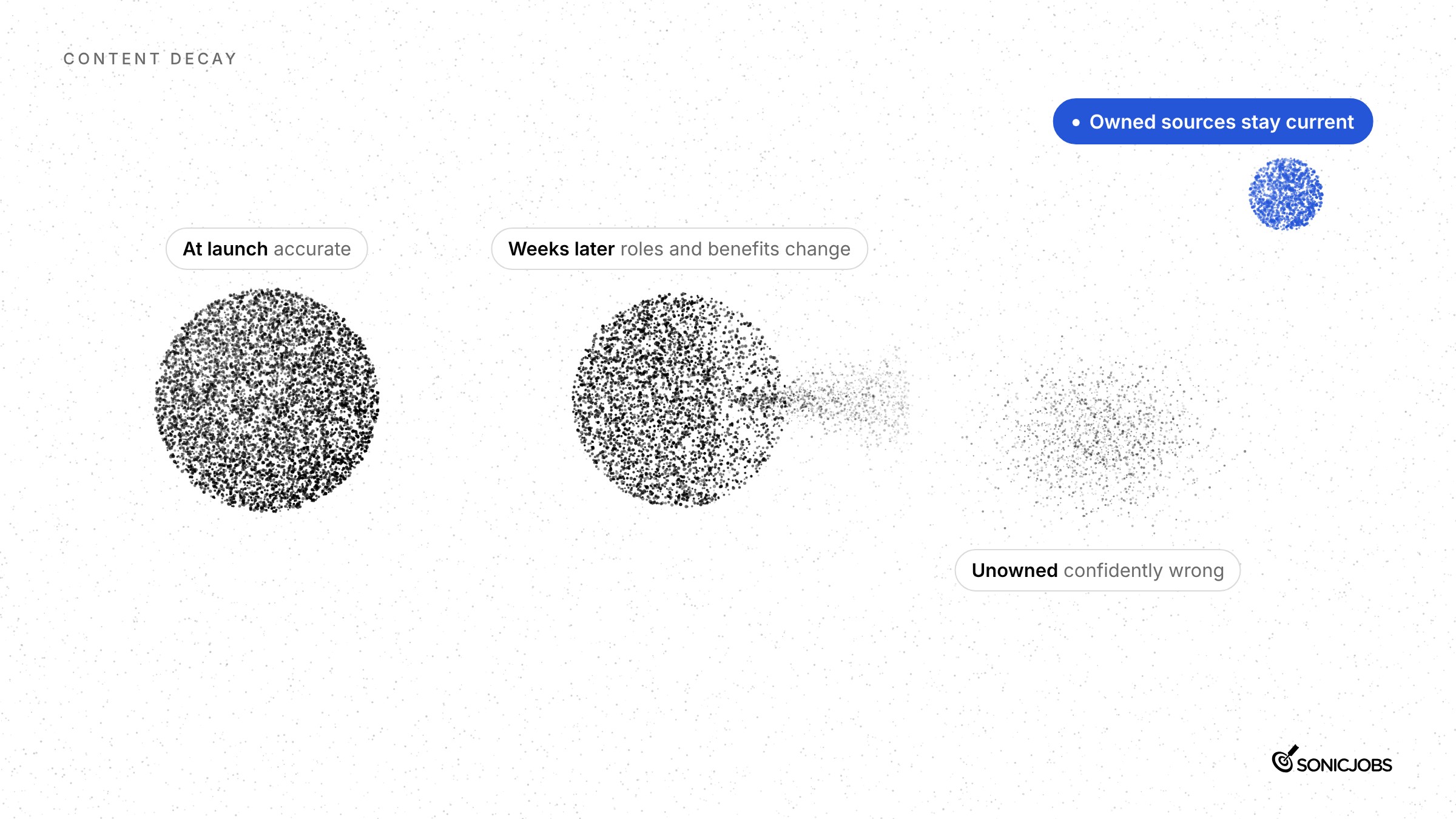
Problem 1: Content decay turns accurate answers into confident wrong ones.
A knowledge base that is accurate at launch decays every week after. Job descriptions change, benefits packages are updated, locations open and close. An AI that continues citing an old source does not return an error; it returns a confident, specific, wrong answer. A governance baseline requires source ownership, documented change control, and a way to know when any source last changed and why. Without that, the assistant becomes a liability the moment something changes on the employer’s side.
Problem 2: Conventional recruiting chatbots carry a setup burden that delays deployment by months.
SonicJobs estimates that employers using conventional recruiting chatbots can spend 6 to 9 months reviewing and approving answers to hundreds of likely candidate questions. That is a SonicJobs estimate, not an established industry norm, but it reflects the real cost of scripted-answer libraries: every question needs a pre-written response, every response needs legal and TA review, and the library needs updating each time conditions change. CareerGPT works differently. Because it answers from the knowledge sources the employer connects, such as the career site, job feed and approved documents, there is no static script to maintain. CareerGPT can go live in days once the job feed, content and approvals are ready.
Problem 3: Sensitive topics require compliance architecture, not just retrieval logic.
HR and career-site AI tools operate in one of the most regulated AI contexts in the United States. Every US employer deploying AI in a hiring context is subject to FMLA, the ADA, Title VII and state-level wage and classification laws. When a candidate asks about pay, accommodation requests or workplace complaints, the assistant’s response carries legal weight. Retrieval alone is not sufficient. Questions in these categories require a deliberate routing decision: informational queries can be answered from approved content, escalation-level queries need a clear handoff path, and certain topics should be treated as out of scope for AI response. These boundaries need to function as hard constraints, not soft guidelines, and they need legal and TA sign-off before the tool goes live.
Problem 4: Public AI platforms create a blind spot employers cannot see into.
AI assistants such as ChatGPT, Claude and Gemini share no search data with employers. Unlike Google, which shares search terms and volumes through Search Console, employers have no visibility into what candidates are asking on public AI platforms, which answers they receive, or whether the employer appears at all. This matters because third-party job sites are already publishing content built around specific candidate questions. Public AI assistants cite that content. In some cases, the employer is named in the answer but someone else’s page earns the citation and the click. The employer appears without controlling what is said.
How approved-source platforms address each of these problems.
CareerGPT is grounded in the knowledge sources the employer connects: the career site, the live job feed and uploaded documents such as PDFs. Answers include source citations so candidates and employers can see where the information came from. Because the assistant draws on connected sources rather than a static script, content can be updated in the source and the assistant reflects the change. There is no approved-answer library to rebuild.
Every CareerGPT prompt is captured as first-party intent data, showing employers the roles, benefits and questions candidates actually ask. That data closes part of the public-AI blind spot: employers can see what candidates ask on the career site, use that signal to identify content gaps and then address those gaps in their own published content. For the off-site picture, Employer GPT Visibility, the separate SonicJobs product, tracks how the employer appears when candidates ask those same questions on ChatGPT, Claude and Gemini.
For compliance-sensitive topics, governance decisions about routing, escalation paths and prohibited categories remain with the employer’s legal and TA teams. CareerGPT answers from the content the employer provides and indicates when it does not have enough information to respond. What the employer connects, and what boundaries it sets in its content, determines what the assistant can and cannot answer.
What to Look for in a Career Page AI Assistant for Employer-Approved Content Delivery
Buying a career-site AI assistant without a governance checklist is a legal and brand risk. The list below covers what talent acquisition leaders and legal reviewers should require before any platform goes live on a career site. Each criterion maps to a specific governance or compliance need.
Must-Have Features for Governance-Ready Career Site AI
Source grounding (retrieval-augmented generation). The assistant must retrieve answers from a defined, employer-approved knowledge base rather than from general AI training data. Retrieval-Augmented Generation (RAG) is the architecture that makes this possible: it lets compliance teams and enterprise legal confirm that responses reflect the employer’s own content, not whatever the underlying model absorbed at training time. When content changes, the knowledge base updates without requiring model retraining.
Source citation in every response. Candidates and employers should be able to see which approved source produced a given answer. Citation is what turns a response into an auditable record. If a candidate later disputes what the assistant told them, a cited source is recoverable evidence. An assistant that gives confident answers with no attribution is difficult to audit and harder to defend.
Employer control over knowledge sources. The employer’s team should be able to add or remove documents, switch sources on or off, and update content without waiting on a vendor or retraining a model. This matters in practice: job details change, benefit plans update, and policies get revised. A platform that requires a development ticket to reflect a content change creates a gap between what the assistant says and what is currently true.
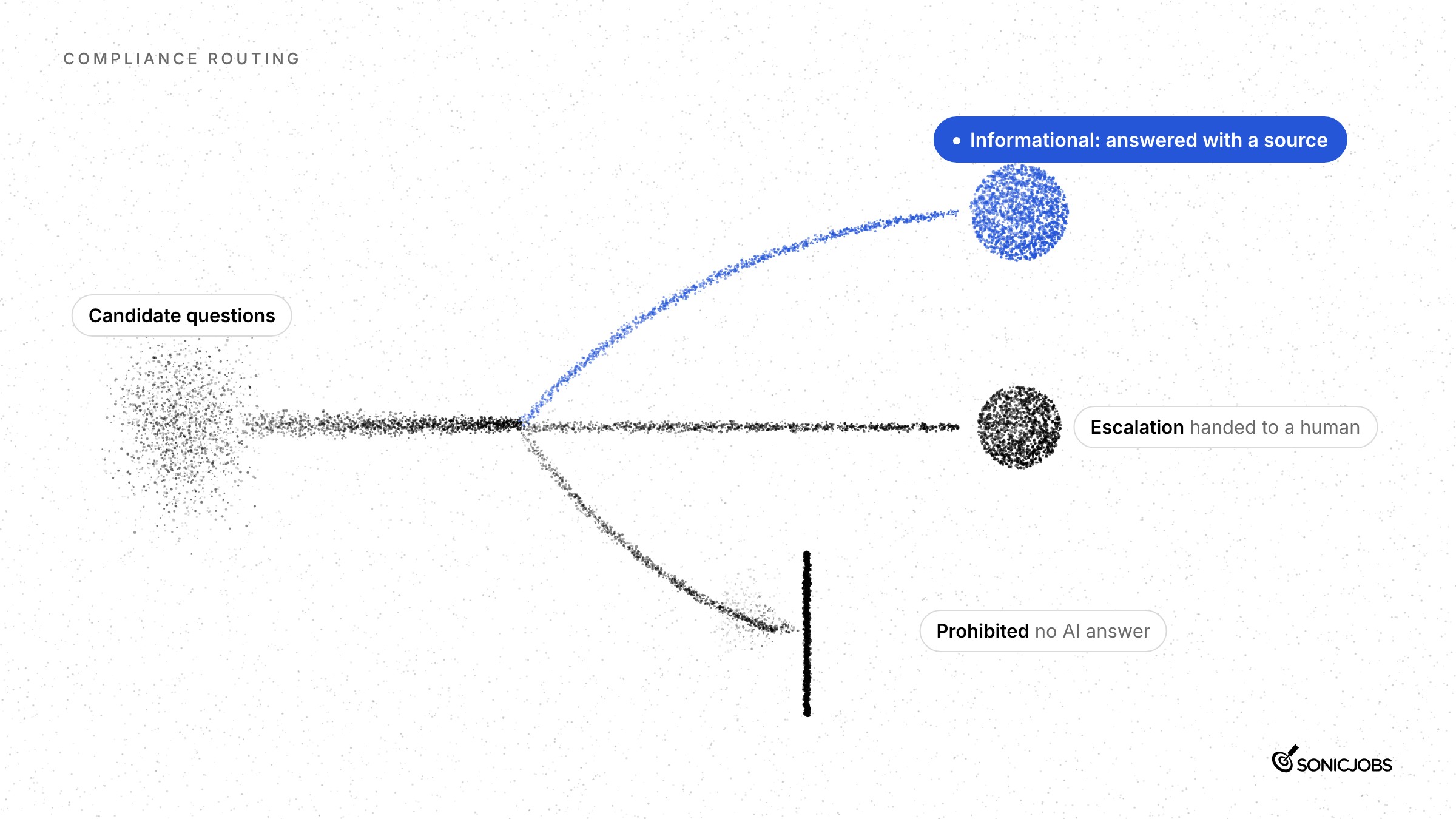
Compliance routing for sensitive topics. AI that autonomously answers questions about pay, accommodation requests under the ADA or the Family and Medical Leave Act (FMLA), or reports of harassment requires compliance architecture, not just retrieval logic. Three-tier routing (informational, escalation, prohibited) should function as hard boundaries, not soft guidelines. Questions in the escalation tier should reach a human; questions in the prohibited tier should not receive an AI-generated response at all. This is an emerging best practice rather than a formally documented industry norm, but legal and TA teams are increasingly treating it as a baseline requirement.
No collection of personally identifiable information (PII). The assistant should not collect, store, or pass candidate PII without explicit consent and a clear data governance framework. Employers who deploy a tool that captures PII without controls carry direct liability. The simpler the data footprint, the lower the risk.
Fast deployment without months of scripting. Conventional recruiting chatbots can require employers to review and approve answers to hundreds of likely candidate questions before going live. SonicJobs estimates this process can take 6 to 9 months. That is a SonicJobs estimate based on its experience with recruiting chatbots, not an established industry figure, but the pattern is common enough that deployment speed should be a formal evaluation criterion. A platform that answers from connected knowledge sources, rather than from a pre-scripted Q&A library, removes that bottleneck.
First-party intent data from every conversation. Every question a candidate asks is a signal about what matters to them. The platform should capture those signals as employer-owned data: which roles candidates ask about, which benefits generate follow-up questions, which searches return nothing. That data is not available from public AI assistants such as ChatGPT, Claude or Gemini, which share no search data with employers. A career-site assistant that captures it gives the employer something it cannot get elsewhere.
CareerGPT meets each of these criteria as verified product capabilities. It draws answers only from the knowledge sources the employer connects, such as the career site, job feed, and approved documents or pages. Those sources are cited in responses so candidates and employers can see where an answer came from. Employers control which sources are active and can switch them on or off or add documents without retraining. The platform collects no PII. Deployment uses a single line of code via Google Tag Manager, and CareerGPT can go live in days once the job feed, content and approvals are in place. Every candidate prompt is captured as first-party intent data that the employer owns: the roles, benefits and questions candidates actually raise, visible in the CareerGPT dashboard. Compliance routing for sensitive topics, such as pay, ADA or FMLA questions, should be reviewed with legal as part of the employer’s own governance setup; the section above sets out what that architecture should require.
How Enterprise Talent Teams Use Career Site AI to Govern Candidate Q&A at Scale
The governance question is not theoretical for large employers. The decisions made about what a career site AI draws on, what it can say and where it stays silent have direct consequences for candidate experience, compliance exposure and hiring results. Below are six ways employers are putting these principles into practice with CareerGPT.
Strategy 1: Clinical role governance at Johns Hopkins Medicine
Johns Hopkins Medicine is a live CareerGPT customer. For a health system fielding high volumes of RN career path questions, the stakes of an imprecise answer are real. CareerGPT answers from the knowledge sources Johns Hopkins has connected, so clinical role questions draw on approved content rather than on whatever a general-purpose AI has indexed. The result is answers that reflect the actual roles, requirements and pathways the employer has sanctioned, not a generic synthesis from across the web.
Strategy 2: Content gap discovery from first-party intent data
CareerGPT captures every candidate prompt as first-party intent data, showing employers the roles, benefits and concerns candidates actually raise. Across SonicJobs launch partners over roughly six weeks, around 30 to 35 percent of candidate questions had no clear answer in the employer’s own career site content (SonicJobs launch-partner data, not an industry benchmark). Employers use this signal to identify which topics need new pages, clearer copy or uploaded documents before those gaps cost them candidates or surface in public AI answers.
Strategy 3: Live job feed integration for current role availability
CareerGPT answers from the job feed the employer connects. When a role closes, it disappears from answers. When a new location opens, it appears. There is no manual update cycle and no risk that CareerGPT recommends a role the employer stopped recruiting for last week. For enterprise employers running parallel hiring across dozens of locations, keeping role availability accurate without a content operations burden is a practical requirement.
Strategy 4: Document-based knowledge expansion
Employers extend CareerGPT’s approved knowledge by uploading PDFs: benefits guides, DEI reports, interview preparation materials or any document that answers candidate questions the published career site does not cover. This lets a TA team add material quickly without waiting on a web development cycle. The document stays within the employer’s controlled source set, and candidates can see where the answer came from.
Strategy 5: Starter prompt configuration to guide candidate conversations
CareerGPT lets employers configure the questions candidates see when they first open the assistant. An employer prioritizing hard-to-fill night shift roles in a specific market can surface that as a starting question. One trying to grow awareness of a graduate program can frame the first prompt around that. The starter prompts are not static marketing copy; employers update them as hiring priorities shift, and the CareerGPT dashboard shows which prompts candidates select and where those conversations lead.
Strategy 6: Visibility monitoring on public AI assistants
SonicJobs Employer GPT Visibility is a separate product sold alongside CareerGPT. It measures how an employer appears on ChatGPT, Claude and Gemini when candidates ask hiring-relevant questions, comparing performance against the competitors the employer names. Browser agents ask each question anonymously, the way a candidate would, so the results are not shaped by the employer’s own browsing history. When CareerGPT data reveals that candidates repeatedly ask about parental leave, that question becomes a Employer GPT Visibility query, and the employer can see whether their content is being cited or a competitor’s is.
The difference source grounding makes
Static chatbot libraries lock answers at the moment someone approved them, often after a review cycle that SonicJobs estimates at 6-9 months for large employers. General-purpose AI draws on public content the employer did not write and cannot control. CareerGPT grounds every answer in the knowledge sources the employer has connected and keeps role information current through the live job feed. According to SonicJobs data, 90 percent of CareerGPT conversations reached a relevant job result and 64 percent led to an application start. Those figures reflect a system where candidates can ask a specific question, receive a specific answer and move toward a role, rather than being told to check with a recruiter.
Best Practices & Expert Tips for Career Site AI Content Governance
Deploying a career-site AI assistant without a governance framework is straightforward. Keeping it accurate six months later is the harder problem. The practices below are organized around the specific failure modes that surface most often: content that goes stale, sensitive questions routed incorrectly, and a knowledge base that was solid at launch but was never maintained.
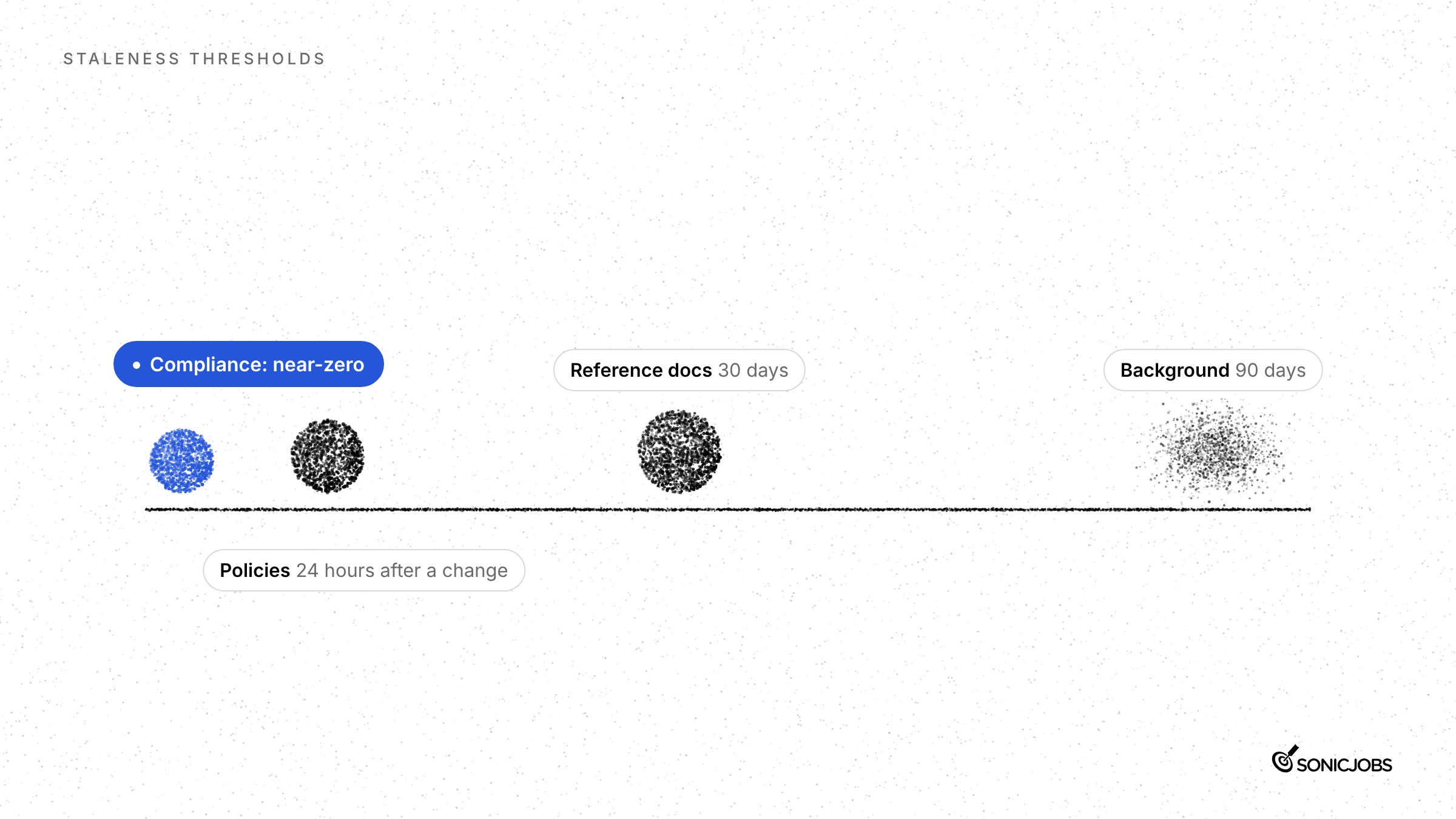
Set staleness thresholds at the document level. Not all content ages at the same rate. Compliance and safety-critical content requires near-zero tolerance for staleness. Policies and procedures should be reviewed on a 24-hour threshold after any change. Reference documents can tolerate a 30-day cycle. Background and contextual material can run to 90 days. Without these distinctions, a single governance policy will either over-restrict stable content or under-protect content that genuinely carries legal exposure.
Run every knowledge base article through a defined lifecycle. Gap identification, draft, subject matter expert (SME) review, quality review, approval, publish, monitor, scheduled review, and retire or archive. High-risk content should move through the slower, fuller path. Low-risk updates can be streamlined so that fixing a stale answer does not require the same queue as approving new compliance language. The important thing is that the path exists and that everyone with a role in it knows which tier their content belongs to.
Treat sensitive topic routing as hard architecture, not soft guidance. Questions about pay, accommodation requests under the ADA or the FMLA, and reports of harassment require something beyond retrieval logic. A three-tier model (informational answers from approved content, escalation to a human for topics that carry legal weight, and hard prohibition on any autonomous answer to questions where an error creates liability) needs to be implemented as a boundary the system cannot cross, not a preference it might respect.
Ground answers in the employer’s own published content. When a career-site AI is grounded in connected sources, it answers from what the employer has approved. When it is not, it fills gaps by inference, and those inferences can include invented roles, salaries the employer never offered, and benefit details that do not exist. A system prompt or governing document should also draw explicit lines around prompt injection and the disclosure of underlying system configuration.
Treat the knowledge base as a living system, not a launch deliverable. A knowledge base that was accurate on the day it went live decays every week after. An AI assistant does not flag stale content with uncertainty; it cites it with the same confidence it would cite a current fact. Governance baseline requirements include source ownership (someone responsible for each document), change control, and a clear record of when any source last changed and why.
Treat every candidate question as first-party intent data. CareerGPT captures every candidate prompt, showing employers the roles, benefits and concerns candidates are actually asking about. That question record is the fastest way to identify what the knowledge base is missing. A cluster of questions about parental leave with no clear answer tells the team exactly what to write next. It also tells them where a candidate found no answer and may have left.
Monitor public AI visibility as a separate discipline. What a career-site AI answers is one problem. What ChatGPT, Claude and Gemini say about an employer when candidates ask hiring questions is a different problem and requires different measurement. Employer GPT Visibility measures how an employer appears on each of those platforms, how often it is named and cited, and which sources the AI assistants are drawing on. Browser agents ask each question anonymously, the way a candidate would, so the results are not shaped by the platform knowing who is asking. Questions that surface as gaps in CareerGPT can be tested directly on public AI assistants to see whether the employer’s content is being found there at all.
Advantages of Employer-Approved Career Site AI for Talent Acquisition Teams
Governance-first career site AI delivers benefits that reach beyond candidate experience. The outcomes below matter to TA leaders, legal counsel and compliance teams alike. Each is grounded in how the underlying architecture works, not in marketing claims.
Reduced hallucination risk. When a career site AI answers only from the sources an employer connects, it cannot invent a salary range, a benefit that does not exist or a policy that was retired last quarter. A study of 526 university users found that participants reported greater trust, higher perceived privacy and fewer perceived hallucinations with a customized institution-specific chatbot than with a general-purpose public LLM. The same logic applies on a career site: grounding the AI in approved content is the structural control that makes the answer reliable.
Faster deployment than conventional scripted chatbots. SonicJobs estimates that employers using conventional recruiting chatbots can spend 6-9 months reviewing and approving answers to hundreds of likely candidate questions before going live. CareerGPT can go live in days once the job feed, content and approvals are ready, because it draws answers from the knowledge sources the employer connects rather than from a pre-built script library.
Compliance protection. Career site AI operates in one of the most regulated AI use cases in employment. Every US employer is bound by FMLA, ADA and Title VII when AI is used in hiring contexts. The EEOC has made clear that employers can be held responsible for violations even when the offending tool was built by an outside vendor. An approved-source architecture limits what the AI can say and routes sensitive questions to the right place, reducing the surface area for a discriminatory or legally problematic answer.
First-party candidate intent data. Every CareerGPT conversation is captured as first-party data. Employers see the exact roles, benefits and concerns candidates are asking about, with no sampling or inference. AI assistants such as ChatGPT, Claude and Gemini share no equivalent search data with employers. Unlike Google, which shares search terms through Search Console, public AI platforms give employers nothing. CareerGPT fills that gap on the career site itself.
Higher application conversion. According to SonicJobs data, 90% of CareerGPT conversations reached a relevant job result and 64% led to an application start. A candidate who can ask a specific question and get a specific answer is more likely to stay in the process than one who hits a dead end.
Public AI visibility. The gap that CareerGPT surfaces on the career site extends to public AI platforms. Employer GPT Visibility measures how an employer appears on ChatGPT, Claude and Gemini when candidates ask hiring-relevant questions, compares results against chosen competitors and shows which sources those answers cite. It uses browser agents that ask each question anonymously, the way a candidate would, so results are not shaped by who is asking. For TA teams that have no other way to see this data, that visibility is the starting point for any content strategy aimed at public AI audiences.
How SonicJobs CareerGPT Keeps Career Site AI On-Message
The governance problem with most career site AI comes down to sourcing: the assistant draws on whatever it can reach, and nobody on the employer’s team approved that content. CareerGPT is built to close that gap at the source level.
Answers from approved sources only
CareerGPT answers exclusively from the knowledge sources the employer connects. That means the employer’s career site, the live job feed, and uploaded documents such as PDFs. If an employer also wants CareerGPT to draw on selected third-party sources, such as their LinkedIn page, Glassdoor profile, Reddit threads or social media, they can connect those individually. Nothing external is included by default. Every source in the knowledge base is there because the employer put it there.
Each answer includes a citation showing candidates where the information came from. If CareerGPT does not have enough information in the connected sources to answer a question, it tells the candidate that directly rather than generating a response it cannot support.
SonicJobs describes CareerGPT’s core compliance posture plainly: no PII collected, approved sources only, guardrails built in.
Employer control over the knowledge base
Employers can switch individual knowledge sources on or off and configure the starter prompts candidates see when they open the agent. That means a TA team running a major nursing campaign can surface role-specific questions at the top of the interface, and a legal review can remove a source from the knowledge base the same day a policy changes, without touching the career site itself.
Deployment requires one line of code, typically added via Google Tag Manager. Once the job feed, content and approvals are in place, CareerGPT can go live in days. Compare that to the SonicJobs estimate of 6-9 months that employers can spend reviewing and approving answers to likely candidate questions in conventional recruiting chatbots, one question at a time. CareerGPT sidesteps that process because the answers come from connected content rather than a pre-approved Q&A library.
First-party intent data from every conversation
Every prompt a candidate types is captured as first-party intent data. Employers see the actual questions candidates ask: which roles they search for, which benefits they ask about, which questions return no clear answer from the current content. That record is not a summary or an aggregate estimate. It is the conversation, attributed to a source wherever one exists.
This matters for governance as much as it matters for recruitment marketing. If a new question pattern appears (candidates asking about a benefit the policy page does not mention, for example), the employer’s TA and content teams can see it and close the gap, either by updating the career site or by uploading a document that addresses it directly.
Johns Hopkins Medicine is one example of a CareerGPT customer operating at scale, where the volume of candidate questions around RN career paths makes this kind of intent visibility practically useful for both content decisions and workforce planning.
The public-AI blind spot: SonicJobs Employer GPT Visibility
CareerGPT governs what happens on the employer’s own career site. But candidates also ask ChatGPT, Claude and Gemini questions about employers before they ever reach a career site, and employers have no visibility into those answers by default.
SonicJobs Employer GPT Visibility is a separate product that addresses this directly. Browser agents ask candidate questions on ChatGPT, Claude and Gemini the way a candidate would, anonymously, so the results are not shaped by who is doing the asking. The employer sees where they appear in those answers, which sources get cited, how they rank against chosen competitors, and what content gaps their competitors are filling that they are not.
The two products address different surfaces. CareerGPT governs the answers a candidate gets on the employer’s site. Employer GPT Visibility measures the answers a candidate gets before they arrive. Together they close both sides of the question: what the employer says, and what is being said about the employer elsewhere.
Key Takeaways & How to Get Started with Career Site AI Content Governance
The governance principles in this guide reduce to a short list of prerequisites. Get them in place before launch, and the career site AI works as intended. Skip them, and the assistant will fill gaps with whatever it can find.
Approved sources come first. CareerGPT answers only from the knowledge sources the employer connects: the career site, the live job feed and uploaded documents such as PDFs. It does not draw on general training data. Every answer is grounded in content the employer has reviewed and connected, with sources cited so candidates and recruiters can check the origin.
Setup time is not the constraint. Traditional recruiting chatbots can require employers to spend months reviewing and approving answers to hundreds of likely candidate questions, by SonicJobs’ estimate 6 to 9 months in some cases. CareerGPT can go live in days once the job feed, content and approvals are ready. Adding the script via Google Tag Manager takes minutes.
Content freshness is ongoing work. Grounding is only as good as the knowledge behind it. Employers need a discipline for replacing uploaded documents when details change, reviewing conversation data regularly and filling gaps the career site does not yet address. Across SonicJobs launch partners, around 30% to 35% of candidate questions had no clear answer in the employer’s own career site content. That figure makes the case for treating content maintenance as part of the product, not an afterthought.
On-site knowledge and public AI citations are separate problems. CareerGPT governs what candidates learn on the career site. What candidates find when they ask ChatGPT, Claude or Gemini about the employer is a different question entirely. SonicJobs Employer GPT Visibility addresses that side: browser agents ask candidate questions on public AI platforms anonymously, the way a candidate would, and show where the employer appears, which competitors appear and which sources get cited. The two products work together, but they address different surfaces and should be evaluated separately.
Compliance routing requires deliberate design. Questions about pay ranges, visa sponsorship, disability accommodations and similar topics carry legal weight. The governance checklist for these topics belongs in content design and legal review before the assistant goes live, not after the first candidate asks.
To see how CareerGPT and Employer GPT Visibility work together on a real career site, contact the SonicJobs team or book a demo.
FAQs About Career Page AI Assistants and Employer-Approved Content Governance
What is a career page AI assistant and how does it use employer-approved content?
A career page AI assistant is a conversational tool that answers candidate questions directly on an employer’s career site, drawing from a defined set of knowledge sources the employer controls rather than from general training data. SonicJobs CareerGPT is built on this model: it retrieves answers from the employer’s career site, job feed and any documents or approved pages the employer connects. Candidates can ask questions in their own words, and every answer is grounded in what the employer has explicitly made available. No approved source, no answer.
How does retrieval grounding work in a career-site AI, and why does it matter for compliance?
Retrieval-Augmented Generation (RAG) is the architecture that makes this possible. Instead of generating answers from a model’s general training, the AI retrieves from a defined, employer-approved knowledge base at the moment a candidate asks a question. This reduces hallucination and keeps answers tied to the employer’s actual content. Critically, when content changes, the knowledge base can be updated without retraining the model. For compliance teams and legal, this means the employer retains control over what the assistant can say, which is the foundation any governance program needs.
What happens when a candidate asks a career-site AI about pay, visa sponsorship or disability accommodations?
These questions require more than retrieval logic. Pay, accommodation requests under the Americans with Disabilities Act (ADA), FMLA eligibility and reports of harassment sit in a regulated category where a wrong or incomplete answer carries legal consequences. A three-tier routing approach treats each question as either informational (answerable from approved content), escalation (requires a human), or prohibited (the assistant should not attempt an answer). These must be hard architectural boundaries. Employers remain responsible for how their AI tools handle these topics regardless of whether a third-party platform is involved.
What is the difference between on-site career AI knowledge and what public AI assistants like ChatGPT can cite?
CareerGPT draws only from the knowledge sources the employer connects: the career site, the job feed and any approved documents or pages. Public AI assistants such as ChatGPT, Claude and Gemini draw from the open web and their training data. Employers have no control over what those assistants cite or how they describe the company. If the answer to a candidate’s question does not exist on the employer’s own site, public assistants cannot draw on it. Having the content does not guarantee a citation, but without it the employer will not be cited.
How do employers keep a career-site AI’s knowledge base accurate and up to date?
Content staleness is one of the clearest risks in career-site AI: an assistant confidently repeating outdated information is worse than no answer at all. Staleness thresholds should be set at the document level. Compliance and safety-critical content requires near-zero tolerance. Policies and procedures should have a 24-hour threshold. Reference documents can run to 30 days, and background material to 90 days. A governance framework with defined lifecycle stages, including drafting, review, approval, scheduled review and retirement, gives both legal and talent acquisition (TA) teams a shared structure for keeping the knowledge base current.
How does SonicJobs CareerGPT ensure answers come only from approved employer content?
CareerGPT answers from the knowledge sources the employer connects and no others. Employers control which sources are active, can switch them on or off, and can upload documents to add information that has not yet been published on the career site. Answers include source citations so candidates and employers can see exactly where information came from. Candidate conversations are not shared with ChatGPT, Claude or any other AI lab, and they are not used to train AI models. Adding the CareerGPT script to an existing career site takes minutes.
What are the top conversational AI platforms for candidate experience in 2026?
Enterprise conversational AI platforms for candidate experience range from high-volume screening tools to full talent experience suites. Buyers evaluating them on governance criteria should look specifically at how each platform grounds answers, whether sources are cited in responses, and how much control the employer has over what the assistant can and cannot say. CareerGPT is differentiated by its approved-source architecture: it answers only from what the employer connects, with citations in every response and employer-controlled source configuration.
How does SonicJobs Employer GPT Visibility help employers understand how they appear on ChatGPT, Claude and Gemini?
Employer GPT Visibility is a separate SonicJobs product that measures how an employer appears on public AI assistants when candidates ask hiring-relevant questions. Browser agents ask each question anonymously on ChatGPT, Claude and Gemini, the way a candidate would, so results are not shaped by the employer’s own account history. The tool shows whether the employer is mentioned, how prominently, which competitors appear and which sources are cited. AI assistants share no search data with employers directly, so Employer GPT Visibility provides visibility that employers cannot get any other way.
What legal risks does an employer face if a career-site AI answers questions about pay or accommodations incorrectly?
The EEOC has confirmed that Title VII and the ADA apply directly to AI tools used in employment, including those developed by outside vendors. Employers cannot transfer liability by relying on a vendor’s assurance of compliance. Colorado’s SB 24-205 took effect June 30, 2026. The EU AI Act’s high-risk system requirements for employment tools become enforceable December 2, 2027. Connecticut’s pay transparency law, in force from October 1, 2026, requires wage ranges and benefit descriptions in every job posting. Every US employer deploying career-site AI is operating in an active and expanding regulatory environment.
How long does it take to set up CareerGPT on an existing career site?
CareerGPT requires three things: a job feed with application links and tracking, the websites and documents it should use to answer questions, and access to add a script to the career site. Adding the script takes minutes. According to SonicJobs, CareerGPT can go live in days once the job feed, content and approvals are in place. There is no need to rebuild the career site or migrate to a different applicant tracking system (ATS). By comparison, SonicJobs estimates that employers using conventional recruiting chatbots can spend 6 to 9 months reviewing and approving answers to hundreds of likely candidate questions.
What content gaps do employers most commonly discover after deploying a career-site AI?
According to SonicJobs launch-partner data collected over roughly six weeks, around 30 to 35 percent of candidate questions had no clear answer in the employer’s own career site content. Common gaps include employee experience and culture, specific benefits details, interview process explanations and role-specific questions that job descriptions alone do not address. When CareerGPT cannot find an answer in connected sources, it tells the candidate so rather than generating one. Those unanswered questions appear in the CareerGPT dashboard, giving TA and content teams a direct view of what to publish next.