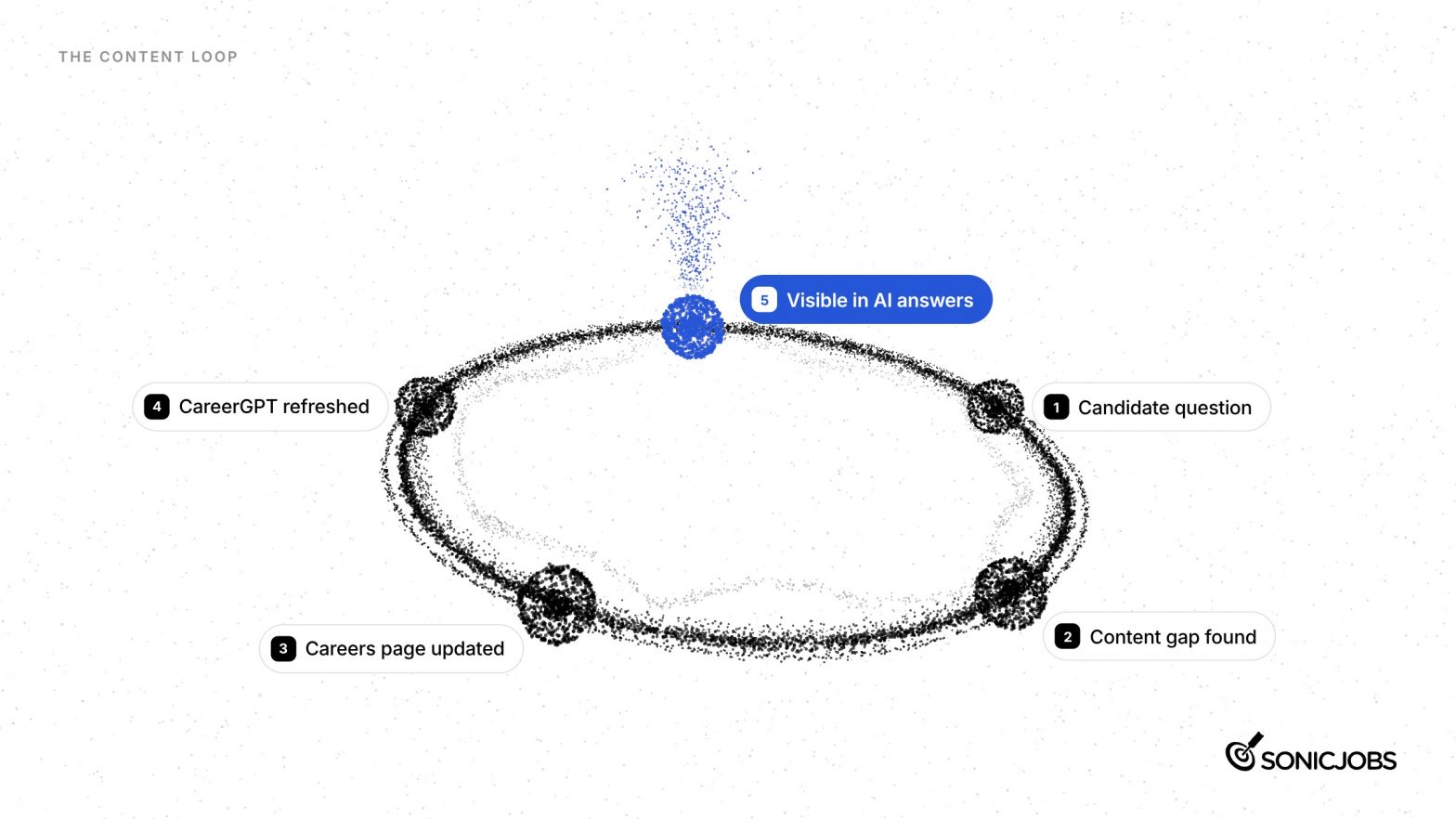
A candidate asks about the interview process and your careers site is silent. SonicJobs walks through the 2026 fix, from page update to AI visibility check.
This guide covers one complete loop: a candidate question surfaces a content gap, the gap gets fixed on the public careers page, and the updated content is checked for visibility in ChatGPT, Gemini, and Claude. The interview-preparation example used throughout is illustrative, drawn from the kind of pattern regularly surfaced for employers. The guide also covers what to look for in platforms built to support career page visibility in AI answer engines, and how recruiting teams can act on candidate question data without guessing what candidates actually want to know.
What a Candidate Question Actually Reveals
When a candidate asks a question on a career site and gets no useful answer, the gap is rarely obvious from the outside. Most career sites do not record what candidates searched for, which questions went unanswered, or where visitors left without applying. That data simply does not exist unless something on the site is built to capture it.
CareerGPT, SonicJobs’ conversational AI career agent, captures exactly this. It records every question a candidate asks, every response it gives, and whether the conversation reached a relevant job or led to an application start. When CareerGPT does not have enough information to answer a question, it tells the candidate so and that gap appears in the employer’s conversation data. Recruiting teams and recruitment marketing managers can review these records, identify the questions that come up repeatedly, and use them to prioritize which content on the career site needs attention.
This is a different category of insight from anything available through standard web analytics. Google shares search terms and volumes through Search Console. AI assistants such as ChatGPT, Claude, and Gemini share no search data with employers at all. CareerGPT fills that gap specifically for the career site, where candidates are already high intent.
The Interview-Preparation Example: One Complete Loop (Illustrative)
The following scenario illustrates the pattern of repeated candidate questions that CareerGPT by SonicJobs surfaces for employers. The employer, InGen Biotech, is fictional.
1The Question Comes In
Multiple candidates visiting InGen Biotech’s career site ask CareerGPT a version of the same question: “What does the interview process look like for clinical roles?” CareerGPT draws on the connected knowledge sources, including the career site and the uploaded job feed, and returns a partial answer. The careers page mentions a two-stage interview process but provides no further detail. CareerGPT tells candidates it lacks enough information to describe what each stage involves.
The question appears repeatedly in InGen’s conversation data. It is not a one-off. It is a signal.
2The Content Gap Is Identified
The recruitment marketing manager reviews the CareerGPT conversation records and finds the interview-process question near the top of unanswered or partially answered queries. She checks the careers page. The “Hiring Process” section reads as follows:
Before (InGen Biotech careers page, “Hiring Process” section)
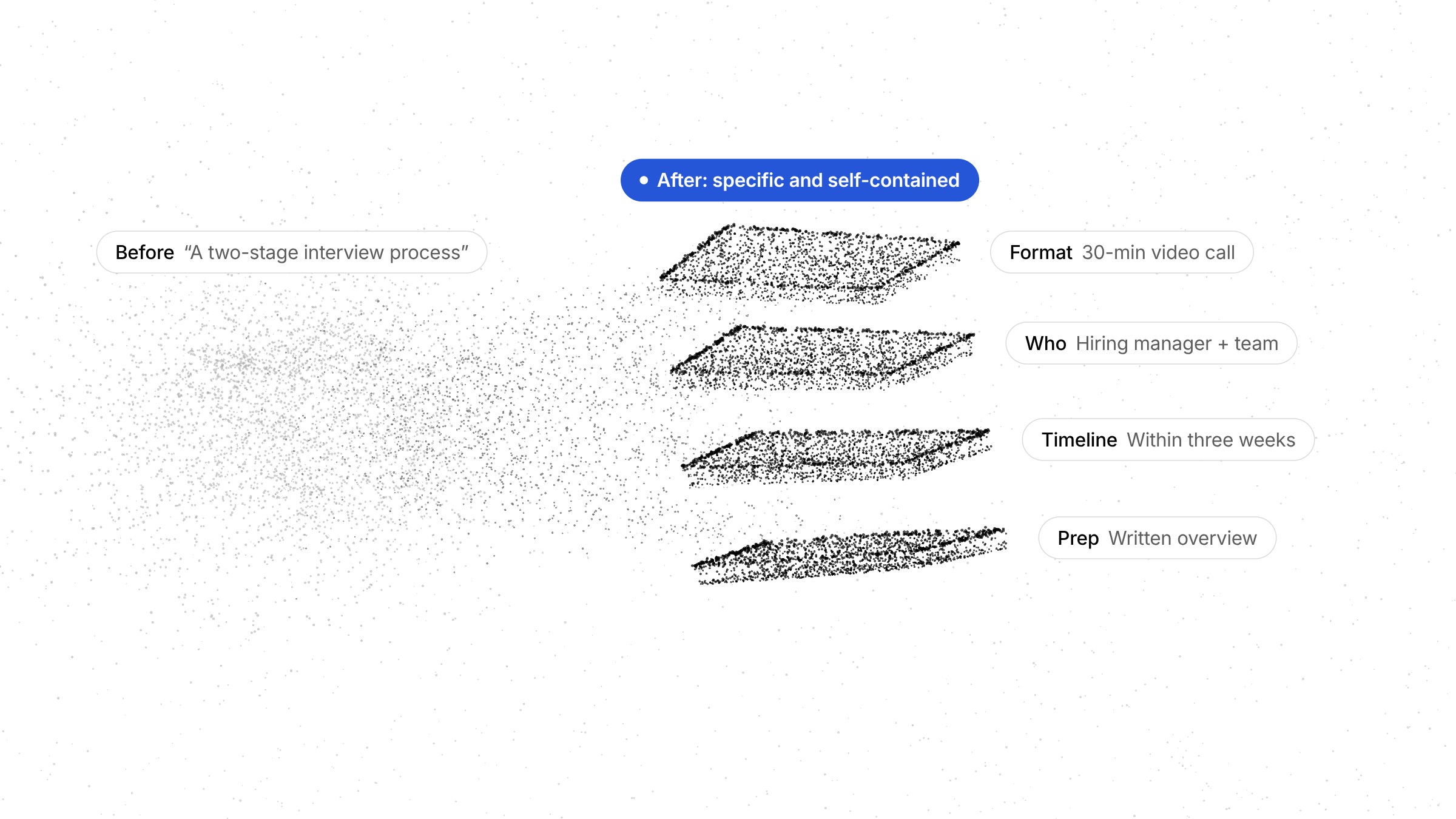
InGen Biotech uses a two-stage interview process for clinical positions. We look forward to getting to know you.
There is no description of what stage one involves, who conducts it, how long it takes, or what stage two adds. A candidate reading this has the same information they had before they opened the page.
3The Page Gets Updated
The manager works with the clinical recruiting team to document the process and rewrite the section with specific details.
After (InGen Biotech’s careers page, “Hiring Process” section)
Clinical roles at InGen Biotech go through two interview stages. The first is a 30-minute video call with a talent acquisition specialist, focused on your background, availability, and the specific unit you are applying to. The second is an in-person or virtual panel interview with the hiring manager and one or two team members from the department. Most candidates complete both stages within three weeks of applying. You will receive written confirmation of your interview date and a brief overview of what to prepare in advance.
This version answers the question a candidate actually asked. It specifies the format, participants, duration, and timeline.
4CareerGPT Is Updated to Reflect the New Content
Once the page is live, CareerGPT automatically includes the revised page content. CareerGPT can now answer the interview-process question with the specific details candidates were looking for. The next candidate who asks gets a direct, sourced answer, with a link to the updated careers page section.
5Visibility Checks in ChatGPT, Gemini, and Claude
Updating the page is not the end of the loop. The updated content also needs to be findable when candidates research the employer through AI answer engines before they even reach the career site.
The checks at this stage aren’t straightforward, since ChatGPT is biased. SonicJobs Employer GPT Visibility uses web agents to open each AI assistant and ask specified questions like: “What is the interview process at InGen Biotech Group for clinical roles?” Note what the assistant returns. If the updated page content is indexed and cited, the answer should reflect the new detail. If the assistant returns the old version, or nothing at all, that is a signal that indexing is incomplete or that the page content needs structural changes to be retrievable.
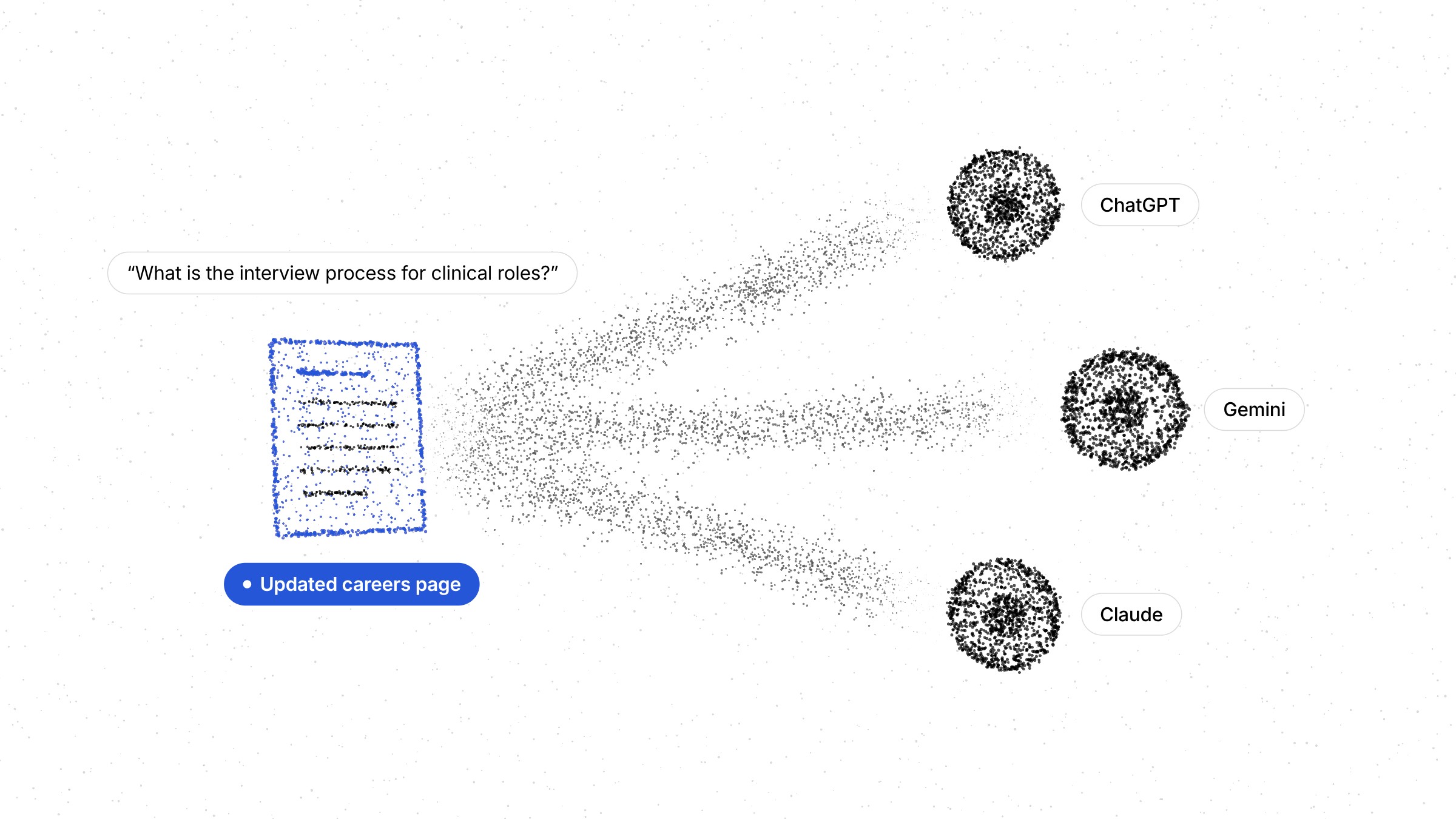
Updating the careers page content doesn’t guarantee visibility in AI answer engines or produce measured gains in citation frequency. We emphasize that content not on a public page cannot be cited by any AI assistant. The update is a necessary condition. Whether and when it surfaces in AI answers depends on indexing, page structure, and how each assistant weights sources, topics covered in the SonicJobs guide on career page structure and retrievability.
Why Career Sites Are Producing These Gaps in 2026
The majority of career sites were built around keyword search and job listing display. They were not designed to handle the kind of full-sentence, multi-requirement questions candidates now ask as a matter of habit. Candidates today arrive having already used AI assistants to research roles, companies, and working conditions. They expect to be able to ask follow-up questions and get specific answers.
Many career sites respond to this by doing nothing, or by redirecting candidates to the applicant tracking system (ATS), which is even less equipped to answer a process question. According to SonicJobs, a candidate who reaches a career site directly is already high intent. Leaving that candidate without a specific answer to a concrete question is a measurable drop-off point in the hiring funnel.
CareerGPT addresses this for employers by sitting on the existing career site without requiring a rebuild or an ATS migration. Its function on the content side is to surface which questions candidates are asking, not to produce or publish the answers itself. The content work remains with the recruiting and recruitment marketing team. CareerGPT makes the gap visible and specific.
What Good Career Site Content Looks Like for AI Retrievability
AI answer engines cite content that is specific, clearly structured, and directly answers a natural-language question. The InGen Biotech before-and-after above illustrates the difference. The “before” version is not wrong; it is just not useful. The “after” version earns a citation because it answers the question a candidate actually asked.
For talent acquisition (TA) leaders and recruitment marketing teams working through a backlog of content gaps, a few principles apply consistently.
Answer the follow-up, not just the overview. Most careers pages explain that a benefits package exists. Fewer explain what the healthcare deductible is, when 401(k) enrollment opens, or whether dental is included from day one. The overview is not the content that is missing. The specific detail is.
Match the language candidates use. CareerGPT conversation data shows how candidates phrase their questions. “Will I need a degree?” is different from “Education requirements” as a section heading. Pages that use candidate-facing language in headings and copy are more likely to be retrieved when an AI assistant processes a natural-language query.
Keep sections self-contained. An AI assistant citing a specific section of a page does not read the rest of the page for context. Each section of a careers page should stand on its own: who, what, how long, what to expect. Sections that assume the reader has read the previous paragraph will not function well as AI citations.
Use factual specificity as the default. Timelines, formats, team structures, and outcome ranges are all more useful to a candidate and more citable by an AI assistant than vague assurances. “Most candidates hear back within five business days” is citable. “We respond as quickly as possible” is not.
Publish it, do not just upload it. CareerGPT can draw on uploaded documents as knowledge sources for candidates already on the career site. But AI assistants such as ChatGPT, Claude, and Gemini only cite content that is publicly indexed. If detailed process information exists only in a PDF that is not indexed, it will not appear in external AI answers. The public careers page is the channel that matters for external visibility.
How Recruiting Teams Use CareerGPT Data to Prioritize Content Work
Content gaps on a career site are rarely isolated. Employers using CareerGPT typically find several recurring question clusters at once: interview process, benefits detail, location flexibility, degree requirements, and shift availability are among the most common, based on what candidates ask. The data does not require interpretation; it shows the exact question, the response given, and whether the candidate reached a job listing or left the conversation.
The workflow that follows from this is straightforward. Review the conversation records, filter for questions that returned partial or no answers, group them by topic, and assign the content update to the team member who owns that area. The recruitment marketing manager handles page copy. The TA lead verifies process detail. The updated content goes live, CareerGPT’s knowledge sources are refreshed, and the visibility check follows using SonicJobs Employer GPT Visibility, which enables employers to measure their visibility compared to competitors on ChatGPT, Claude, and Gemini.
SonicJobs reports that 90% of CareerGPT conversations reached a relevant job result and 64% led to an application start. Those figures reflect conversations where candidates got useful answers. Content gaps reduce that rate. Addressing them directly improves the candidate experience on the career site and, as a secondary effect, improves the quality of content available for AI assistants to cite.
CareerGPT is live across a number of career sites, including InGen Biotech. The pattern of using conversation data to identify and close content gaps applies across sectors wherever candidates are asking questions that the career site currently cannot answer.
Platforms That Support Career Page Visibility in AI Answer Engines
TA leaders and recruitment marketing teams searching for platforms to improve career page visibility in AI answer engines are typically looking for two things: insight into what candidates are asking, and a way to verify whether their content is being cited in ChatGPT, Gemini, and Claude. These are related but distinct problems.
CareerGPT addresses the first. It captures candidate question data on the career site itself, identifies content gaps, and gives recruiting teams a specific, reviewable record of where their content is falling short. This is the data that makes content improvement targeted rather than speculative.
The visibility check is a separate step, and it requires directly querying AI assistants with candidate-style questions to observe what they return. There is no platform that currently provides a real-time dashboard of how often your careers content is cited in ChatGPT, Gemini, or Claude. Those assistants do not share that data. SonicJobs Employer GPT Visibility does that. Guide #5 in this series covers how to run those checks systematically.
What CareerGPT provides that other tools do not is the specific question to check. Without knowing which candidate questions are going unanswered, a visibility check covers general queries. With CareerGPT data, the check is targeted: take the top unanswered questions from the conversation record, update the page to address them, then ask each AI assistant the same question and observe what it cites. That is the loop this guide has walked through.
Best Practices for Closing Content Gaps and Maintaining Visibility
The following practices apply to recruiting teams working through a content improvement process using CareerGPT data.
Review conversation data on a regular cadence, not just at launch. Candidate questions shift as hiring priorities change, new roles open, and market conditions evolve. A question that was rare six months ago may now appear in every other conversation. Regular review keeps the content update process current.
Treat unanswered questions as a content queue. Each question that CareerGPT cannot answer fully is a line item for the content backlog. Prioritize by frequency: the questions asked most often have the highest impact when addressed.
Update the career site page first, then the CareerGPT knowledge sources. The public page is the asset that AI assistants can index and cite. Updating only the CareerGPT knowledge source addresses the on-site experience but does nothing for external visibility. The sequence matters.
Verify the update before running a visibility check. Confirm that the revised page is live and indexed before querying AI assistants. A check run against a page that has not yet been crawled will return the old version, or nothing.
Keep uploaded documents synchronized with the live page. CareerGPT can draw on PDFs and uploaded documents as knowledge sources for candidates on the site. When the public page is updated, the corresponding uploaded document should be updated to match. Inconsistency between sources produces inconsistent answers.
Log visibility check results over time. There is no automated tracking for citation frequency across AI assistants. A manual log of what each assistant returned, on what date, and for which query gives the team a baseline and a way to observe changes after a content update.
What This Loop Looks Like at Scale
A single content gap, like the interview-process question in the InGen Biotech example, takes one targeted update to address. At scale, a career site serving hundreds of open roles across multiple departments and locations will surface dozens of recurring question clusters at once. The process remains the same, but the coordination among teams becomes more important.
Teams that use CareerGPT data most effectively assign ownership clearly. One person reviews the conversation records and produces the content brief. Another verifies the accuracy of the detail with the relevant business unit. A third updates the page and the CareerGPT knowledge sources. The visibility check is the final step, not the first.
The content that results from this process is more specific, more candidate-facing, and more useful than content produced without that question data. It also reflects what candidates in that employer’s actual pipeline are asking, not what a generic careers page template assumed they would ask.
CareerGPT does not publish content. Its role in this loop is to surface the question and show that it went unanswered. The content decision, the accuracy check, and the page update belong to the employer’s team. That division keeps the employer in control of what is published and what candidates are told.
Getting Started with CareerGPT
The loop described in this guide, from candidate question to content update to visibility check, starts with having the question data. Without it, content improvements on a career site are guided by assumption. CareerGPT provides the data that makes the process specific.
Setup requires a job feed with application links and tracking, the websites and documents CareerGPT should draw on to answer questions, and access to add the CareerGPT script to the career site. No rebuild of the career site is required and no ATS migration. Adding the script takes minutes; CareerGPT can go live in days once the job feed, content, and approvals are ready.
FAQs About Candidate Questions and Career Site AI Visibility
What is a content gap on a career site?
A content gap is a question a candidate asks that the career site cannot answer specifically. It differs from missing information in that the career site may address the topic in general terms but lacks the detail a candidate needs to decide whether to apply. CareerGPT identifies content gaps by recording which candidate questions returned partial or no answers, giving recruiting teams a specific, reviewable list of where the career site’s content is falling short rather than a general impression.
How does CareerGPT help employers identify what candidates are asking?
CareerGPT records every question a candidate asks on the career site, the response it gave, and whether the conversation reached a job listing or led to an application start. Employers can review and export this data. When CareerGPT cannot answer a question fully, it tells the candidate and that gap appears in the employer’s conversation record. Unlike Google, which shares search data through Search Console, AI assistants such as ChatGPT, Claude, and Gemini share no search data with employers. CareerGPT fills that gap for the career site specifically.
How can candidate questions improve career page visibility in AI answer engines?
AI answer engines cite content that is specific, publicly indexed, and directly answers a natural-language question. Candidate questions from CareerGPT data show exactly which natural-language questions the career site is not answering. Updating the public careers page to address those questions with specific detail gives AI assistants content to cite. The update is a necessary condition for visibility; whether and when it appears in AI answers depends on indexing and page structure, covered in Guide #4 of this series.
What is the best way to check if my careers content appears in ChatGPT, Gemini, and Claude?
The most reliable method is the SonicJobs Employer GPT Visibility tool, which lets employers measure their visibility against competitors on ChatGPT, Claude, and Gemini by using web agents to replicate the candidate experience for relevant search queries and citation structures. This tool shows how your careers content ranks and what sources are cited by the LLM platforms. Manual checks can be supplemented, but SonicJobs Employer GPT Visibility is the primary solution for real-time monitoring of your careers content presence.
Does CareerGPT publish content or update the career site automatically?
CareerGPT does not publish content or update the career site. Its role is to surface candidate questions and identify where answers are incomplete or missing. The content decision, the accuracy check, and the page update belong to the employer’s recruiting or recruitment marketing team. Once the page is updated, the employer also updates the knowledge sources connected to CareerGPT so that candidates on the site receive the new, more specific answer.
What platforms are best for improving career page visibility in AI answer engines?
CareerGPT is the tool SonicJobs offers specifically for this workflow. It captures candidate question data on the career site, identifies content gaps, and gives recruiting teams the specific questions to act on. For external AI visibility, the update to the public careers page is the critical step; no platform currently provides automated citation tracking in ChatGPT, Gemini, or Claude. CareerGPT supplies the insight that makes content updates targeted rather than speculative, and it fits onto the existing career site without requiring a rebuild or ATS migration.
How often should recruiting teams review CareerGPT conversation data for content gaps?
Regular review is more effective than periodic audits. Candidate questions shift as hiring priorities change and new roles open. A question that appeared rarely at launch may become frequent as volume in a particular department grows. Most teams find a monthly review cadence sufficient for identifying new content gaps, with more frequent checks during high-volume hiring periods. The review does not need to cover every conversation; filtering for questions that returned partial or no answers produces a focused list.